
A dozen Democratic Senators are imploring members of two key committees to ban “prediction contracts that resemble sports bets or casino-style gaming products” in the pending CLARITY Act legislation.
In a letter dated July 17, the group wrote to the chairs and ranking members of the Committee on Banking, Housing, and Urban Affairs and the Committee on Agriculture, Nutrition, and Forestry with a plea to protect tribal gaming sovereignty and state enforcement rights in a hotly debated crypto bill drawing opposition from tribes, labor unions and chambers of commerce.
“Currently, prediction markets are misusing federal commodity and derivatives rules to offer nationwide sports and event wagering, completely ignoring state and tribal gaming licenses and regulations,” the letter reads in part. “These platforms claim to derive their operational authority from the Commodity Futures Trading Commission (CFTC), which has asserted its exclusive jurisdiction to oversee and regulate all prediction markets and continues to erroneously classify these products as financial swaps or derivatives rather than gambling.
“Any further Congressional grant of exclusive CFTC jurisdiction over digital asset markets without ample guardrails for prediction market contracts will reinforce the CFTC’s claimed exclusive authority over event contracts and permanently circumvent the hard-won regulatory and economic protections established under IGRA and states’ police powers.”
What CLARITY Act sports, casino ban would look like
The letter contains draft language for insertion into the CLARITY Act that would amend the Commodity Exchange Act, under which prediction markets and Commodity Futures Trading Commission (CFTC) officials contend their regulation falls. It would occur through three steps:
- (i) Notwithstanding any other provision of this section, no agreement, contract, transaction, or swap relating to the outcome of or team or individual performance or statistics within any sporting event or athletic competition or any casino-style game may be listed or made available for clearing or trading on or through a registered entity.
- (ii) Nothing in this Act shall be construed to preempt the Indian Gaming Regulatory Act, Unlawful Internet Gambling Enforcement Act of 2006, Wire Act or any State or tribal law, rule, regulation, ordinance or resolution that regulates or prohibits any agreement, contract, or transaction relating to any sporting event or athletic competition or any casino-style game.
- (B) Nothing in this Act, or any amendment made by this Act, may be construed to preempt, repeal, limit, supersede, or otherwise affect the application of any Federal law, including the Indian Gaming Regulatory Act (25 U.S.C. 2701 et seq.), state law, or tribal law relating to gaming or gambling.
Which Senators support banning sports, casino prediction markets?
The 12 Senators signing onto the letter are all Democrats, representing a diverse swath of the country across states with varied commercial and tribal gaming economies:
- Tammy Baldwin (Illinois)
- Richard Blumenthal (Connecticut)
- Maria Cantwell (Washington)
- Martin Heinrich (New Mexico)
- Mark Kelly (Arizona)
- Patty Murray (Washington)
- Alex Padilla (California)
- Gary Peters (Michigan)
- Jacky Rosen (Nevada)
- Brian Schatz (Hawaii)
- Adam Schiff (California)
- Tina Smith (Minnesota)
“We write with urgency regarding the continued lack of proper regulation over prediction markets and the resulting circumvention of state and tribal gaming regulatory frameworks,” the letter begins. “The Digital Asset Market Clarity Act (CLARITY Act) and Digital Commodity Intermediaries Act (DCIA), as currently drafted, will only serve to exacerbate these issues by further removing regulatory accountability for decentralized finance (DeFi) betting protocols that deploy unvetted prediction and wagering markets, directly infringing on instances of tribal gaming exclusivity and state police powers.”
Will CLARITY Act pass Senate?
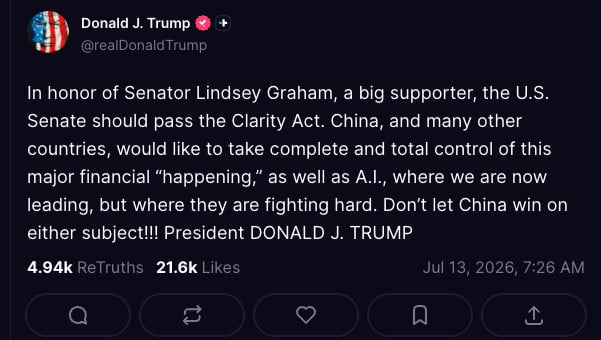
The CLARITY Act, backed by Sen. Cynthia Lummis (R-Wyo.), reportedly faces uncertain prospects despite continuous pressure from U.S. President Donald Trump to pass the industry-friendly crypto bill.
Newly revised ethics language is drawing partisan debate over perceived favoritism to Trump’s personal crypto interests. The president reportedly took in well more than $1 billion in crypto profits in 2025.