
Each Friday, in ‘Prediction Markets Weekly,’ SBC Americas summarizes some of the biggest stories of recent days, as well as some of the under-the-radar items you might have missed.
We covered several big-picture developments throughout the week, including:
- Kalshi’s split-decision loss in the Fourth Circuit
- Legal experts’ analysis of what a Supreme Court case might look like
- Commodity Futures Trading Commission (CFTC) nominees facing Senate Agriculture Committee questions
- Democratic Senators’ call to CFTC Chairman Michael Selig to preserve records and communications tied to prediction markets
- The Senate passing the DEATH BETS Act
- Novig’s Ohio lawsuit claims that the CFTC changed the rules
Beyond those headlines, plenty more happened this week in the world of prediction markets. Let’s dive in.
Familiar lines drawn as CFTC swap rule comment period ends
The public comment period for the CFTC proposed rules on whether sports constitute swaps closed on Nov. 19, drawing more than 140 submissions on a rule that would classify sports contracts as swaps as defined by the Commodity Exchange Act (CEA).
Many familiar commenters made their voices known in the comments section of the rule to classify sports contracts as swaps, with state gaming and tribal interests opposing and prediction market companies supporting.
One of the most notable submissions was a joint effort from a bipartisan coalition of 44 attorneys general, which urged the CFTC to withdraw the proposal. They affirmed their argument that Congress did not intend for federal oversight of prediction market products that equate to gambling
“A sports bet isn’t a derivative just because the CFTC says so,” said Ohio AG Andy Wilson. “The agency doesn’t get to invent powers that Congress never gave it, ignore federal court decisions and bulldoze state consumer protections. If Congress wanted the commission running sports gambling, it would have said so — and headquartered it in Las Vegas.”
Kalshi, Novig ask states to share gambling self-exclusion data
At the same time that prediction market operators including Kalshi and Novig are battling state regulators and attorneys general in court, the companies want them to share data on their self-excluded gamblers.
The two firms united to write to 35 states requesting access to information on individuals who voluntarily blocked themselves from accessing state-regulated gambling websites, Bloomberg reported. While prediction market exchanges continue to insist in court that their products are financial instruments rather than sports wagers, the operators acknowledged that betting and trading pose many of the same risks to consumers.
“We believe a person’s choice to self-exclude should not depend on where they live or which regulator oversees a platform,” read the letter, sent Nov. 19. “Today’s patchwork of separate state lists leaves gaps that at-risk people can fall through … A single federal self-exclusion program can protect every person who asks for it, on every platform, in every state.”
Kalshi and Novig both work with Integrity Compliance 360 (IC360), a partnership that includes membership in the ‘Bad Actor’ program to tackle harassment, as well as trading monitoring services. The two prediction market operators share IC360’s own cross-platform self-exclusion website selfexclude.io, which allows users to begin a cooling-off period that restricts their trading activity across participating prediction markets. Approximately 1,800 people are reportedly signed up to selfexclude.io.
Novig ties its brand to more sports leagues, teams
Meanwhile, as Novig seeks to position itself as a leading sports-focused prediction market, it continues to lean heavily into prominent sports ties.
First this week, Front Office Sports reported that the NBA made Novig its latest authorized prediction markets partner.
The NBA unveiled arrangements with Kalshi and Polymarket in late October that made the companies “preferred prediction market exchanges” of the league, and also extended its existing sports betting deal with DraftKings to cover sports event contracts. Those agreements gave the operators the right to use league and team IP on their platforms, access to Sportradar’s official NBA data, and media marketing rights and promotional activations.
Details of the NBA’s Novig deal were not confirmed.
The day after that report, Novig confirmed new partnerships with seven NHL teams:
- Boston Bruins
- Buffalo Sabres
- Carolina Hurricanes
- Dallas Stars
- New Jersey Devils
- New York Islanders
- Philadelphia Flyers
Those deals give Novig the rights to various advertising integrations during NHL broadcasts, including digital signage and on-ice branding, as well as team branding in some Novig marketing campaigns.
Novig is already an official partner of Major League Baseball and the New York Mets. It continues to scale up its ties to major-league sports and is reportedly valued at approximately $2bn after its latest funding round, all while it battles various states in court for the right to offer its sports markets under CFTC registration.
Mansour defends Trump ‘mention markets’ after CFTC order
Kalshi CEO Tarek Mansour opposes the CFTC telling the company not to list markets based on what President Donald Trump will say during public events.
The CFTC issued a directive on Nov. 13 that ‘mention markets’ about Trump comments must be halted indefinitely while it investigates whether such event contracts really do meet the criteria of the CEA and the CFTC’s regulations, as Kalshi says they do. The CFTC also said it is examining whether those markets are “readily susceptible to manipulation.”
The commission specifically cited Kalshi’s “Will <word> be said by Donald Trump after Issuance and before <date>?” and “What nicknames will Trump say before 2027?” contracts in its order.
Spokespeople for Kalshi told outlets including Bloomberg that it complied with the order, but Mansour defended those markets at an Axios event on Nov. 17.
“What the president does say moves markets,” Mansour said. “So predicting what he’s about to say is actually pretty meaningful.”
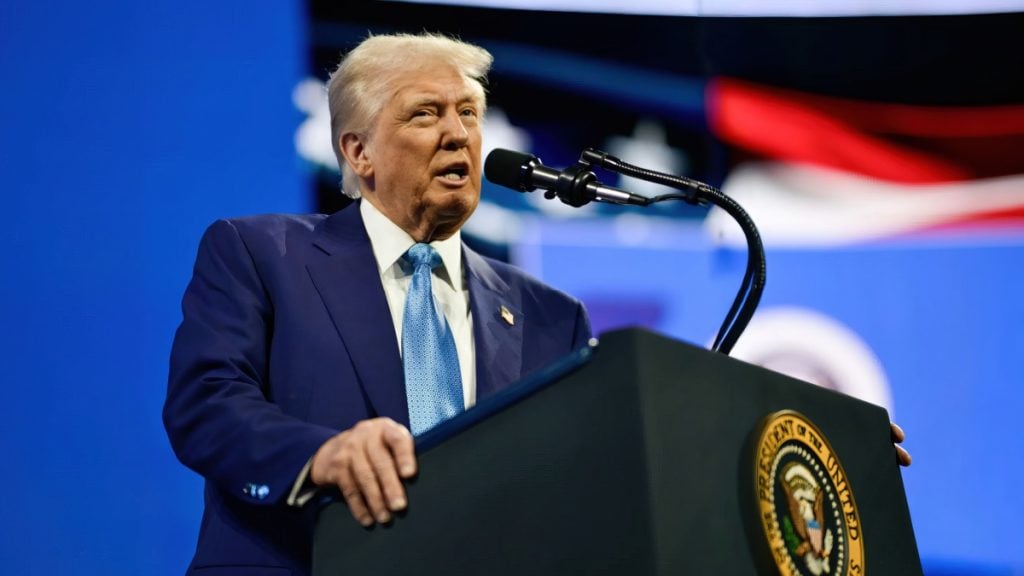
‘Mention markets’ involving Trump made headlines earlier this year after the president’s former teleprompter operator agreed to pay more than $172,000 to settle CFTC allegations that profited from trading on what Trump would say during his speeches. The CFTC said at that time that those contracts had “a heightened risk of manipulation.”
AGA says 8 in 10 Americans think PMs should be regulated as gambling
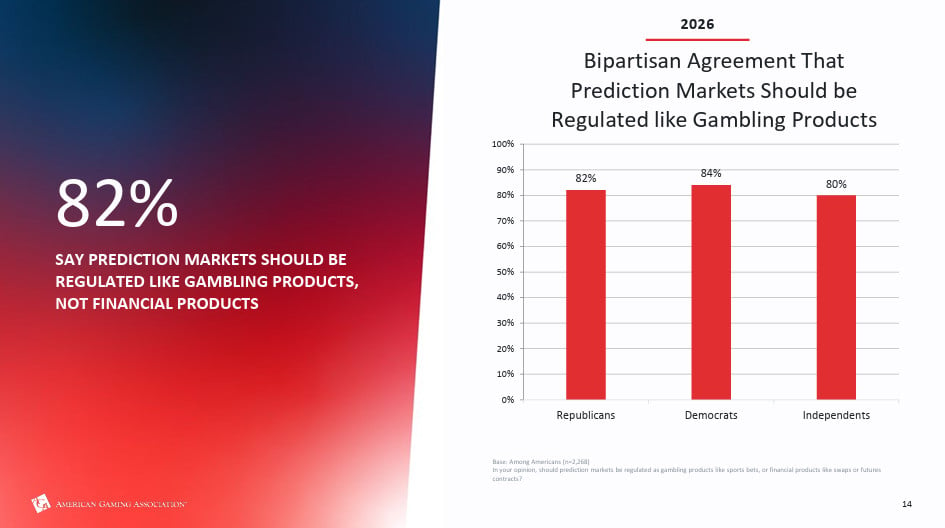
The American Gaming Association (AGA) continued to provide numbers that it says evidence its view that prediction markets are gambling, publishing a new study wherein the headline number was that 82% of Americans believe prediction markets should be regulated as gambling products rather than financial products.
That prevailing opinion crossed party lines, with 84% of Democrats and 82% of Republicans agreeing.
The AGA survey, published on Nov. 16, was conducted online in September from a sample of 2,268 registered voters aged 21 and older.
Other conclusions from the study included:
- 75% of all respondents agree that sports event contracts are fundamentally the same product as betting via a sportsbook
- 72% said that sports event contracts should be regulated by states rather than the federal government
- 74% believe that prediction markets should verify that every user is at least 21 years old
- 74% say that prediction market advertising should include responsible gaming messages and helpline information
The study also revealed an evident lack of knowledge about the current state of play.
Two-thirds (67%) of respondents believed prediction markets were already regulated by state gaming regulators, while another 24% said they were unsure how they were regulated.
“Insidiously misrepresenting sports betting as an investment to 18-year-olds, and telling them it can pay their rent or college tuition, is a grotesque business practice that undermines decades of work industry, state, and tribal regulators have done to protect and educate consumers,” said AGA President and CEO Bill Miller.
“Across party lines, Americans and 47 attorneys general agree that ‘prediction markets’ should be subject to the same rules and provide the same regulatory oversight and consumer protections as state-and-tribal-licensed sportsbooks.”
With its deep-rooted state gaming interests, the AGA is vocal in its opposition to prediction markets. It filed letters to Congress and the CFTC, spoke up in multiple amicus briefs in litigation battles, and runs an online hub dedicated to painting a picture of the threats of prediction markets, complete with a ticker of the tax dollars it claims they cost states.
Several major gambling operators that now offer prediction markets left the AGA last year, including DraftKings, Fanatics, and FanDuel.