KEY TAKEAWAYS
- Lawyers caution that the case covers only sports contracts and that the justices could split the difference, allowing contracts with real hedging value while barring manipulation-prone props.
- Attorneys say while the Supreme Court is closer than ever to taking up the prediction market sports-contract fight, but a definitive ruling likely will not arrive before summer or fall 2027.
- Eleven amicus briefs, including filings from Dodd-Frank namesake Chris Dodd and former CFTC Chair Gary Gensler, back New Jersey’s petition.
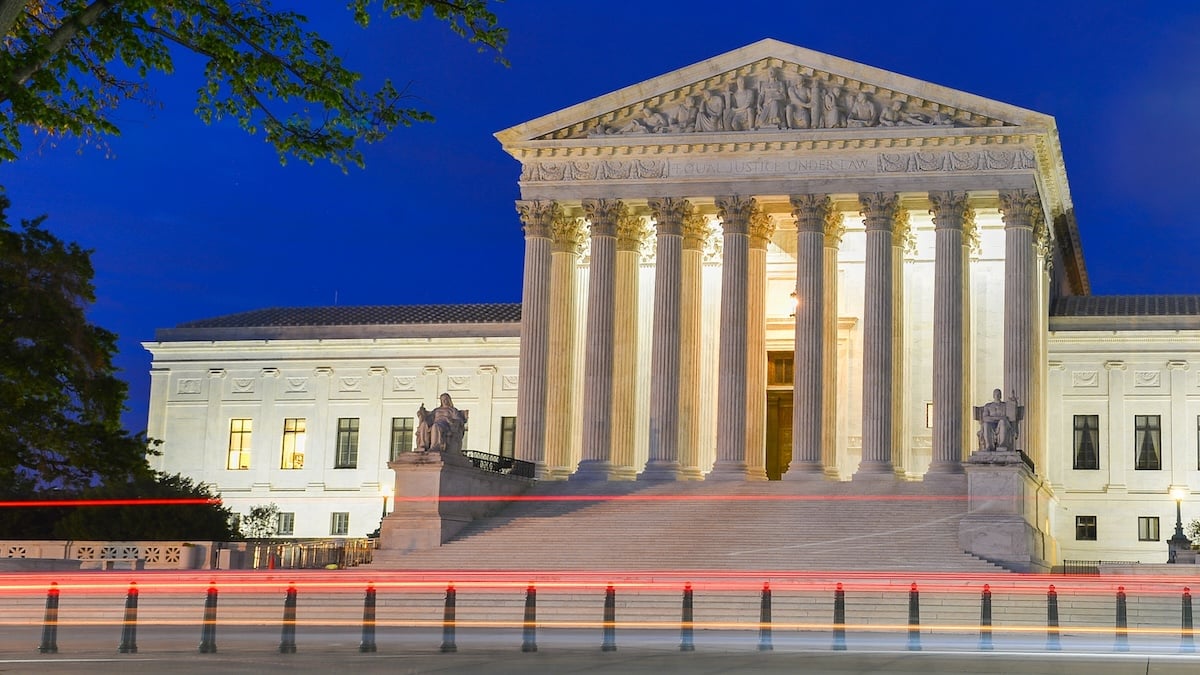
The prediction markets jurisdictional fight over sports contracts is at the U.S. Supreme Court‘s door. Whether the justices open it, and when, remains the industry’s biggest open question, along with how nuanced a final ruling could be.
New Jersey asked the court on Sept. 2 to review the April ruling by the Third Circuit Court of Appeals for Kalshi in Flaherty v. KalshiEX.
The justices are considering whether to hear that prediction markets Supreme Court case or the one coming from the Ninth Circuit, as requested by Robinhood and Crypto.com.
Stephen Piepgrass, a partner at Troutman Pepper Locke, said while the case sits closer to the high court than at any point in the dispute, but he warned the process still has several steps to clear.
“We are on the doorstep. Obviously, the door still has to open, and then the whole briefing and oral argument,” Piepgrass told SBC Americas. “We are closer than ever, but it will still take time.”
Kalshi founder Tarek Mansour said he also expects the dispute to reach the Supreme Court, but declined to predict an outcome on a recent episode of the Reuters Econ World podcast.
Piepgrass and other attorneys who spoke with SBC Americas noted a point the public conversation often misses: The court is not being asked to decide whether prediction markets survive, but rather how far they reach into sports.
“Often lost in the public dialogue is that the issue before the courts is narrow, and it’s only prediction market sports trades,” he said. “Early on, as these markets were coming out, [people said] all of this will be banned. That’s not actually going to happen. These markets are here to stay, but the question is how broad, and whether they cover the area of sports.”
PM case concerns sports, not every event market
Piepgrass said that public debate often obscures how narrow the legal question is. Ultimately, the battle hinges on one question: are sports event contracts swaps under the Commodity Exchange Act (CEA), subject to the Commodity Futures Trading Commission‘s exclusive jurisdiction, or are they sports bets that states and tribes may regulate?
He added that the black-and-white framing both sides use in public misses how much uncertainty the justices must sort through.
“There is a lot of gray in this. There is so much nuance to it, but both sides, as they speak into it, tend to take a very black-and-white view of it,” Piepgrass said. “Both sides have good arguments. But the states do benefit when they can say if it looks like a duck and quacks like a duck.”
Straight from the horse’s mouth on sports question?
Former Sen. Chris Dodd filed a brief in support of New Jersey in August, and directly addresses the sports question. Dodd’s filing carries particular significance because Kalshi’s swap argument runs through the 2010 law that bears his name, the Dodd-Frank Act, which amended the CEA and gave the CFTC exclusive jurisdiction over swaps.
Kalshi argues its sports contracts are swaps. Dodd told the court the Third Circuit’s reading is wrong.
“Congress did not set out to authorize nationwide sports betting through derivatives markets or displace decades of state and tribal primacy over gaming regulation,” Dodd wrote.
Former CFTC Chair Gary Gensler worked with Congress on Dodd-Frank, and his brief speaks to how the agency itself read the law at the time. Gensler said sports betting never came up in his 54 appearances before Congress as chairman and that the CFTC never sought the resources to become a national gambling regulator.
“If Dodd-Frank had preempted the states and tribes on sports betting, it would have been one of the biggest stories about Dodd-Frank at the time. But nobody ever mentioned it,” Gensler wrote.
Justices could draw line between hedging, props
Both Piepgrass and Peter Sanchez Guarda, a former CFTC special counsel and founder of TurnKey Family Office, said the court could split on a decision rather than blessing or banning the contracts outright.
“People seem to assume that it will be all or nothing. That the Supreme Court will bless it or ban it. It could be a compromise,” Sanchez told SBC Americas. “There could be a decision that permits some types of sports contracts in prediction markets where there are legitimate hedging and price discovery features and bans others.”
Sanchez Guarda pointed to the commercial effect of a championship.
“If someone wins the Super Bowl, that will affect merchandise sales, the amount they can charge for broadcast rights and stadium ticket sales. So that is more easily defensible,” he said. “In-game bets on whether the next pitch is a curveball or fastball seem to have fewer arguments you can make for them. Especially with regard to the CFTC’s Core Principle 3, that the contracts being traded are not readily susceptible to manipulation.”
Piepgrass said the NFL’s amicus brief maps that middle ground.
“If you’re a Supreme Court justice, you can see how a major sporting event could have an economic impact. That’s one of the touchstones under the CEA that would argue for the CFTC to have authority,” Piepgrass said. “You could see a number of justices coalesce [around the view] that where a hedge could be useful [the contracts are permissible], but individual player activity, calls, are off limits. There is room for nuance that could leave some pathways open.”
CFTC rules, age limits add more variables
The CFTC’s October rulemaking adds another layer. The agency proposed defining event contracts tied to sports, politics, culture and weather as swaps. Piepgrass said the timing was no accident.
“We all expected that to come out, and clearly [there was] a push to get them out before the court took it up,” he said. “That’s an additional argument to have them have exclusive authority: we’ve promulgated rules and are ready to roll.”
Piepgrass read the NFL brief as a message to the commission as much as to the court.
“They’re clearly signaling that, if you have authority, we think these are areas that you need to tighten up,” he said. “That conversation will take place in parallel to the Supreme Court deciding when to take it up, and ultimately to decide.”
Age limits could become another pressure point. Most states require sports bettors to be 21, while Kalshi allows 18-year-olds to trade.
“It will be interesting to see if that issue plays out and whether there might be compromise room on that,” Piepgrass said. “So far, it doesn’t seem to be. … It’s hard to see what a settlement looks like, but things like that need to be addressed.”
Where courts stand on prediction markets jurisdiction
The legal landscape has only grown more crowded. The DeFi Rate litigation tracker counts 155 U.S. prediction markets legal matters, including 141 lawsuits.
While the Third Circuit ruled in favor of Kalshi, the Ninth and Sixth ruled against, and multiple other circuits are still weighing the issue. Piepgrass said the current split gives the justices a clean record, even if they choose to wait. But each court ruling brings in more nuance, which he said the Supreme Court justices love.
“It remains to be seen if the court decides to take what’s before it today,” he said. “You’ve got three different views, two of which came to the same decision for slightly different reasons.
“The court has, in fact, everything it needs in terms of having the issue set out,” he added. “Still, a number of appellate courts could weigh in. The Supreme Court may want to wait to have the benefit of additional lower-court opinions. Nonetheless, the parties are pushing to get this resolved.”
Prediction markets Supreme Court ruling likely lands in 2027 at earliest
Even if the justices grant review, a decision will take time. Sanchez Guarda said the court’s calendar works against a quick resolution.
“The Supreme Court doesn’t hear a lot of cases. About 60-70 cases per term out of thousands of petitions,” he said. “They have already announced about half the cases that they will hear this term and the prediction market cases are not among them. If they decide to hear the cases in the standard timeline (not out of order), then the earliest for a decision will likely be in the fall of next year.”
Piepgrass offered a similar estimate.
“My own [estimate] would be earliest August 2027 before we have a definitive ruling, but it could be later,” he said.
Bill Pascrell III, an industry lobbyist with Princeton Public Affairs Group, called the process a likely “slow roll” at the NEXT Predict Summit and said he does not expect a ruling within 12 months.
Several other gambling-sector attorneys told SBC Americas the court could take it up next summer.
Until then, sports contract availability will keep depending on which circuit a state sits in, and the parallel fight over CFTC rules will keep moving alongside the court’s decision on whether to hear the case.