
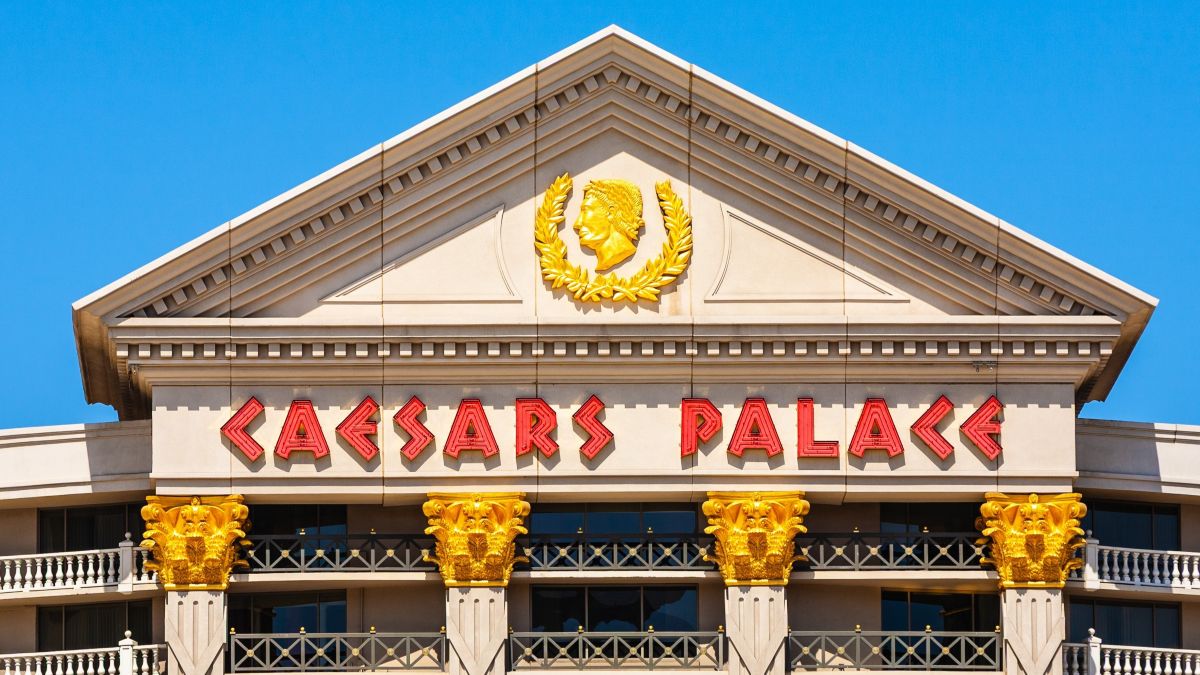
Caesars reported strong Digital segment growth in 2025 as increased online gaming revenues offset a flat year for its Las Vegas properties.
The company reported on Tuesday that its net revenue totaled $11.5bn for the full fiscal year 2025, up fractionally from $11.2bn for the comparable prior-year period. Amid the narrative of declining visitation, full-year Vegas-specific revenue fell 4.7% from $4.25bn to $4.05bn, while same-store adjusted EBITDA for Vegas dropped 8.6% to $1.73bn.
Chief Executive Officer Tom Reeg noted that while Vegas remains down, Q4 saw a sequential improvement upon Q3 when comparing year over year.
“If you look back over the history of Caesars in Vegas, this was probably the third or fourth best fourth quarter of all time,” Reeg said on a Feb. 17 earnings call. “So, there is really no crisis happening in Vegas. It is normal cyclicality, and it will play itself out.”
In contrast, Caesars Digital posted record annual revenue of $1.41bn, a 21% jump from 2024’s $1.16bn. The online gaming arm’s adjusted EBITDA more than doubled from $117m to $236m in FY 2025. Caesars operates three major online gaming brands across North America: Caesars Sportsbook and Casino, Caesars Palace Online Casino and Horseshoe Online Casino.
Online casino opportunities are key
Caesars Digital President Eric Hession noted on the call that online casino was a huge driver of that digital growth, something that has been echoed by other operators such as MGM Resorts International’s joint venture BetMGM.
To Caesars’ pleasant surprise, there may be more opportunities than expected to expand the operator’s online casino footprint this year.
As well as Alberta opening later this year as Canada’s second regulated iGaming province, Maine’s governor allowed iCasino legalization to pass into law in January. There, where online casino will be tied to the state’s tribes, Caesars will feel well-placed given its existing tribal operational relationship for online sports betting. There has also been recent progress in Virginia, where iCasino bills passed both the Senate and the House.
“In Virginia, the fact that we are still alive at this point in the session is a good sign for brick-and-mortar operators,” added Reeg. “Our fingers are crossed in Virginia. That would be a very good outcome for us.
“I would tell you, in both Maine and now Virginia, weeks before we were in the position that we are in now, we would have told you we are not particularly optimistic. So this stuff can come together very, very quickly. In the last 18 months, we have seen taxes on OSB [online sports betting] move up, we have seen per-wager taxes. We are due for some good news in the political cycle, and it looks like there may be some coming.”
Reeg was also asked about another Virginia bill making progress that would allow for a new casino to be opened in the Northern Virginia region of Fairfax County.
“Danville, Virginia, for us was a huge success,” he reflected. “We have warm feelings for the Commonwealth. If there is an opportunity in Northern Virginia, yes, we would take a look.”
Caesars CEO says imminent Digital sale unlikely
Reeg and other Caesars executives previously mooted that the company could look to spin out Caesars Digital and capitalize on its success with a sale.
However, as of right now, that sounds unlikely.
“We will do what maximizes value to shareholders over the long term,” the CEO explained. “I would say, given what we have seen in valuations in the space over the past six to nine months, this does not seem like a market that screams you should come and offer some equity of any kind. So it’s unlikely you see something in the near term.
“Our focus is on hitting our numbers, scaling the business, proving it is scalable, and we are still in the midst of that and making great progress. But in the current market environment, it is unlikely you will see us pursue a separation transaction.”
Caesars still keeping distance from predictions
Of course, the topic of prediction markets came up on Tuesday’s call. With deep roots in Nevada and so much hinging on Vegas and Caesars’ other state gaming licenses, Reeg reiterated what he has said all along: Caesars has no active plans to partake.
“To me, this is clearly gambling,” he told investors and analysts. “I think it will take a couple of years to wind its way through the courts, and you will have a patchwork of states where they are allowed or are not allowed.
“In the current regulatory environment, you should not expect us to be participating in prediction markets. Some of our most valuable assets are our gaming licenses in the states where we operate, and it has been made clear to us in a number of states that if we pursue that avenue, some of our brick-and-mortar licenses could be at risk. You should not expect us to do that.
“I would tell you unequivocally, we view this as gambling that should not be deregulated. We will let that play out through the courts
Reeg did admit that if it became clear down the road that there is a legal path for prediction markets that satisfies land-based gaming regulators, Caesars would look to participate. In the meantime, he said that the company has not seen any discernible impact on its own operations from prediction markets’ expansion into sports.