
Timing and agility dictate the success of most mergers and acquisitions, as Underdog Sports showed clearly in selling Thursday to IG Group for $1.3bn.
After launching a daily fantasy app focused on pick’em and best ball games in 2020, Underdog leveraged a swift pivot to prediction markets late last year to cash in on the suddenly booming vertical at a valuation hard to imagine even two years ago.
“Prediction markets are one of the most exciting developments we’ve seen in a long time,” Underdog founder and CEO Jeremy Levine said in September 2025. “While still new and evolving, one thing is clear – the future of prediction markets is going to be about sports – and no one does sports better than Underdog.”
In that spirit of agility, England-based fintech outfit IG Group plans to scale Underdog’s platform beyond sports “in time to come across financial markets, culture and politics,” CEO Breon Corcoran said on a Thursday webinar announcing the acquisition.
“If sport is where Underdog has won, it’s not where the opportunity ends,” Corcoran later said. “The infrastructure is category-agnostic.”
The companies expect the deal to close either in late 2026 or early 2027.
How Underdog deal with IG Group deal is structured
London-listed IG Group will facilitate its purchase largely through issuing more than 24 million new shares. Those will comprise 60% of the upfront equity payment and then represent about 6.8% of its enlarged issued share capital.
Markets recoiled at the deal (and perhaps also New York‘s $36bn lawsuit against Kalshi) Friday, sinking $IG more than 14% at close to 1460GBX (19.62 USD).
Underdog founders Levine and Brandon Stakenborg will receive 1.5% of IG’s total stock, subject to vesting and a 24-month lockup. Measured at today’s IG share price, that would equate to more than $105m.
In a prepared statement, Levine said in part, “… we’ve proven we can build the best products no matter how the regulatory landscape shifts. It’s why we’ve taken off in prediction markets since we launched last year. Now, with our own exchange and by joining IG, we’re going to take an incredible leap in what we can offer customers and make Underdog the place to make predictions on sports and beyond.”
Underdog disclosed net revenue of approximately $466 million in the year ending in June 2026. That represents a 21% year-on-year increase from $380 million in the year closing in June 2025.
Underdog will remain a commercially standalone company with its own management team. In that regard and others, the deal reads similarly to Allwyn‘s September 2025 acquisition of Underdog rival PrizePicks for $1.5bn.
Additional financial details of IG Group acquisition
The deal also includes a $450m bridge facility to help cover:
- Approximately $380m upfront payout to Underdog shareholders
- Up to $200m in 2026 earnout, contingent on Underdog delivering on net revenue targets and a positive year-end EBITDA
- Total of $160m in repayment of Underdog debt when the transaction closes
In addition to the $1.3b purchase price, IG also will create a management incentive program (MIP) for certain Underdog employees worth up to $850m by 2029. The company expects Underdog earnings to self-fund the program in cash but reserved the right to issue more stock to meet the MIP requirements if needed.
Further, IG Group paused an active share buyback program until 2027.
Underdog’s path from DFS to prediction markets
Levine’s reference to “regulatory landscape shifts” contains multitudes. In fact, Underdog spent most of its independence in either negotiation with or combat against state legislators and gaming regulators over the legality of its against-the-house pick ’em DFS product.
So-called ‘DFS 2.0’ or ‘DFS-plus’ operators such as Underdog and PrizePicks spent much of 2023 fielding cease-and-desist orders from regulators across the country and pulling its player vs. house product in many of them in after the Super Bowl in 2024. They also dodged shots from FanDuel, who fought similar legal battles along with DraftKings years earlier to create the fantasy “game of skill” foundation on which Underdog and PrizePicks began serving closed markets the sports betting giants could not reach as regulated OSB operators.
“There are companies today posing as fantasy-sports operators, and they are running illegal sportsbooks,” FanDuel state government regulations head Cesar Fernandez said at NCLGS in summer 2023.
Levine bites back at hands that once fed
Levine, who sold StarStreet to DraftKings in 2014 and DRAFT to future FanDuel parent Paddy Power Betfair in 2017, fought back publicly in an open letter to customers, saying in part:
“They’ve seen our company, and others, produce superior products, more exciting user experiences, and begin to challenge them for sports fans’ attention – and they’re scared that we will challenge their market positions. We’re already bigger than they are in fantasy. Frankly, they should be scared.”
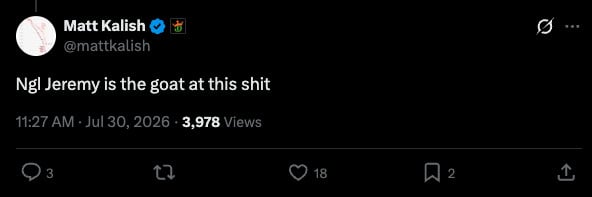
Three years and many regulatory shifts later, DraftKings co-founder Matt Kalish tweeted praise for Levine on Thursday:
Sports betting ambitions shelved as prediction markets blast off
From its founding, Underdog presented plans for entering regulated online sports betting alongside its fantasy offerings. It acted on those ambitions in North Carolina and Missouri, but ultimately withdrew OSB from both markets by December 2025.
In hindsight, that pullback fit the typical rightsizing pattern for companies seeking exits. Underdog also laid off about 20% of its 500 employees in March 2026 after shifting to prediction markets.
“We went from a focus on a state-by-state framework to a national prediction markets platform with seamless offerings across the country,” Levine said at the time. “It’s simply a different operation, and the changes we made are a part of that transition.”
Trump win pumps Underdog, PrizePicks valuations
The transition took root in November 2024 with the return of U.S. President Donald Trump and his embrace of financial deregulation and prediction markets. After opposing sports event contracts on prediction markets during the Biden administration, the Commodity Futures Trading Commission (CFTC) pivoted 180 degrees under Trump to fighting on behalf of them.
That about-face cracked the door to sports wagering across the country for predictions-first operators Kalshi and Polymarket. But it blew the doors completely off for Underdog and PrizePicks, companies with 50-state customer databases and tech stacks ready to scale immediately.
Underdog leaned on that regulatory good fortune to raise $70 million in a Series C round through Spark Capital in March 2025 that valued the company at $1.2bn. Just three years earlier, the company’s Series B round produced a $485m valuation.
“I first met Jeremy three or four years ago as the business was just getting off the ground, and it seemed implausible that a new startup could emerge in that space,” Spark Capital partner Will Reed told Axios last year. “So I’d wish him luck, and then each year he’d come back having done what he said he’d do.”
Timeline to prediction markets
Only months after the $70m infusion, Underdog moved quickly through accreditation and acquisition, aided by a CFTC certification process with relatively less hurdles than state-level gaming regulation.
September 2025: A Crypto.com partnership brings the first sports trades to the former DFS company.
January 2026: The company acquired National Futures Association (NFA) approval as an FCM and a swap firm. That allowed UD to team with other designated contract markets (DCM).
March 2026: Underdog bought Aristotle Exchange, a CFTC-registered DCM and DCO that operates the PredictIt exchange.
April 2026: Underdog added Kalshi sports contracts to its prediction markets.
July 2026: The operator launches its in-house exchange.
“Underdog has a clear right to win,” Corcoran said Thursday. “It is built for sports. It is a large sports-first customer base who are used to fast, real-time risk taking. The wallets, the KYC, the brand are already in place so moving into prediction markets is close to friction-free. That’s what sets it apart from competitors who are built for more sophisticated traders than for sports fans.”
Corcoran also ran Paddy Power Betfair when it acquired DRAFT from Levine. Like early-stage backers Mark Cuban and Kevin Durant, Corcoran holds an investment position in Underdog. The CEO recused himself from the IG board’s formal approval of the deal.
How long is US prediction markets runway?
As shown by the sea change from Biden to Trump, the long-term future of sports in prediction markets hinges on both who oversees the CFTC and what happens when the Supreme Court tackles the matter. Notably, the Underdog MIP ends in 2029, which is the first year beyond Trump’s last term.
Corcoran acknowledged those realities Thursday, saying IG Group took the US political climate into consideration.
“We’re clear-eyed about the risks, including the fast-moving regulatory environment,” Corcoran said.