

As Stats Perform unveils its new Opta Dynamic Stats API for basketball, SBC Americas spoke to Andrew Skweres, the sports data company’s head of product, to explore the challenges and opportunities facing sportsbooks and affiliates as they deliver more personalised, data-driven player prop and bet-builder experiences at scale.
SBC: It’s still rare to see detailed trends provided across sports for prop markets, especially beyond basic form, or for specific bets selected by bettors. This seems like a miss given their popularity and the relative information asymmetry of such markets compared to outrights. Why is this?
Andrew Skweres: The popularity of player props, same-game parlays, and micro-markets continues to surge across regulated markets. But you’re right, until now, delivering contextual, personalized stats tied to specific bet selections or markets has been difficult to achieve at scale. In conversations with our operator partners they consistently raise two key challenges:
- Data complexity: The sheer number of player-stat permutations, splits, and streaks creates a heavy technical load for ingestion, computation and database queries – especially when thousands of unique bettor requests are happening simultaneously.
- Cluttered UI: Supporting thousands of potential player and team stat markets, particularly in bet-builder contexts, has traditionally discouraged designers and developers, who worry about overwhelming users with endless scrolling and hurting conversion rates.
SBC: How does your new Dynamic Stats API help overcome these challenges?
AS: Building on the success of Opta’s award-winning Dynamic Stats API for soccer, already used by leading global sportsbooks, the new basketball API makes it easy to:
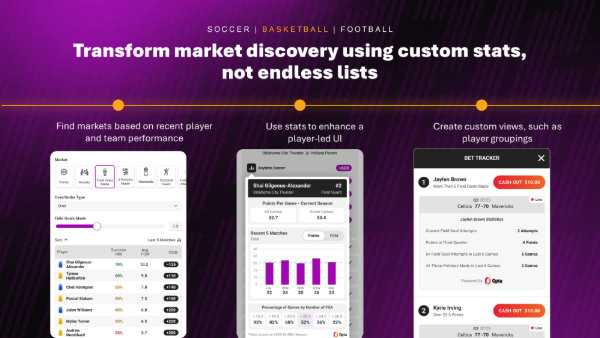
- Surface relevant, contextual insights instantly for any player prop selection, such as “average rebounds against the Rockets at home,” and even for in-play prop bets like “three-pointers made by Stephen Curry in the 3rd quarter.”
- Power personalized bet slips and same-game multis by embedding contextual stats directly alongside selected legs, allowing users to track performance without leaving the operator’s site and make more informed cash-out decisions.
- Enrich the betting experience at scale across thousands of potential markets, without slowing down the platform or adding friction.
SBC: How does it help affiliates?
AS: In testing, we proved that adding contextual insights to banner ads for sportsbooks increased click-through rates by 6.7x. While that testing focused on soccer, we see no reason the same approach won’t deliver comparable results in basketball.
SBC: Opta is well-known and trusted as the gold standard for soccer data. Was it easy to build the Dynamic Stats API for a different sport?
AS: All our data across sports is collected with rigor, integrity, and, importantly, with uniform and consistent definitions. That consistency makes it straightforward for our developers to scale products like the Dynamic Stats API across multiple leagues and sports.
For basketball specifically, our data has powered NBA, WNBA and college basketball box scores, big screens, stat sheets, broadcasts, digital platforms and sportsbook products for decades in the U.S. and worldwide. Opta’s basketball database extends back to 1939, giving partners both historical depth and live accuracy.
SBC: What impact can sportsbooks expect from the new API?
AS: Contextual betting stats alongside markets are already proven to lift activity. Alongside the results I mentioned above for click-through rates, we published a case study earlier this year showing that a sportsbook saw a 1.3x increase in bet count and double the average stake size after they included a contextual stat next to markets.
It’s harder to quantify the entertainment uplift bettors get from being able to track their specific bets or feel more confident when placing them, but we’re confident this will also be even more positive.

SBC: Can you outline some more ways a sportsbook could use the Dynamic Stats API to enrich its basketball betting experience?
AS: The great thing about the new API is the scope it provides for operator creativity and differentiation in both the UI and UX. Some of the stand-out suggestions we’ve heard include:
- When a user selects a market like “Luka Dončić” over 4.5 assists in the 2nd half”, instantly display relevant contextual stats such as, his average 2nd-half assists over his last 5 games, and in his last 5 matchups against that opponent.
- Let users track the real-time performance of every bet in their bet slip, including individual legs within a multi.
- Suggest additional stat-based bets or multi-leg additions backed by form, such as highlighting other players who typically average over 18.5 points at home against the same opponent.
SBC: How can sportsbooks and affiliates find out more?
AS: Hopefully they’ve been contacted by their Stats Perform account manager, or by our exclusive reseller to licensed U.S. sportsbooks, SportsContentCo. We’ve also produced a guide to 10+ ways to use the new API and creative operators will undoubtedly find even more applications.