

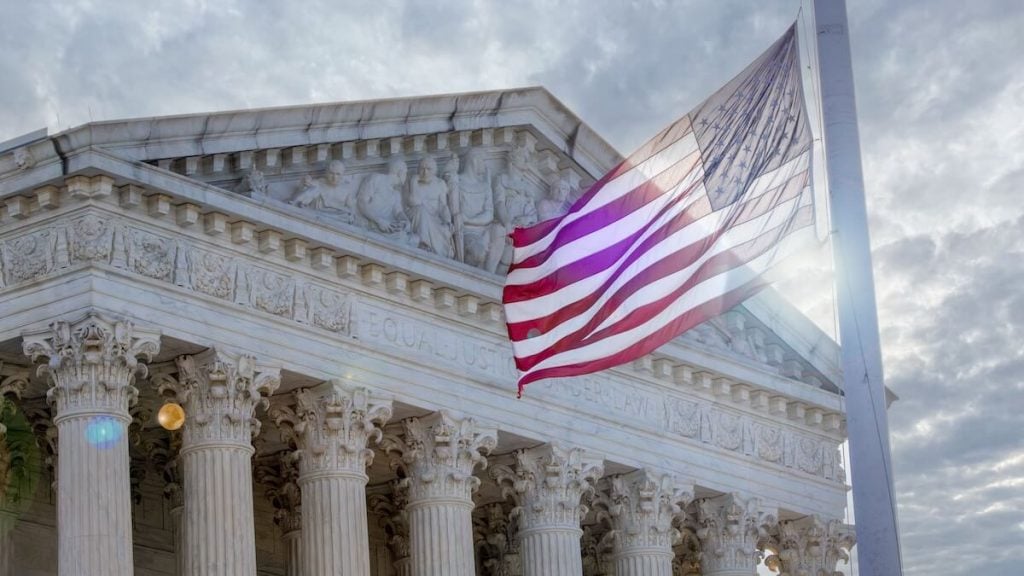
Inevitability completed its journey to Washington, D.C., on Wednesday, as the state of New Jersey asked the U.S. Supreme Court to rule on the legality of sports betting on Kalshi and its fellow prediction markets.
New Jersey Attorney General Jennifer Davenport took the most significant step toward the country’s highest court deciding the fate of a nascent industry generating hundreds of billions of dollars. Davenport filed for cert shortly after last week’s Ninth Circuit Court of Appeals ruling against prediction markets created a federal court split with the April decision from the Third Circuit that allowed Kalshi and competitors to offer sports event contracts in New Jersey.
“Companies like Kalshi claim to offer legal sports betting in all 50 States, but they refuse to follow the gambling laws of any State,” Davenport said in a statement. “… We’re calling on the Supreme Court to resolve this issue and recognize that Congress did not silently make the sports-betting industry immune from state law.”
Notably, Davenport narrows the question for the justices to answer to focus specifically on sports betting: “Whether the 2010 Dodd-Frank Wall Street Reform and Consumer Protection Act preempted States from regulating sports bets that occur within their jurisdictions if those bets are offered on markets registered with the Commodity Futures Trading Commission.”
“At issue is whether Congress federalized a multi-billion-dollar sports-betting industry via a single word and its definition—’swap’—in Dodd-Frank. After all, if Kalshi is right that it can offer sports bets on federal exchanges irrespective of state law, companies can disregard all state sports-gambling statutes with ease, so long as they register with the CFTC,” the petition asserts, pointing at the ‘swap’ definition that was at the heart of the Third Circuit’s 2-1 split decision in favor of Kalshi.
When Supreme Court will decide whether to hear Kalshi case
Gaming law expert John Holden, an assistant professor in the Department of Business Law and Ethics at the Kelley School of Business at Indiana University, explains that it could take a few months for SCOTUS to make its call.
New Jersey’s petition for cert triggers a set of required steps that will play out over the next two months:
- An opposition brief from Kalshi is due within 30 days
- From that filing date, New Jersey will have 10 days to respond
- Within a month from that response, SCOTUS typically conferences to decide next steps
From that point, the justices can choose from a menu of options:
- Grant cert, or choose to take the case
- Deny cert
- Extend to another conference
- Ask the U.S. Solicitor General for more analysis
Holden said the justices could add months to the decision process if they elect to ask for more analysis, which this case could warrant.
How NJ prediction markets case got here
The 18-month march to Washington began in March 2025, shortly after Kalshi began offering sports wagering on its platform in January 2025. The New Jersey Division of Gaming Enforcement (DGE) sent cease-and-desist letters to Kalshi and Robinhood requiring the operators to stop “offering any form of sports wagering to New Jersey residents and void any such wagers already placed.”
Kalshi responded in the manner that it has to most state-level enforcement actions; by suing the state of New Jersey and claiming its only regulatory authority is the federal Commodity Futures Trading Commission (CFTC). A district court judge then granted a temporary injunction allowing sports event contracts to continue.
The DGE appealed that decision, ultimately leading up to the Third Circuit hearing arguments and siding with Kalshi. The most notable part of that ruling held that sports bets qualified as swaps under the Commodities Exchange Act (CEA).
“Because Kalshi’s sports-related event contracts are traded on a CFTC-licensed DCM and depend on event outcomes associated with economic consequences, they fit within the Act’s definition of ‘swaps’ subject to the CFTC’s jurisdiction,” the majority opinion read in part.
Last week’s Ninth Circuit decision repeatedly took aim at the Third Circuit ruling and directly contradicted that view. This created the split at the heart of New Jersey’s request for cert.
“But because Congress has spoken on the issue of gambling in other statutes (and did not impliedly repeal or amend those statutes through Dodd-Frank), there is no limiting principle to Kalshi’s broad reading of the definition of swap and adopting that reading would assume that, by granting the CFTC regulatory authority over gaming nationwide, Congress ‘hid an elephant in a mousehole.’ Thus, we conclude that these sports event contracts are likely not swaps under the CEA.”