Polymarket is facing a new lawsuit over allegations of deceptive marketing practices
That is according to a report from the Wall Street Journal detailing the alleged illicit activity. According to documents filed in the Superior Court of the District of Columbia, Polymarket is being sued by the National Association of Consumer Advocates (NACA) for allegedly deploying a “pattern of flagrantly deceptive and unfair marketing” to mislead American consumers to risk their money to “place bets” on Polymarket platforms.
In addition to deceptive marketing of the Polymarket platforms, the NACA is accusing the prediction market of deceptive failure to disclose material connection and unfair promotion of the Polymarket platforms to college-aged Americans.
The association cites the District of Columbia Consumer Protection Procedures Act (CPPA), alleging that Polymarket’s marketing practices violate the statute.
The suit also names Polymarket CEO Shayne Coplan and Chief Marketing Officer Matthew Modabber as defendants, as the two executives hold “ultimate decision-making authority” over the prediction market’s business operations, including marketing.
SBC Americas reached out to Polymarket for comment on the NACA’s legal action but has not yet received a response.
Crux of Polymarket suit from consumer group
The NACA’s suit against Polymarket centers on the prediction market’s alleged use of paid endorsers, some whom were college-aged, to deceptively advertise its offerings.
“Defendants have used deliberately secretive marketing campaigns to raise their brand’s profile through ads by paid endorsers that are disguised as organic content,” reads the complaint. “In fact, individual influencers with hundreds of thousands of followers have secretly received thousands of dollars from defendants to post about the Polymarket platforms, and have done so without disclosing their affiliation with the brand.”
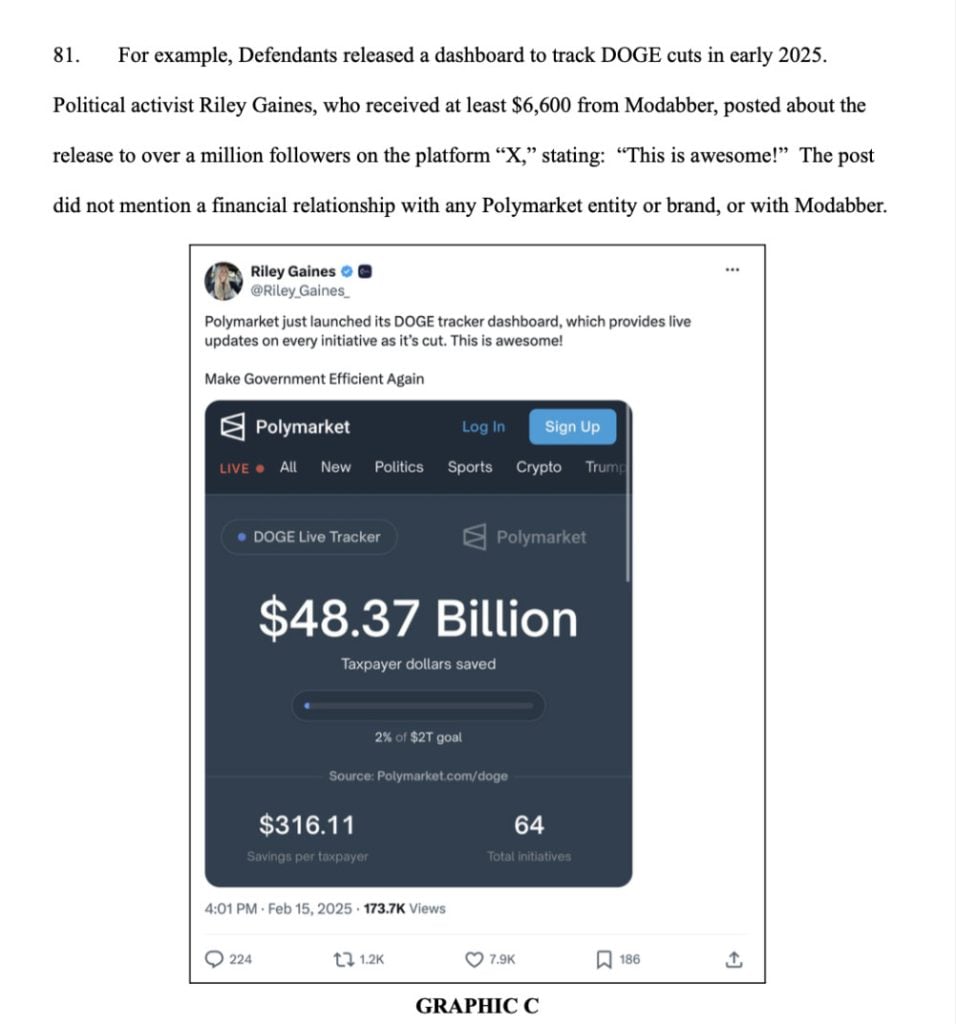
According to the complaint, Modabber used his personal PayPal account to send at least $350,000 to a group of content creators over a 13-month period. One of the content creators included political activist Riley Gaines, who received at least $6,000.
She was allegedly compensated by Modabber for sharing a social media post about the Polymarket’s launch of a DOGE job cut tracker to her more than 1 million followers on X. Gaines’s alleged collaboration with Polymarket did not include on-screen wagering.
The suit also details Polymarket’s allocation of fake wagers to paid content creators. The WSJ report provides details of Polymarket’s alleged unlawful advertising practices:
- It reviewed 1,105 videos from 10 Polymarket creators, with 70% showing a placed bet
- In total, the fake on-screen wagers had a value of $1.9 million
- The 10 creators pocketed roughly $900,000 from the bets showcased across 118 videos
- About one in four of the videos used the term “free”
- Some of the content creators were paid $2,000 to $3,000 per month for their videos
The NACA is also taking issue with the alleged use of “clipping” to push the content by using short ad videos spread across both small and large social media accounts.
“The clippers who repost content can make videos go viral, thus expanding Defendants’ reach into the world of social media users quite substantially,” reads the NACA’s suit.
“For example, a recent Wall Street Journal investigative report showed how a video that received just 151 page views on its own skyrocketed to 2.4 million views following the clipping campaign.”
Polymarket grassroots campaigns also draw concerns
The suit against Polymarket also includes allegations of Polymarket targeting college students directly on their campuses through activations with students and fraternities.
The legal action claims Polymarket worked with CampusGTM to run marketing campaigns with college students, with earnings ranging from $500 to $2,000 per campaign.
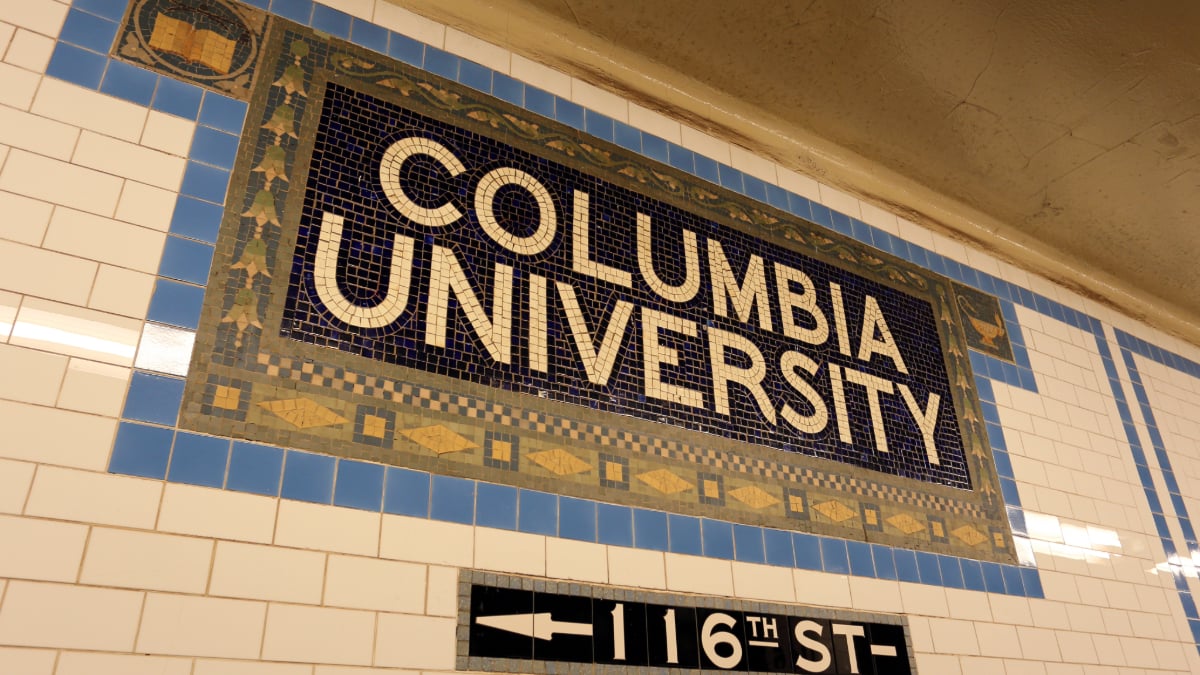
Polymarket also allegedly worked directly with fraternities to deploy sign-up campaigns. The prediction market reportedly reached out to Columbia University’s Sigma Phi Epsilon chapter and invited the group to its headquarters in New York City last year.
About 20 chapter members reportedly visited Polymarket’s headquarters and received $10 to use on the platform, and were offered a sign-up deal that provided kickbacks to the fraternity. Polymarket also allegedly offered other fraternities branded merchandise and $1,000 to use for hosting parties that included branding of the prediction market.
In total, Columbia’s Sigma Phi Epsilon reportedly pocketed $30,510 in two weeks after launching its sign-up deal with Polymarket. Some of the proceeds were used for a party.
What is NACA seeking?
The NACA is demanding a jury trial in its complaint against Polymarket, seeking a declaratory judgment that the company’s conduct violates the CPPA.
The association is also seeking “equitable relief, including equitable restitution, disgorgement of profits, and a permanent injunction against defendants’ use of the unlawful trade practices. . .”
Tough couple of weeks for Polymarket
Polymarket is facing a new lawsuit after a District Court judge denied the company’s motion for a preliminary injunction against state officials in Michigan. According to Judge Paul Maloney, Polymarket failed to prove it would suffer immediate irreparable harm by shuttering its sports event contract operations in in the state.
The ruling came after Polymarket preemptively sued Michigan Attorney General Dana Nessel and other state officials in March after the state filed suit against Kalshi.
The NACA lawsuit and the unfavorable ruling in Michigan comes less than two months after the company reopened its U.S. exchange to iOS users after only offering a waitlist.
Polymarket has reentered the U.S. after exiting the market in 2022 after reaching a settlement with the Commodity Futures Trading Commission (CFTC) by paying a $1.4 million civil penalty. The penalty levied by the CFTC was for a failure to register as a designated contract market or a swap execution facility with the federal agency.
Polymarket’s ability to reenter the U.S. was made possible by the company’s July 2025 acquisition of the holding company of derivatives exchange QXC and its affiliated clearinghouse. The acquisition was valued at approximately $112 million.