
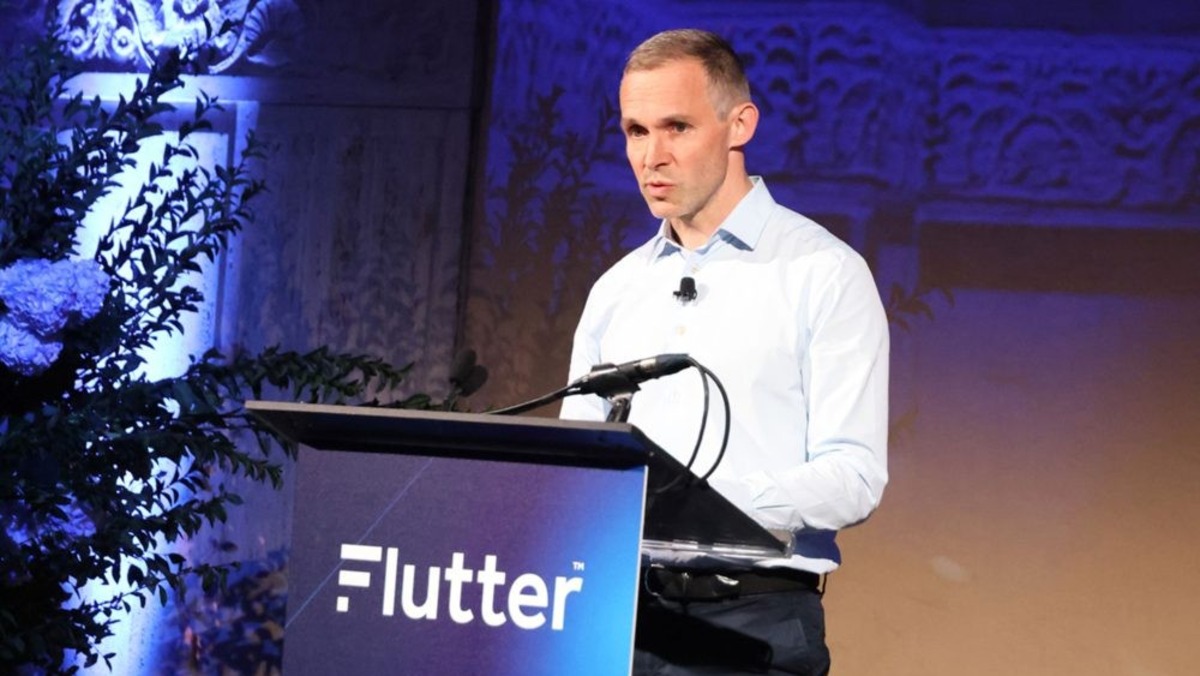
Flutter Entertainment announced on Wednesday that Chief Executive Officer Peter Jackson is stepping down, three months after the company ousted Amy Howe as CEO of FanDuel.
Jackson will depart his role, as well as Flutter’s board of directors, on Sept. 30 and will be replaced as CEO by Dan Taylor, who has been CEO of the company’s International division since 2020 and was also named as its President in May 2026.
“After nearly nine years as CEO, this is the right time to hand over to Dan,” Jackson said on a Q2 earnings call on Aug. 5. “It’s been an enormous privilege to lead this business, and I do so with tremendous confidence in Flutter’s future, in the team we’ve built, and in Dan’s leadership.”
Peter Jackson’s 8+ years as Flutter CEO
Jackson has led Flutter since January 2018. He has overseen big changes during his time in charge of the Irish company as it shifted its focus from its historic UK and Irish operations to U.S. market leadership with FanDuel. Some of the milestones of his time as CEO include:
- The acquisition of FanDuel in 2018 and the brand’s rapid U.S. expansion after the repeal of PASPA
- Flutter’s 2019 rebrand from Paddy Power Betfair
- The integration of The Stars Group in 2020
- The launch of FanDuel Predicts in 2025
- Flutter’s now-completed shift from the London Stock Exchange to the New York Stock Exchange
“One thing I’ve always tried to do throughout my time as CEO is to take a long-term view of how we create value for shareholders,” Jackson added on Wednesday’s call. “That has sometimes meant making decisions that weren’t universally welcomed in the moment because we believed they would strengthen the business over the long term.
“In 2019 and 2020, for example, we continued to invest heavily in FanDuel at a time when many questioned those decisions because of the impact on short-term earnings. Looking back, those investments proved to be the right thing to do. They strengthened our competitive position and laid the foundations for the business we have today, and we’re making the same type of decision again today.”
Jackson leaves as Flutter’s stock plummets
Speaking of shareholder value, the news of Jackson’s departure comes amid a crash in Flutter’s stock price on the NYSE.
Flutter’s share price was $308 in late August 2025, positioning it as the world’s most valuable publicly listed gambling company; it was $105 as of Aug. 4, representing a 66% drop in less than 12 months.
That has come amid headwinds on numerous fronts, including impacts of major tax changes in the UK and other parts of Europe and the spread of sports betting-style prediction markets in the U.S. Overall, Flutter posted net losses of $160m in FY24 and $400m in FY25.
FanDuel’s revenue and earnings take hits
On Wednesday, alongside the CEO update, Flutter reported Q2 2026 results that showed that U.S. revenue dropped 6% to $1.68bn for the three-month period ended June 30. Jackson and Chief Financial Officer Rob Coldrake put that decline down to “customer-friendly” sports results; FanDuel’s U.S. sportsbook revenue fell 15% to $1.04bn.
In contrast, FanDuel’s online casino revenue grew 14% year over year. Jackson told analysts that Flutter hopes to see at least one more state legalize iGaming by the end of 2027 to boost that side of their business.

U.S. adjusted EBITDA fell 70% from $400m to $119m, although Flutter positioned that as coming in “ahead of expectations after prediction market investment and new state launch investment.” Citizens analyst Jordan Bender backed up Flutter’s comment, stating that the U.S. reported EBITDA was 13% ahead of his expectations.
Since late last year, FanDuel has launched in numerous North American jurisdictions, including:
- Missouri online sports betting in December 2025
- Arkansas online sports betting in March 2026
- Alberta online sports betting and online casino in July 2026
Globally, Flutter posted a net loss of $296m (compared to a $37m profit this time last year), which executives attributed partly to planned investments in both prediction markets and FIFA World Cup marketing. Overall company EBITDA fell 45% to $508m.
As a result, Flutter has cut its full-year revenue guidance by $395m to $17.91bn at the midpoint, and adjusted EBITDA outlook by $210m to $2.655bn at the midpoint.
Flutter bullish on US focus under new leadership
Despite the comparative struggles, Jackson insisted that Flutter is confident in its long-term U.S. outlook as it balances FanDuel’s existing state-regulated gaming operations with its newer prediction markets business.
Flutter’s earnings release claimed that FanDuel is America’s top online sportsbook and casino with 39% and 27% gross gaming revenue market share, respectively. Jackson said the company sees a big opportunity to invest further in that status under Howe’s replacement as FanDuel CEO, Christian Genetski. “We recognize that this weighs on near-term earnings, but we’re convinced it’s the right thing to do to maximize long-term shareholder value,” said Jackson.
“The U.S. leadership changes we recently implemented are working,” Jackson added. “I’m encouraged by the progress we’ve made in Q2. In the U.S., we’re delivering continued sequential improvement in key sportsbook metrics alongside sustained iGaming growth …
“I’m confident that the choices we’re making today, from investing in the U.S. to expanding our term with FanDuel Predicts and market-making, strengthening our international businesses and advancing the next phase of cost transformation, will deliver sustainable long-term value for our shareholders.”
Citizens’ Bender wrote in an analyst note that Flutter “appears to be at a crossroads in terms of product strategy and overall direction.”
“We continue to believe Flutter’s historical execution capabilities, combined with the revamped management team led by seasoned industry veteran Dan Taylor, will drive near-term market share gains during the most important period of the year for a sports betting operator,” Bender added. “While we still expect improved results in 2027, our confidence has moderated, and management must demonstrate it can return the business to a position of global leadership.”
FanDuel Predicts relocates sports contracts to Crypto.com
Other than the CEO transition, FanDuel’s prediction markets business was a core focus of Wednesday’s update.
Jackson said that Flutter is seeing limited cannibalization from the wider prediction markets industry on its existing customer base in regulated sportsbook states, quantifying it as “low single-digit impacts” on the business.
Before the World Cup, FanDuel Predicts expanded its sports offering with Crypto.com contracts. Jackson confirmed on Wednesday’s call that in coordination with FanDuel’s joint venture partner CME Group, Flutter has agreed to move all sports and novelty event contracts to Crypto.com, while continuing to provide customers with access to CME’s financial markets. FanDuel Predicts began offering sports and other contracts through CME Group in December 2025 and expanded nationwide the following month.
Moving forward, FanDuel is focused on scaling up its parlay-style combination markets across different prediction market platforms. The Flutter executives also spoke of their optimism about FanDuel moving to an all-in-one app, similar to DraftKings‘ ‘super app’ strategy, wherein sports betting, iCasino, and prediction markets are all housed on the same platform, with the availability of each product depending on jurisdiction.
Jackson and Coldrake also suggested that Flutter expects to generate approximately $50m of revenue from its own market-making by the end of 2026.
“Our ambition here is to establish a leading position in this space by leveraging the pricing and risk management and the trading capabilities that we’ve got developed over the years with our sportsbook, and we feel we’ve got a real advantage in pricing,” added Coldrake. “As the combo volume increases, we’re better placed to take advantage of that, and we see that as a really attractive and high-margin segment for us.”
Ultimately, though, while Jackson noted that Predicts gives FanDuel an opportunity to acquire customers “in the half of America that we can’t currently operate in,” he reiterated that Flutter and FanDuel expect the bulk of their business on the sports side to come through regulated sports betting, with sports prediction markets “incremental” to their bottom line.