
Earnings call season comes around four times a year in the U.S. gambling industry but not for Caesars anymore.
When the land-based and online casino giant announced its Q2 results on Tuesday, only a press release highlighting the topline numbers appeared, and that was it. No more CEO Tom Reeg, Caesars Digital President Eric Hession, and other executives explaining trends, mapping out future plans, or responding to hot-button industry topics on company calls with investors and analysts.
Caesars is in the process of finalizing a sale wherein it will be taken private by Fertitta Entertainment, Inc. in a deal valued at $17.6bn, including a $5.7bn payment and the inheritance of almost $12bn of debt. The Nevada company announced on May 28 that it would not host a conference call this week when it reported its latest quarterly results, and it will soon be delisted from the Nasdaq when the deal is ratified and completed.
It all means that Caesars’ Q1 earnings call was the last public update from company leaders for the foreseeable future. Further insight will be limited to whatever Fertitta and Caesars executives deem worthy of sharing through their own platforms.
Caesars history as a public company
Caesars confirmed the definitive agreement for the Fertitta acquisition in late May, more than 14 years after it first went public through a small initial public offering on the Nasdaq in February 2012. Back then, Caesars was still the relatively new name of Harrah’s Entertainment, with that former company name retained as one of its core brick-and-mortar casino brands.
The casino staple has been through a lot since then, including:
- The bankruptcy of its operating unit in early 2015 that led to the founding of casino real estate investment trust (REIT) VICI Properties two years later
- Another merger in 2020, this time with Eldorado Resorts in a deal worth a reported $17.3bn all-in
- The establishment and growth of its online casino and sports betting arm after the repeal of PASPA in 2018, spurred on by the $3.7bn acquisition of William Hill’s U.S. operations in 2021
- The sale of the World Series of Poker brand to NSUS Group for $500m in August 2024
Soon, Caesars and its 50-plus owned, leased, or branded brick-and-mortar properties will be the latest assets in the portfolio of Texan billionaire business magnate Tilman Fertitta, alongside the likes of the Golden Nugget casino chain and the NBA’s Houston Rockets. There has also been persistent talk that Caesars Digital could be spun off via a sale, although Reeg played down that talk earlier this year, before the Fertitta agreement was announced.
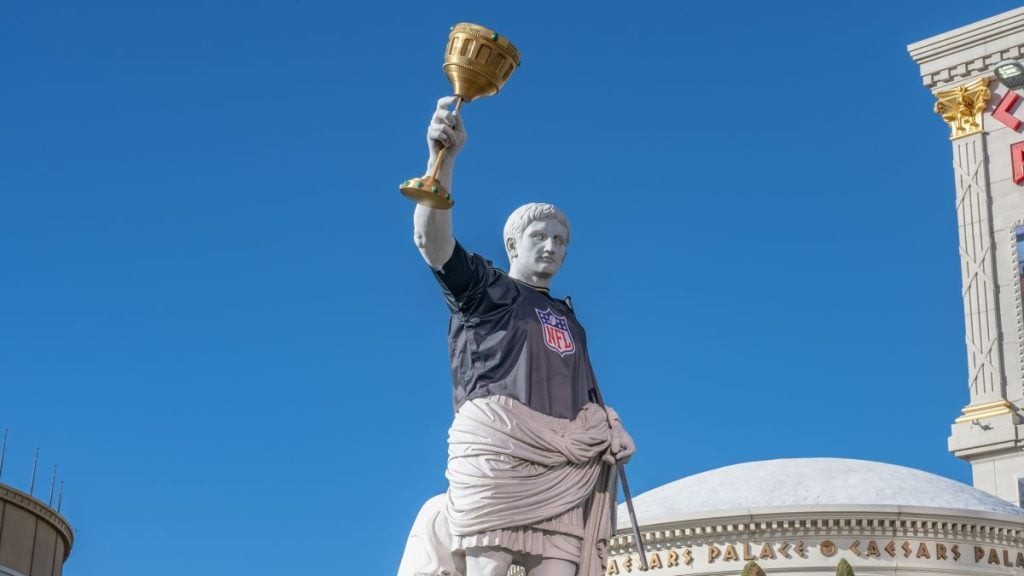
Caesars might not be the only Las Vegas casino giant to stop reporting publicly in the near future, if the rumors of MGM Resorts International’s potential acquisition by Barry Diller prove to have substance.
Mixed bag for Caesars in Q2
As for the numbers reported in Caesars comparatively brief public disclosure on Tuesday, total net revenues for the quarter ended June 30 came in at $3.0bn, 3% better than the $2.9bn reported in the same period last year. However, adjusted EBITDA slipped 3.7% year-over-year to $920m.
Its bottom-line performance varied widely by segment:
- Up: The Regional portfolio’s revenue grew 9.4% year over year to $1.57bn and swung from an $11m loss in Q2 2025 to a $23m profit, while the Caesars Digital operation made $351m in revenue, a slight increase of 2.3% on Q2 2025.
- Down: For the Las Vegas segment, revenue dipped 3.5%, adjusted EBITDA dropped 12.6%, and net income fell 26.4% to $156m, although it was still by far the biggest revenue generator of any part of Caesars’ business at $1.02bn. Meanwhile, the company’s Managed and Branded revenue fell 23% to $57m.
However, despite Caesars Digital’s modest revenue growth, profitability declined and adjusted EBITDA fell 15% to $68m, which the firm put down to more investment in customer acquisition and marketing.
Caesars ended the quarter with a total net debt of $10.8bn, although it had $965m in cash. It did not offer any forward-looking guidance in the earnings release.