
The prediction markets news cycle rarely seems to slow down.
To help you keep up with it all, SBC Americas rounds up some of the developemnts you may have missed each Friday in ‘Prediction Markets Weekly’.
Oklahoma tribe denies Kalshi claim of partnership
Last week, we noted Kalshi’s claims that it partnered with several more Indian tribes, including the Alabama-Quassarte Tribal Town of Oklahoma, with a view to launching prediction market products with them.
Oklahoma Indian Gaming Association (OIGA) Chairman Matthew Morgan commented on the reports, stressing that while some non-OIGA member tribes signed contracts with Kalshi, the association believes such actions undermine the Indian Gaming Regulatory Act (IGRA) and Oklahoma tribal-state compacts.
The plot thickened (and twisted) this week, as the Alabama-Quassarte Tribal Town publicly denied signing such an agreement with Kalshi, according to statement shared by Indian Gaming Association (IGA) Conference Chair Victor Rocha.
“Any suggestion or assertion by any individual or organization that Alabama-Quassarte Tribal Town, the Governing Committee or any member of its legal leadership, or any representative of the Tribe, has engaged in an agreement or signed a contract to partner with any prediction market gaming apps, including Kalshi, is false,” read the statement, which Rocha linked to the nation’s Chair Samuel Marshall Jr. “The Tribal administration of the Alabama-Quassarte Tribal Towns position is clear: prediction markets undermine the Indian Gaming Regulatory Act and Oklahoma/Tribal State compacts by allowing illegal Class ll gaming to diminish the sovereignty of Tribal nations and undermine revenue streams critical to Tribal government programs and services.”
Morgan subsequently said the OIGA “applaud[s] their tribal leadership’s position on prediction markets.”
At the time of writing, Kalshi’s website still hosts the announcement about the Alabama-Quassarte Tribal Town agreement.
Polymarket asks court to block New York case
Less than three weeks after New York Attorney General Letitia James sued Polymarket in the state’s Supreme Court, seeking a permanent injunction and potentially billions of dollars worth of financial recompense for its sports prediction markets, the company asked a federal judge for a preliminary injunction against James and other New York officials.
Polymarket filed the request on Monday, Oct. 12, writing that it believes it deserves an expedited response “because of ongoing irreparable harm” it is suffering as a result of New York’s actions.
The company previously responded to James’s lawsuit by immediately suing New York officials in federal court.
Its chief legal officer, Neal Kumar, told SBC Americas in late September that New York’s leaders conducted a “media hit” on the New York City-headquartered company.
“While the AG’s decision to copy/paste a recycled lawsuit is disappointing, we’ll fight for our users,” Kumar said. “We didn’t run to preemptively sue the state — we chose to engage with them directly on the substance and address their concerns. They preferred the media hit. Any time the AG’s office wants to swing by, our door is open for a conversation about how we protect consumers and offer fair, transparent and legal markets.”
Google blocks prediction market ads in 5 litigating states
Google updating its advertising policies recently to include dedicated rules for prediction markets. As part of that, it stresses that “products and ads [must] comply with all local laws, financial regulations, industry standards and all other Google Ads Policies.”
Of particular note, a dedicated prediction markets advertising page states that Google now prohibits such companies from advertising in five states, all of which are engaged in legal battles with the industry in court:
- Connecticut
- Michigan
- Nevada
- New York
- Ohio
All of those states are tangling with prediction markets in court. Gaming regulators in Michigan and Nevada touted success in getting sports event contracts forced offline in their jurisdictions.
Google, which partners with with Kalshi and Polymarket, began explicitly allowing prediction markets registered with either the Commodity Futures Trading Commission (CFTC) or the National Futures Association (NFA) to advertise as financial products in January 2026. From the outset, it excluded Nevada from that policy.
Nevada gaming chair Dreitzer ramps rhetoric
Speaking of Nevada, the leader of the state’s gaming regulator is talking a lot about prediction markets.
Nevada Gaming Control Board (NGCB) Chair Mike Dreitzer has been a strong critic of sports event contracts since they first grew in popularity. His agency is one of the most active in taking the fight to companies including Kalshi.
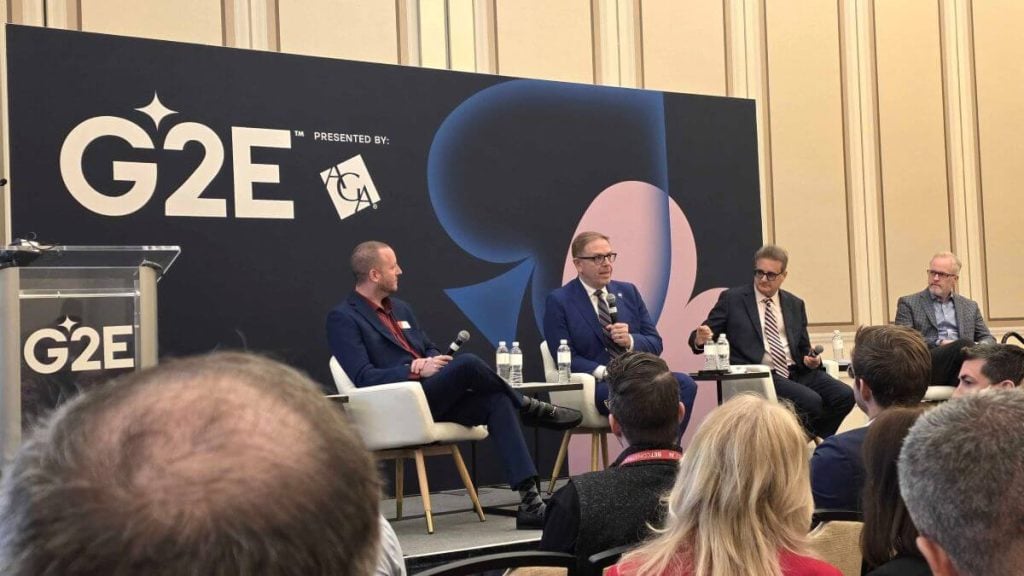
Speaking on a panel at a generally anti-prediction markets Global Gaming Expo (G2E) in late September, Dreitzer was full of soundbites:
- “What exactly is innovative about what they do? Is it innovative that they take bets from 18, 19, and 20-year-olds? Is it innovative that they take bets in states where it’s a felony to do so? Is the fake liquidity the innovative part?”
- “The bottom line is that crime and deception are not innovation. And the reporters in the audience, please quote me on that.”
- “We’re very proud in Nevada of the fact that we are a sports prediction-free state … We’ve been strong because it’s illegal gambling, and it’s that simple. They try to make it more complex than that, but it’s that simple.”
This week, Dreitzer joined Rocha, IGA Executive Director Jason Giles and tribal gaming attorney Scott Crowell on ‘The New Normal’ webcast, where he used much of the same rhetoric in a prediction markets-focused conversation.
“Doing it in states in which it’s a penalty or a violation of the penal code, that’s not innovation,” Dreitzer said. “I don’t want people to confuse innovation with committing crime and having an unlicensed sportsbook … This idea that they’re innovative and we’re just protecting the industry against innovation is complete nonsense.
“I’m looking at two apples, but they are trying to gaslight me to convince me that one of the apples is a banana.”
Kalshi announces integrity deal with Signify
Meanwhile, Kalshi announced its latest measure aimed to bolstering its integrity and security measures, unveiling a partnership with Signify Group intended to protect athletes and coaches from online abuse, threats, and harassment linked to its sports markets.
Kalshi vowed that users who are found responsible for abusive or threatening behavior could face enforcement action, including permanent account closure. The company also said that it would consider sharing relevant evidence with sports organizations and law enforcement as and when it deems appropriate.
Kalshi already works with entities including Integrity Compliance 360 (IC360) and the National Council on Problem Gambling (NCPG). The collaboration with Signify includes its participating in Signify’s Threat Matrix and the Bad Actor Program, a joint initiative established by Signify and IC360. Those tools are already utilized by some state-regulated sportsbooks.
Kalshi Head of Enforcement Robert DeNault said the partnership “gives us another important tool to identify unacceptable behavior and take action against those responsible.”
Signify Group CEO Jonathan Hirshler added that Kalshi’s commitment to protecting athletes and coaches and tackling online abuse and threats “represents an important step forward in creating a safer environment across sports.”
“As prediction markets continue to grow, it is important that athletes and coaches are protected from abuse and threats, including behavior that may be linked to a person’s financial interest in a sporting outcome,” he added. “Kalshi has rightly chosen to confront that directly.”