
SAN DIEGO, CALIF. — Prediction markets were naturally going to be a prominent focus at this year’s National Council of Legislators from Gaming States (NCLGS) Summer Meeting. On Thursday, the key question permeating the room at the Hard Rock Hotel San Diego was: What can legislators do about them?
Lawmakers have various ideas about how to try to tackle the swell of sports event contracts. Several states have introduced bills that attempt to outright ban or otherwise severely limit them, while others including Kentucky, Illinois, and North Carolina have passed legislation to try to tax them and/or regulate them like licensed sportsbooks.
Then there’s Congress, where several prediction market-related proposals currently sit in the Senate and the House, mostly focusing on the mainstream media headline issue of insider trading.
Will any of this action make a meaningful dent?
Ex-Chief of Staff Mulvaney: Congress or CFTC won’t save states
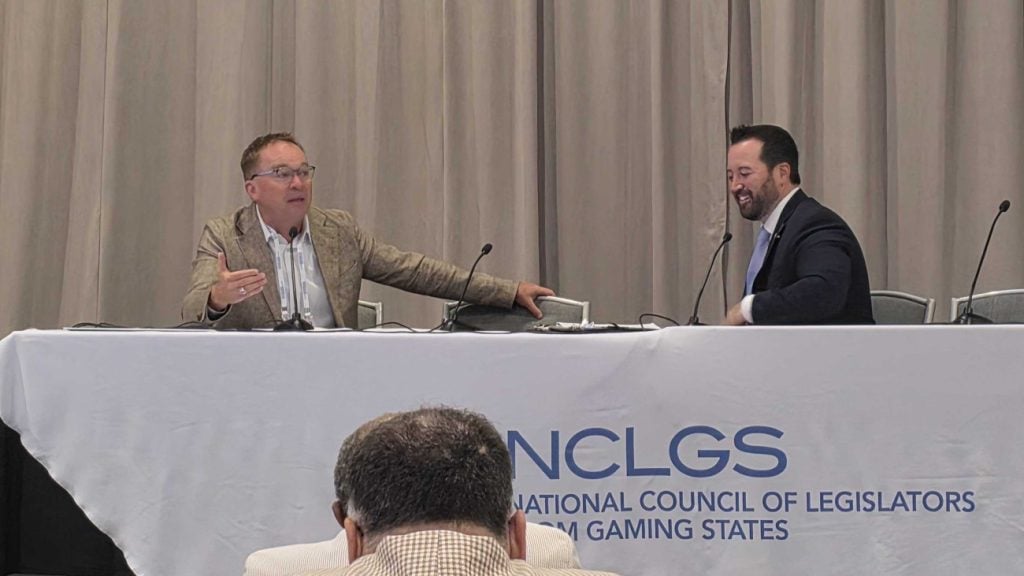
The issue was top of mind in the very first session of the first day of the NCLGS conference, a one-on-one chat between NCLGS President and West Virginia Delegate Shawn Fluharty and ex-White House Chief of Staff Mick Mulvaney.
Mulvaney is now the Executive Director of the lobbyist group Gambling Is Not Investing (GINI), which opposes the idea of the Commodity Futures Trading Commission (CFTC) regulating sports contracts at the federal level. He told the room that he believes the CFTC is simply not set up to do that. “It’s like telling a baseball umpire to referee a soccer match,” he opined.
Mulvaney also made it clear that he does not think that any states should be pinning their hopes on either the CFTC changing its stance on sports contracts or on Congress blocking prediction markets.
“Federal legislation is not going to be your fix,” he told Fluharty and attendees, describing the current federal political set-up as “not a healthy place for lawmaking.”
Having served as acting Chief of Staff for a period during Donald Trump’s first administration, Mulvaney knows the President pretty well. He told the room that Trump “never admits he’s wrong on anything,” and warned that any idea of the CFTC changing the course it has set out and defended in court — that sports event contracts are not sports betting and that they fall under its federal remit, which superseded state gaming laws — should be laid to rest.
States may be ‘tacitly approving’ prediction markets
The latest major state action came just this week, when North Carolina Gov. Josh Stein signed the Tar Heel State’s new fiscal budget, which includes a 6% tax on prediction markets. Incidentally, that is significantly lower than the revenue-based tax rate imposed on licensed online sports betting operators, which the budget raised from 18% to 23%.
But while that budget added the tax on prediction markets, it did not include any regulatory or licensing requirements for those companies, unlike how it treats sportsbooks.
Mulvaney seemed to question how quickly North Carolina came up with that approach, noting that it took the state “years and years” to approve the licensed online sports betting it launched in 2024.
Speaking just after Mulvaney on a separate but related NCLGS panel, Pechanga Band of Indians General Counsel Steve Bodmer said that by approving such legislative measures, states like North Carolina are “tacitly approving” prediction markets’ gambling-like products, which essentially compete with state-licensed gambling operators without the same rules.
Don’t waste your time with bills, says Nevada regulator
In the background, numerous states across the U.S. continue to fight a litigation war with the CFTC and/or specific prediction market operators like Kalshi and Polymarket. Kentucky and Illinois’ approved bills to regulate and tax prediction markets are already subject to court challenges, and it would not be surprising to see the same course of action in North Carolina.
Delivering a keynote speech later on Thursday, Nevada Gaming Control Board (NGCB) Chairman Mike Dreitzer stressed that, in his view, states are wasting time with prediction markets legislation, given the fundamental question being contested in the courts of whether the CFTC’s federal authority pre-empts state gaming laws.
Most in the industry predict that a Supreme Court ruling in the future will settle that issue, although exactly how long that will take remains a subject of debate.
Light & Wonder Head of Government Affairs and Legislative Counsel Howard Glaser was forceful in imploring legislators not to count on that process. “We would be deluded to sit on our hands and wait for the Supreme Court,” he said. “The barbarians would not be at the gate; they would be over the gate.”
States should speak up, and target predictions support system
The NCLGS conference panelists had some suggestions for how states can tackle the issue in the shorter term.
Glaser posited that if targeting prediction market operators directly is not working effectively enough, legislators should go chasing after “the supporting ecosystem” of entities that work with them, such as marketing affiliates, media partners, and payment processors.
“You cannot run a prediction market if you can’t process the payments. If you can’t touch prediction market operators, get at the supporting ecosystem. This is a free field for you, and I really believe it is the strongest possible action you could take while you wait for the Supreme Court.”
Meanwhile, Mulvaney urged all the legislators present at NCLGS to speak up, and to choose their delivery methods wisely.
Using the example of the public comment period on the CFTC’s proposed rules for prediction markets, which take a lenient stance on sports contracts in general, he emphasized that putting things on the record in writing makes a difference and can make it easier to challenge things in the future. He suggested that legislators unite to file such communications collectively, opining that those calls would be harder to ignore.
He also suggested that, given that Trump is “maybe the biggest consumer of news I have ever met,” state legislators may want to turn to more mainstream media and news avenues to fight their fight against sports prediction markets. “There are ways to communicate directly with Donald Trump and it’s through those publications,” Trump’s former Chief of Staff said.