
It’s been another week of lawsuits and more suits in the world of prediction markets.
Kalshi suffered a court loss in Michigan and then sued Ohio over the state regulator’s planned $5m fine, while Polymarket sued New Mexico citing that state’s own lawsuit against Kalshi. Meanwhile, in New Jersey, a key committee in both legislative chambers said yes to the idea of taxing prediction market platforms.
But, as usual, that’s not even the half of it. Each week in Prediction Markets Weekly, we round up some other news you might have missed.
Michigan walks out on NCPG
We start by heading straight back to Michigan. On Thursday afternoon, news emerged from ESPN’s David Purdum that the Michigan Gaming Control Board (MGCB) is quitting the National Council on Problem Gambling (NCPG) over the council’s partnership with prediction market Kalshi.
MGCB Executive Director Henry Williams wrote to NCPG Executive Director Heather Maurer on Wednesday to formally withdraw the state gaming regulator from the NCPG. Stating that the MGCB’s membership of the NCPG is now “inconsistent” with its own mission and responsibilities, Williams asked the council to remove all references to the Michigan regulator’s membership of or affiliation with the council.
“By partnering with a company that numerous states, including Michigan, are actively litigating against for disregarding state gaming laws, NCPG directly undermines state enforcement actions and risks weakening the positions of state regulatory bodies nationwide,” wrote Williams. “… Additionally, NCPG’s partnership with Kalshi also creates substantial confusion by suggesting to the public that Kalshi is subject to the same consumer protections, licensing requirements, and regulatory oversight as licensed sports betting operators. It is not…
“I regret that this action is necessary but trust you understand the MGCB’s need to ensure that it is not associated with organizations that are affiliated with companies engaged in illegal gambling,” concluded Williams.

Michigan has been one of the most staunchly anti-prediction market states since such platforms began expanding into sports in earnest.
NCPG Director of Public Affairs Cait Huble told SBC Americas that the council is “disappointed” by the MGCB’s decision. She emphasized that the NCPG has “maintained a neutral position” on legal gambling for more than 50 years, and that NCPG membership or partnership does not constitute endorsement or influence NCPG’s operations or policy positions.
Mud-slinging in Maryland
A local media report in Maryland sparked a furor this week. An FOIA request seemingly unearthed the fact that a letter the Maryland Lottery and Gaming Control Agency (MLGCA) sent last year to the Commodity Futures Trading Commission (CFTC) to sound the alarm about prediction markets was strikingly similar to a draft authored by the American Gaming Association (AGA).
The Coalition for Prediction Markets, which includes Kalshi and Crypto.com among its members, immediately went into PR overdrive, widely distributing a press release via email in which it claimed there is “troubling evidence” that state gaming regulators are working hand-in-hand with casino lobbyists to attack prediction markets. The coalition sent a letter to 20 state auditors and inspectors general, as well as the federal DOJ and FTC,
“We assume that these documents are but one example of a wider and more systemic scheme involving numerous participants,” said the coalition. “… The AGA is orchestrating, or at a minimum coordinating, the broader, multi-state scheme that the Maryland emails reveal.”
Numerous outlets picked up the prediction market coalition’s rhetoric and ran stories based on it. Frankly, the fact that state gaming regulators and the AGA are each anti-prediction markets should not surprise anyone. They’ve made it plain in public on numerous occasions, after all, just as prediction markets and the CFTC have made clear they feel states are overreaching. It’s a whole lot of mud-slinging, and it leaves everyone dirty.
Supreme Court? This is New Jersey calling…
While New Jersey lawmakers move to regulate and restrict prediction markets, the state is trying to accelerate the litigation battle’s journey to the Supreme Court.
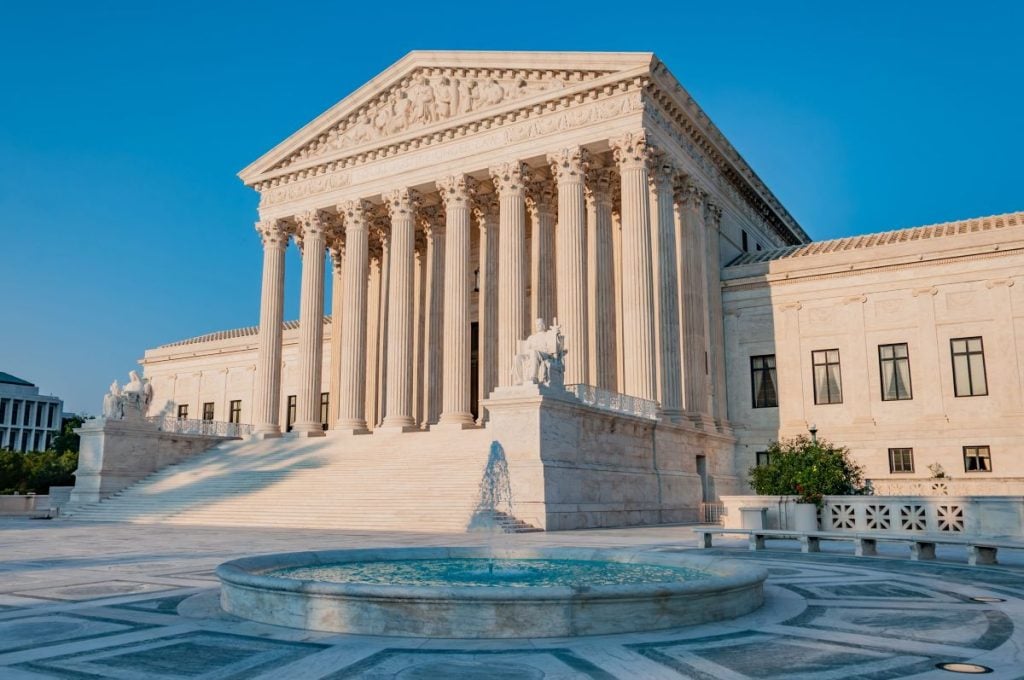
The Press of Atlantic City’s Wayne Parry wrote that the New Jersey Attorney General’s Office filed paperwork with the Supreme Court on Friday seeking an extension of the deadline for asking the nation’s highest court to take the case. Garden State Solicitor GeneralJeremy Feigenbaum wrote that the state is considering a formal request for the highest court in the U.S. to hear the case.
The general assumption is that this will all end up in the Supreme Court one way or another and at one time or another, but New Jersey is pushing hard to get it there sooner rather than later.
New Jersey is one of the OG court battlegrounds for the sports event contracts issue, and the ante was upped in April when the Third Circuit federal appeals court denied the state’s attempt to ban Kalshi, Polymarket and others from operating in the state.
Nevada Supreme Court pushes Kalshi away
Meanwhile, over in Nevada, the state’s Supreme Court on Wednesday denied Kalshi’s emergency motion for a stay pending appeal.
The prediction market operator therefore must implement geofencing technology to block certain event contracts from being accessible to Nevadans, including sports. A Carson City state court granted the Nevada Gaming Control Board’s request for a temporary restraining order against Kalshi in March and subsequently directed the company to prepare to geofence out the state, something Kalshi has repeatedly complained is prohibitively expensive and complicated to do.
The NGCB has requested that a court hold Kalshi in contempt, alleging that it has neglected to implement adequate geolocation measures in the Silver State despite being told to do so by a judge.
Meta flirted with idea of buying Kalshi
Last week’s Prediction Markets Weekly included the mainstream media report that Mark Zuckerberg’s Meta has begun developing an experimental prediction market app “similar to Polymarket and Kalshi” that will begin with free play only.
It turns out that he considered taking the shortcut route, as NPR reported this week that before Zuck told employees to build a standalone prediction market app, he suggested buying Kalshi. Zuckerberg reportedly met with Kalshi CEO Tarek Mansour last year about a possible takeover, but things went no further than a first date.
NPR reported that a source claimed that a possible reason that talks didn’t advance is that Meta considered Kalshi’s legal and ethical status “too messy.” Meta, of course, has a spotless record when it comes to gambling issues.