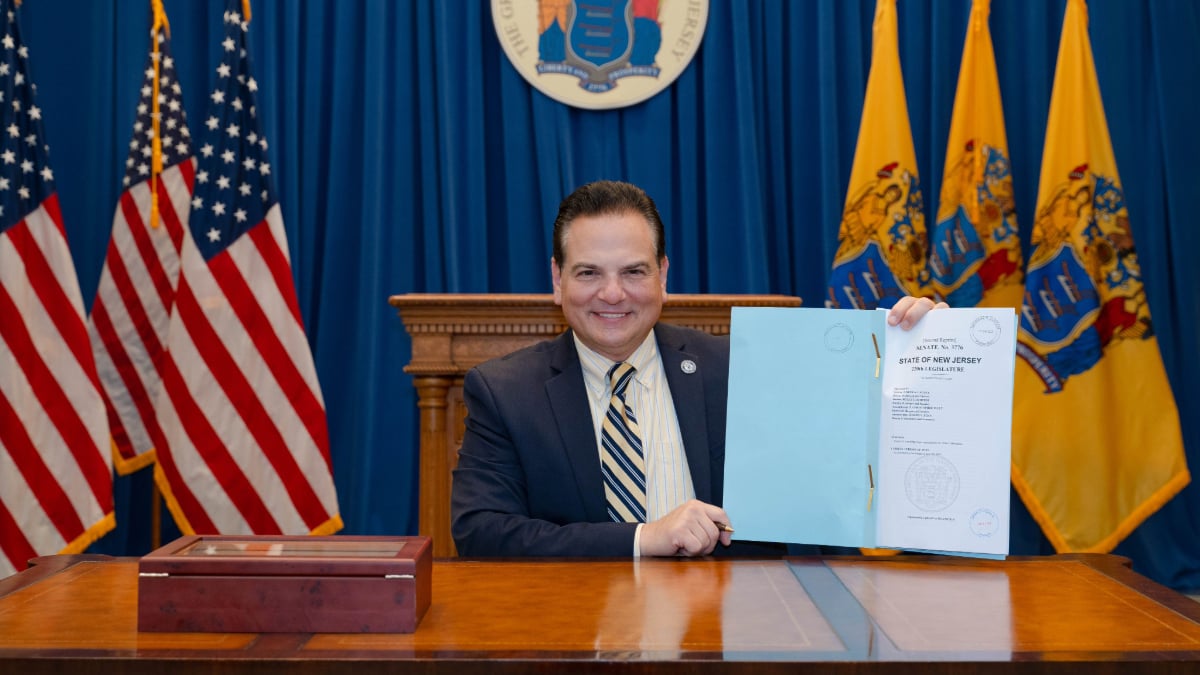
A pair of lawmakers in New Jersey introduced legislation aimed at regulating prediction markets and creating a pathway for the platforms to legally offer sports event contracts.
Sens. Nicholas Scutari and Paul Sarlo introduced Senate Bill 4447 on June 11 to regulate prediction markets at the state level, despite ongoing legal and regulatory disputes over whether the platforms are only subject to federal regulation by the Commodity Futures Trading Commission (CFTC) under the purview of the Commodity Exchange Act (CEA).
“Because these prediction markets are registered and operate under the Commodity Exchange Act, they assert that they need not comply with state law,” reads SB 4447.
“As a result, prediction markets are able to offer wagers without the approval of the appropriate gaming authorities, and offer wagers to persons under the age to legally wager in this state, pay lower tax rates than the operators who offer the exact same wagers but who have received proper licensure to do so, and avoid the reporting and compliance requirements provided by state law.”
New Jersey considers prediction market bill after ruling
The bill comes after the U.S. Court of Appeals for the Third Circuit ruled that Kalshi’s sports event contracts fall under the purview of the CFTC and the CEA. The legal dispute was initiated after the DGE sent a round of cease-and-desist orders in March 2025 to Kalshi and Robinhood.
Kalshi responded to the C&D order by suing the DGE. A request from Kalshi for a temporary injunction was granted, with the DGE appealing the decision.
The appellate court ruled in a 2-1 vote that the DGE does not have the authority to prohibit Kalshi from offering sports event contracts in the state, as the CEA grants “the CFTC exclusive jurisdiction over ‘swaps. . . traded or executed on a [DCM].’” The DGE argued that the prediction markets offered “unauthorized sports wagering” in the Garden State.
The decision marked the first time a federal appellate court took that approach when dealing with legal disputes concerning the delivery of sports event contracts.
New Jersey regulator would oversee prediction markets
The New Jersey Division of Gaming Enforcement (DGE) would serve as the sole regulator of prediction markets under a bill that also establishes guidelines for prediction markets. Scutari and Sarlo’s prediction market bill provides a regulatory framework for the platforms to operate in New Jersey, but with strict conditions on what markets can be offered.
The measure explicitly bans three categories of event contracts:
- Catastrophic event markets
- Death markets
- Political markets
“Each of these markets violate or encourage the violation of longstanding state policies that protect the health, safety, and welfare of the state’s citizens,” continues the measure.
Scutari and Sarlo also included the ban on political markets in New Jersey amid recent reports of “public officials using insider information obtained in the course of their public service to place wagers on prediction markets to enrich themselves.” SB 4447 explicitly bans state officers, employees and immediately family from trading political markets.
Violators are subject to a fine of up to $10,000, 18 months of confinement, or both.
How responsible gaming fits in NJ prediction markets bill
New Jersey’s prediction market bill also establishes responsible gaming requirements. Prediction markets must work with the DGE to deploy several RG measures and policies:
- Age and identity verification procedures
- Self-exclusion tools
- Daily, weekly, or monthly deposit limits
- Displays of problem gambling helplines
SB 4447 also establishes penalties for failing to adhere to the proposed rules. The bill allows the state’s attorney general to “petition the court for an injunction to stop any operation of a prediction market that violates these basic requirements.”
Operators who refuse to comply are subject to a fine of $1 million per day.
How do sports event contracts fit into New Jersey bill?
The bill to regulate prediction markets in New Jersey directly addresses the proliferation of sports event contracts.
“The bill also regulates athletic event markets in a similar manner as sports wagering,” reads Scutari and Sarlo’s bill.
The prediction market regulation bill in New Jersey proposes implementing a minimum age limit of 21 for sports event contract trading. The provision would require prediction markets, including Kalshi, that allow traders between 18 and 20 years old to block those users from accessing their platforms when providing sports event contracts in New Jersey.
Under Scutari and Sarlo’s bill, prediction markets are required to hold a sports wagering license to offer sports event contracts in the state. Prediction markets are also allowed to offer sports event contracts if they are licensed as an athletic event market operator.
Tax rates in New Jersey bill
The bill also includes specific tax rules for non-sports and sports event contracts.
- General event contracts face a 10% surcharge on revenue
- Sports event contracts are taxed at a 19.75% rate — the same rate as sports wagers
- In addition to the tax rate, sports event contracts also face an additional 10% surcharge
- The bill effectively taxes all sports event contracts at a 29.75% rate
The measure also requires vendors that offer goods and services to sports wagering licensees in New Jersey to be licensed as an athletic event market operator in the Garden State.
- Vendors file license applications with the DGE
- The applicants are responsible for the full costs of a license, including investigative costs
- An initial athletic event market operator license costs $5 million
“Any person who operates an athletic event market without approval of the division will be guilty of a crime of the fourth degree, will be subject to a fine of not more than $25,000 and, in the case of a person other than a natural person, to a fine of not more than $100,000,” reads the prediction market bill.
SB 4447 was introduced last week and referred to the Senate Budget and Appropriations Committee for consideration.
Another New Jersey prediction market bill
SB 4777 joins another legislative effort to address prediction markets in New Jersey.
In February, Sens. Joseph Cryan and Shirley Turner introduced Senate Bill 3692. The bill is similar to Sarlo and Scutari’s measure by attempting to ban event contracts on politics, deaths, and catastrophic events. SB 3692 also allows prediction markets to deliver sports event contracts if they obtain a sports wagering license in New Jersey from the DGE.
The bill taxes sports event contracts at the same rate as online wagering, but the measure does not include any language that includes surcharges for general and sports contracts.
It has stalled after being introduced and referred to the Senate State Government, Wagering, Tourism & Historic Preservation Committee that same month.
There are other states outside of New Jersey considering prediction market regulation bills:
- Ohio’s Senate Bill 430 aims to amend state law to constitute sports event contract trading as sports betting that is subject to state regulation
- House Bill 2497 in Pennsylvania proposes imposing a 20% tax on event contracts and creating a regulatory framework powered by the state’s gaming regulator.
- Lawmakers in Illinois introduced House Bill 5059 as a measure that creates a regulatory division for prediction markets while banning certain types of markets.
All three measures are pending in legislative chambers in their respective states.