

Many state lawmakers may tell you that the major sportsbooks like FanDuel and DraftKings are printing money. Longtime industry participants will tell you that booking sports is traditionally be a low-margin business.
Certainly sportsbooks hold has gone up in the post-PASPA era. Hold at Nevada sportsbooks in the era before the Supreme Court decision sat at around 5%. Nowadays, national hold sits around 9%, with market leaders FanDuel and DraftKings regularly posting double-digit hold in earnings reports.
Those numbers seem big in a vacuum, but it also is a reminder that, on average, 90% of the money sportsbooks take in goes back out to customers. The remaining 10% is not just money in the pocket of operators either.
During a presentation at the National Council on Lawmakers from Gaming States (NCLGS) Summer Meeting, FanDuel Head of U.S. Government Relations Cesar Fernandez presented some numbers to help the lawmakers in the room understand where the money goes in a sportsbook.
These numbers do not represent FanDuel’s exact profit and loss numbers, rather an industry average. Moreover, the tax rate is a blended average of effective tax rates across the country, as those rates can range wildly state-to-state.
$90 goes back to customers
Using a $100 bet as an example, the overview very clearly displays just how much does not even stay in a sportsbook’s account that long:
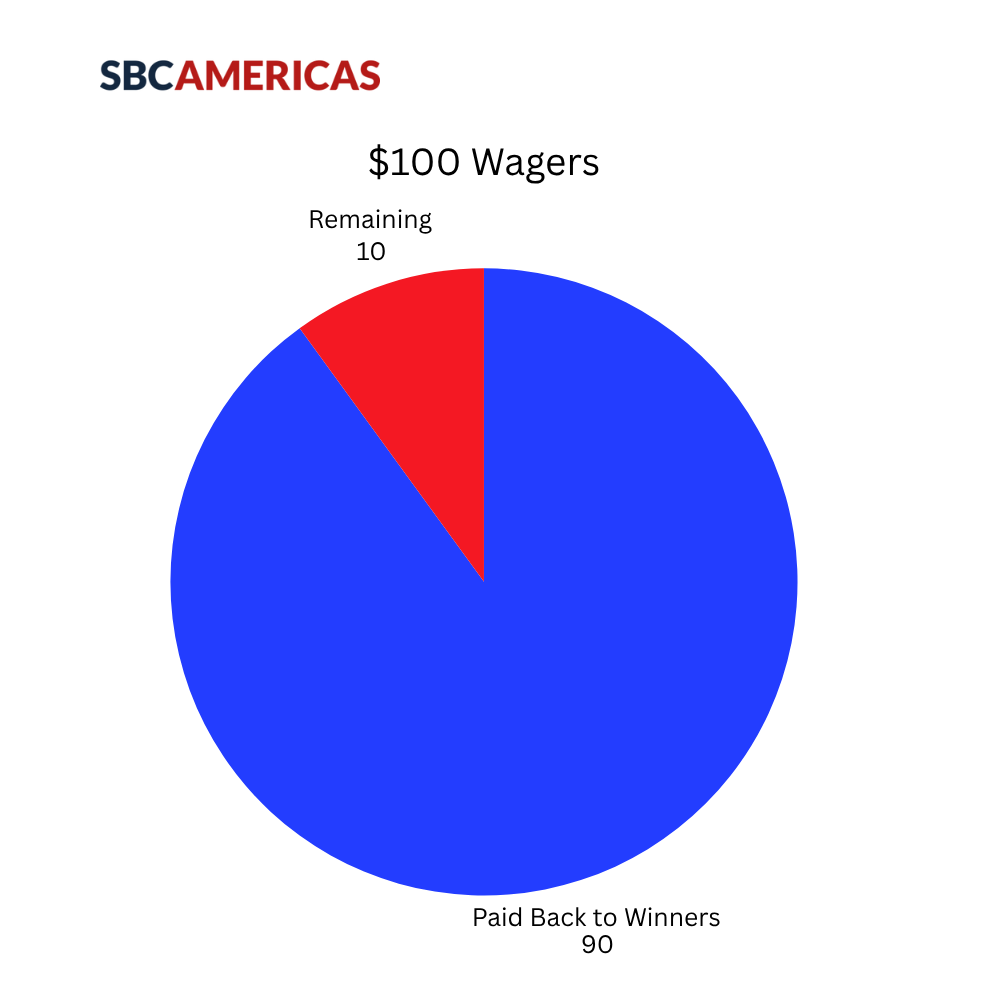
Let’s take a closer look at that remaining ten percent and how it breaks down:
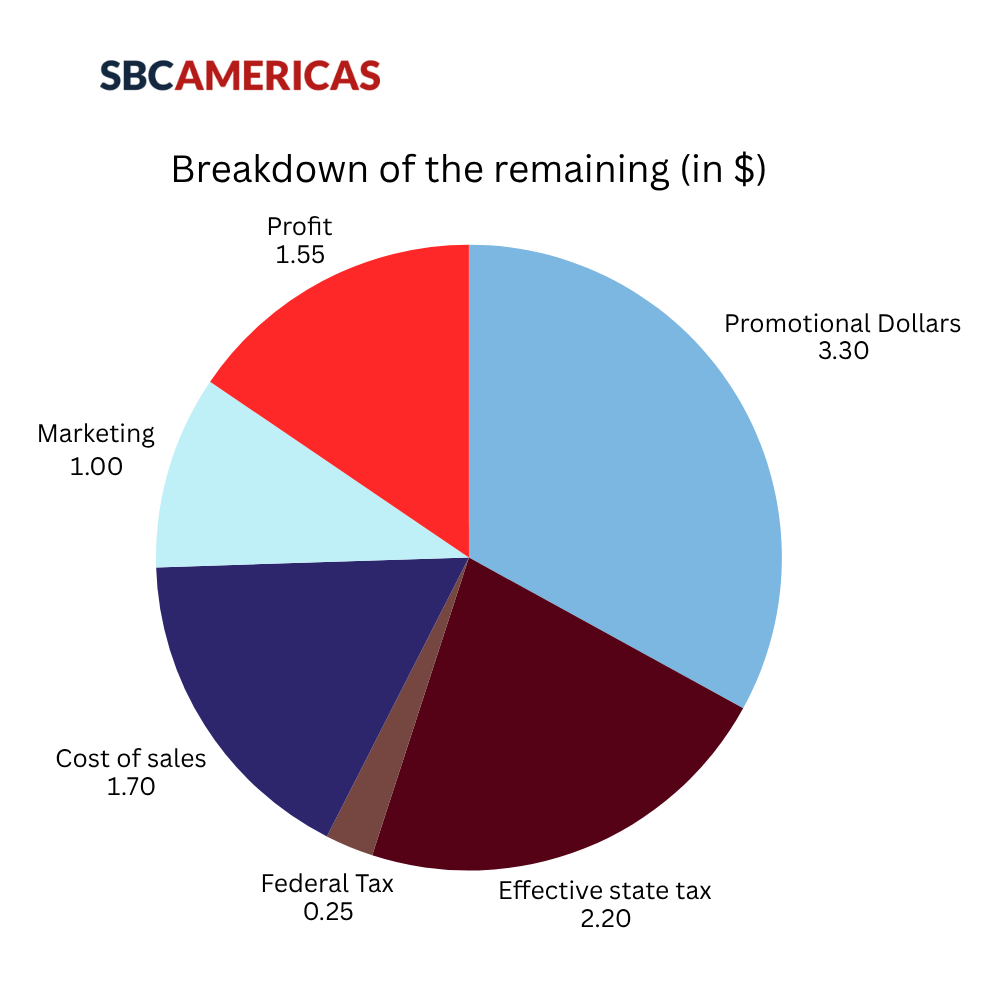
$3.30 pays for promotional costs
The biggest chunk of the money Fernandez attributed to promotional dollars. While some states allow tax write-offs on a percentage of promotional credit, many states require operators to pay taxes on bonus bets they hand out to customers.
“So this is a bonus bet. This is a sign that says ‘not money.’ So imagine I gave this not money to my friend Brad,” Fernandez explained to the crowd with his visual aid. “Brad uses ‘not money’ to bet the Yankees and the Yankees lose. That ‘not money’ comes back to the sportsbook, and we pay taxes on ‘not money’. So that’s why $3.30 of that $10 is not real revenue.”
Does that mean 33% of all bets are promotional credit? No. While there have been instances, such as the first month of sports betting in Ohio, where operators doled out that level of promotional credit relative to handle, typically it represents a much smaller chunk of overall bets.
The amount of promotional credit awarded is also seasonal, with start of football being a time where those numbers surge. Additionally, as a market ages and the market share grab dies down, promotional credit becomes less important and is used more sparingly. In the second month of Ohio sports betting, promotional spending dropped by 80%.
For example, in May 2025, Pennsylvania sportsbooks gave out $16.6 million in promotional credit and generated $655.4 million in handle, so promo credit accounted for just 2.5% of all bets.
In theory, with promotional spend going down as markets age, that $3.30 will shrink. Nonetheless, promotional credit is not going anywhere and the issue remains: even if it does not necessarily cost operators a full dollar to offer a dollar of promotional credit, having to pay taxes on something that isn’t actually revenue seriously eats into the bottom line.
$2.20 goes to state taxes
The next stop for the remaining $6.70 is the tax man, who takes roughly one-third of what is remaining with its $2.20 cut. Unlike promo costs, which theoretically should be going down, this number is on the rise, as more and more states like Illinois, New Jersey and Louisiana revisit and increase tax rates and implement new measures like surcharges on wagers.
Another factor impacting both taxes and the previous category are measures like the ones passed in Colorado and Maryland to gradually sunset promotional credit deductions from tax payments.
$1.70 goes to things like payment processors and KYC costs
Fernandez explained that $1.70 goes into a category he termed “cost of sale”. This includes more than just payment processor fees. This also covers the costs of other necessary tools in order to operate in a regulated environment such as geolocation, AML, KYC checks, responsible gambling initiatives and server hosting.
25¢ goes to the federal government
That leaves $2.80 in the piggy bank. A quarter of that money goes to the federal government to cover the excise tax. This tax is a bit of a mystery and a source of consternation for the industry. Nevada Rep. Dina Titus has been trying for a decade to repeal it. She noted in her efforts to figure out how this money is spent that no one at the IRS could give her a clear answer.
While Titus and the industry push to repeal the tax, others have proposed designating a purpose for it. One suggestion comes from Sen. Richard Blumenthal’s Gambling Addiction Recovery, Investment, and Treatment (GRIT) Act, which would take the estimated $350 million in excise tax revenue and put it towards responsible and problem gambling initiatives.
Another recent suggestion from Rep. Mike Rulli is to use federal excise funds to support Immigrations and Customs Enforcement (ICE) border patrol.
$1 pays for marketing
Ten percent of the money a sportsbook takes in on a wager goes back out towards marketing. Again, this is a number that should theoretically decrease as the market ages. Several operators like Rush Street and Caesars have discussed how they are scaling back on marketing efforts now that the mad rush of new states has subsided.
However, one could argue those funds aren’t being kept as marketing decreases. Rather, they are going towards another important aspect of the business: retention.
That leaves operators $1.55
What’s left? A whopping $1.55.
Using the Pennsylvania numbers from above as an example, gross gaming revenue on the month for operators was $76 million. Using the numbers provided by Fernandez though, the amount of money sportsbooks actually kept was just under $10.2 million.
It’s not a perfect example, as the hold for the month was a little higher than the 10% in the example, but it still helps put the huge numbers seen in the news in context.
What looks like billions is indeed just millions. Handle can often be confused for revenue by mainstream media, so nuanced conversations about adjusted vs. gross gaming revenue and promotional credit get lost in the shuffle.
For Fernandez and other government affairs staffers at sportsbooks, the challenge is on them to ensure lawmakers process the math and the difference between money and “not money”. It’s a tall order, but a necessary one so the measures like the ones operators are taking in Illinois that put the cost burden on consumers, are few and far between.