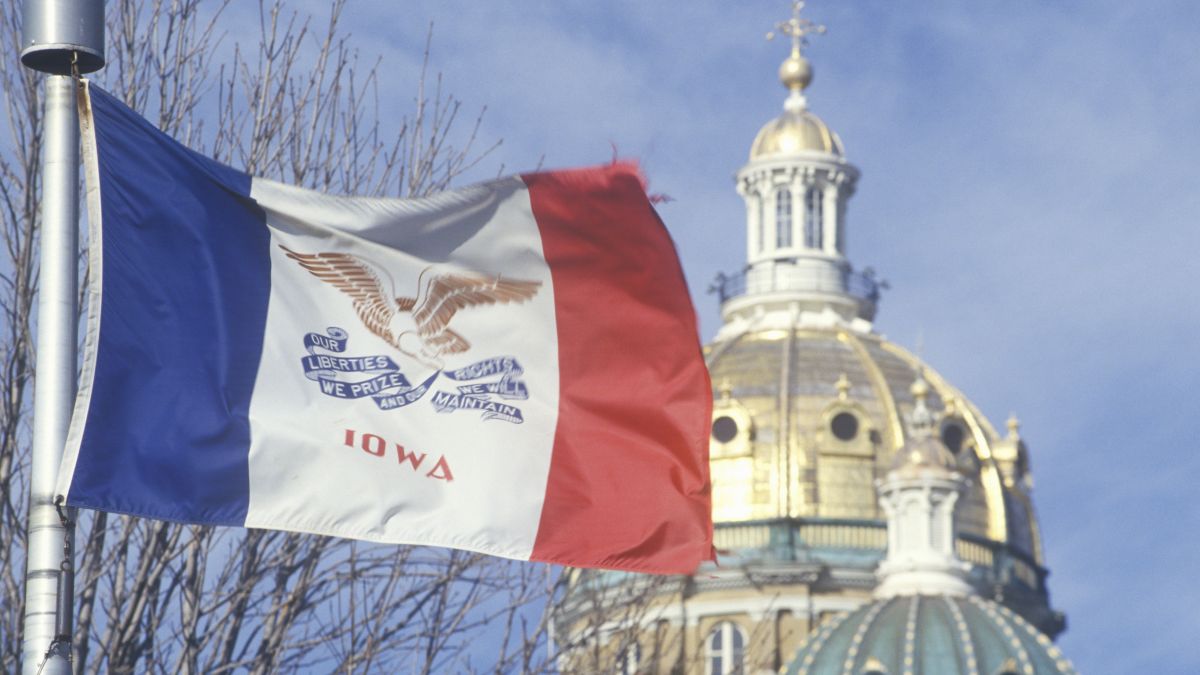
Kalshi filed a preemptive lawsuit against Iowa’s Attorney General and gaming regulator in federal court this week, citing concerns that it will soon face enforcement measures in the state.
The complaint filed in the U.S. District Court for the Southern District of Iowa on March 11 names Iowa AG Brenna Bird and the Iowa Racing and Gaming Commission (IRGC) and its leadership as defendants. Kalshi stated in the filing that the signs suggest there is a “substantial risk” that Bird will pursue enforcement action against Kalshi on behalf of the IRGC with the intent to stop the company offering event contracts in the state.
As it did in Utah, Kalshi preemptively filed the lawsuit before Iowa pursued any course of action such as a cease-and-desist order. Kalshi seeks a permanent injunction and declaratory relief to prevent Iowa from taking such measures against it in the future.
Kalshi sued Bird and the IRGC while Iowa legislators mull the idea of trying to regulate and tax the company and its competitors.
Kalshi faced Iowa ‘deposition’, alleges suit
As with all of Kalshi’s lawsuits, the central issue is whether theCommodity Futures Trading Commission’s (CFTC) federal oversight of derivatives trading under the Commodity Exchange Act (CEA) supersedes state gaming laws.
But the Iowa filing is the latest indication that Kalshi is now prepared to initiate court action based on perceived threats of enforcement action rather than measures that have already been taken against it.
In Utah, Kalshi’s preemptive lawsuit cited public comments made by Gov. Spencer Cox and AG Derek Brown, describing them as “threatened conduct” and claiming they signposted an imminent risk of enforcement.
In the Iowa lawsuit, Kalshi referred to comments allegedly made during a meeting last week with Bird. The company stated that it believed the meeting would be an introductory session to discuss pending legislation regarding prediction markets in the state, but that it was instead grilled by attorneys including Iowa’s Solicitor General about its business operations. The court complaint claimed that Bird referred to the meeting as being “like a deposition.”
Subsequently, Kalshi said, Iowa officials gave no assurances that it would not pursue enforcement action in the future. Kalshi was allegedly told that Iowa has been monitoring it for a long time. Last year, Bird signed amicus briefs in other Kalshi litigation in other states.
“Accordingly, defendants’ anticipated actions threaten impending and irreparable harm, not just to Kalshi, but to its customers and commercial counterparties,” stated Kalshi’s filing. “Shutting down Kalshi’s ability to offer event contracts in Iowa would threaten Kalshi’s viability and require devising complex technological solutions whose feasibility is entirely untested and unclear.”
Kalshi cites its court wins, while suffering other setbacks
In the suit, Kalshi pointed to ongoing court cases in Tennessee and New Jersey, where federal courts granted preliminary injunctions to the prediction market platform. In Tennessee, a federal judge agreed with Kalshi’s assertion that sports event contracts fall under the CEA’s definition of “swaps” and opined that Kalshi is likely to succeed in the full court case based on the merits.
But other federal court judges in the likes of Nevada, Massachusetts and most recently Ohio have ruled against Kalshi in their most recent issuances, denying Kalshi temporary relief against state officials.
In Ohio, Judge Sarah Morrison wrote on Monday that Kalshi failed to clearly show that it was entitled to the “extraordinary” preliminary injunctive relief it seeks. Morrison disagreed with the Tennessee judge, finding that the CEA’s definition of “swaps” does not extend to sports contracts.
Iowa legislators advance bill to regulate prediction markets
The prediction markets legislation that Kalshi referred to in its Iowa filing is Sen. Mike Klimesh’s SF 2085, which was filed in January.
That bill would not try to ban prediction market platforms outright, but wants to require platforms like Kalshi to apply for licenses from the state Department of Revenue. Klimesh’s proposal suggests charging companies a $10m licensing fee to do business in the state and taxing their revenue from event contracts at 20%.
That bill was approved by the Iowa Senate Ways and Means Committee on Wednesday. But Chair Sen. Dan Dawson noted during the committee hearing that the bill is a work in progress, and also referenced the potential difficulties of a state trying to regulate products that ostensibly fall under federal oversight.
“How do you tax a product that is otherwise legal that competes with a current product here in the state of Iowa?” Dawson asked.
But he noted that, as of right now, Iowans aged 18-20 years old can effectively wager on sports on national platforms despite Iowa gaming laws prohibiting that on state-licensed sportsbooks.
“This committee and the General Assembly have a responsibility to protect Iowans by taxing this otherwise legal product that is operating in a space that we have already regulated,” he concluded.
SBC Americas reached out to Kalshi to ask whether the company had any comments on the bill but had not heard back at the time of publishing.