
Editor’s note: This article has been updated with a clarification from the Arizona Department of Gaming.
Arizona could be the next state to implement a tax rate increase on sports betting under a suggested overhaul included in the state budget.
The $17.7 billion Executive Budget proposed by Arizona Gov. Katie Hobbs for FY2027 lays out a plan for the Grand Canyon State to increase tax revenue by charging sportsbooks more to do business.
She hopes that will help to mitigate a decline in federal funding with the passing of the One Big Beautiful Bill Act (OBBBA), which she stated “adds significant costs to the Arizona taxpayer by shifting expenses from the federal government to the state.”
Hobbs proposes mixed revenue and handle tax system
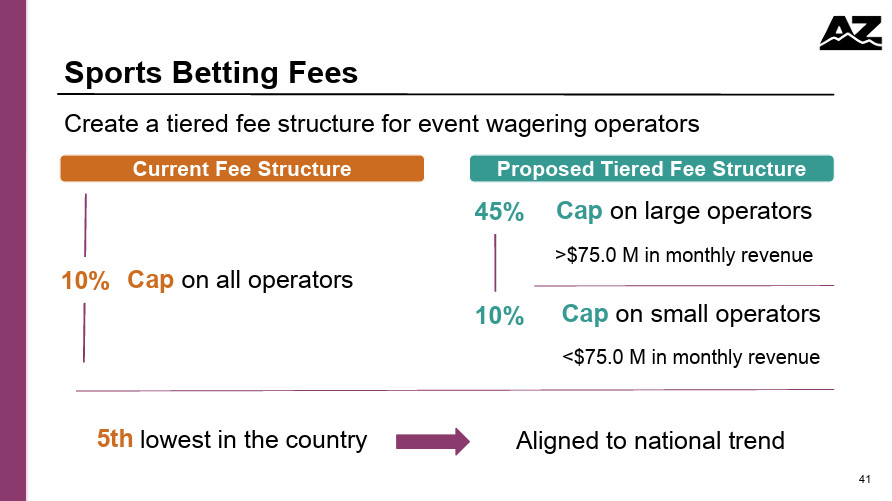
Hobbs’ executive budget proposes increasing Arizona’s tax rate on sports betting from 10% of revenue to 45% for the “large operators” in the state. The budget documentation said that the 45% rate would be levied on sportsbooks that reported more than $75 million in monthly revenue.
However, an Arizona Department of Gaming spokesperson confirmed to SBC Americas that while the budget presentation (below) linked the 45% tax rate to revenue, the $75 million threshold refers to gross event wagering receipts, or handle, as reported monthly by the ADG. By that metric, FanDuel, DraftKings, and BetMGM would be on the hook to pay the new rate under the most recent revenue report available (November 2025).
Operators that do not eclipse $75 million in average monthly sports betting handle would still be taxed at 10% of revenue.
The budget projects the tax hike would generate over $145 million in revenue in FY2027, rising to $202 million by FY2029. She also noted how other states have implemented tax increases amid the popularity of sports betting.
“As the industry changes, it is clear that not all operators are alike, with a handful of large operators capturing the majority of the market. Low privilege fees and generous tax deductions have allowed these operators to achieve record corporate profits,” continued Hobbs. “In response, states across the country have continued to modify and update their regulatory structures since 2021, raising fees and leaving Arizona in a competitive disadvantage.”
SBC Americas reached out to Hobbs and her office for comment on Arizona’s potential tax hike, as well as to the Sports Betting Alliance (SBA), whose membership includes bet365, BetMGM, DraftKings, Fanatics and FanDuel.
Arizona could follow in the footsteps of other US markets
Arizona would add to the growing list of U.S. sports betting states to implement tax rate increases on sports betting over the last two years.
In 2024, Illinois Gov. J.B. Pritzker approved a fiscal budget that taxes online sports betting operators on a sliding scale, up to a ceiling of 40% for operators who make more than $200 million in annual revenue to be taxed at 40%. Before Pritzker signed the fiscal budget, Illinois taxed online operators at a flat 15% rate. Last year, Illinois made additional changes to its tax requirements for online sports betting.
The Land of Lincoln also charges online sportsbooks at least 25 cents per wager, with the per-wager tax increasing to 50 cents after the first 20 million bets received in a year. Several operators in Illinois responded to the per-wager tax by imposing transaction fees or by raising the minimum bet amounts in the state.
Last June, then-New Jersey Gov. Phil Murphy and the state’s legislature agreed to a new 19.75% tax rate on gross gaming revenue for online casinos and sportsbooks. New Jersey previously imposed a 13% tax rate on sports betting, with online casinos at a 15% rate. That was a compromise, as Murphy had previously proposed a 25% tax rate for both iGaming and sports betting.
Louisiana and Maryland have also increased their online sports betting tax rates last year, from 15% to 21.5% and from 15% to 20%, respectively. Like Murphy, Maryland Gov. Wes Moore wanted a higher hike, initially proposing a 30% rate.