

New research from YouGov commissioned by the American Gaming Association (AGA) suggests that a large majority of the public believes that prediction markets are exploiting loopholes to offer an equivalent to sports betting.
A report published on Sept. 10, detailed conclusions from an online survey of a nationally representative sample of 2,025 registered voters conducted Aug. 1-8. The results found that eight in 10 respondents believe sports event contracts are effectively a form of gambling and should be regulated as such.
Asked whether they felt a sports-related event contract, such as whether the New York Yankees would win a particular game, more closely resembled gambling or a financial instrument like a commodity contract, 85% said it was more like gambling.
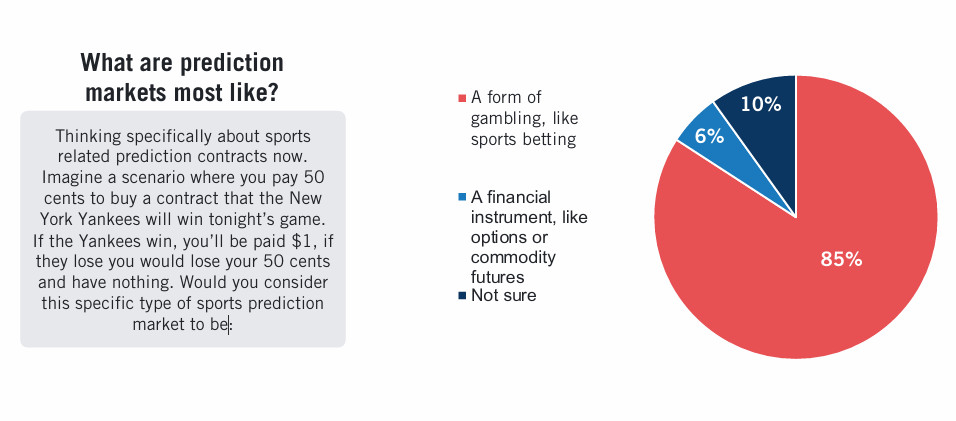
Other topline conclusions included that 80% of people either strongly or somewhat agreed that prediction markets should be regulated like online betting, and 69% think state residents should have a say on whether sports prediction contracts can be offered in their state.
Kalshi and other prediction market operators would likely argue that they already are regulated; the company has repeatedly stated that it believes the Commodity Futures Trading Commission’s (CFTC) federal authority to regulate derivatives markets supersedes state gaming laws.
Loopholes being exploited, says the public
Per the research results, the public has a dim view of how prediction markets operate, as 70% opined that the platforms are “exploiting a loophole” to offer sports bets without calling themselves a sportsbook and without being licensed to do so.
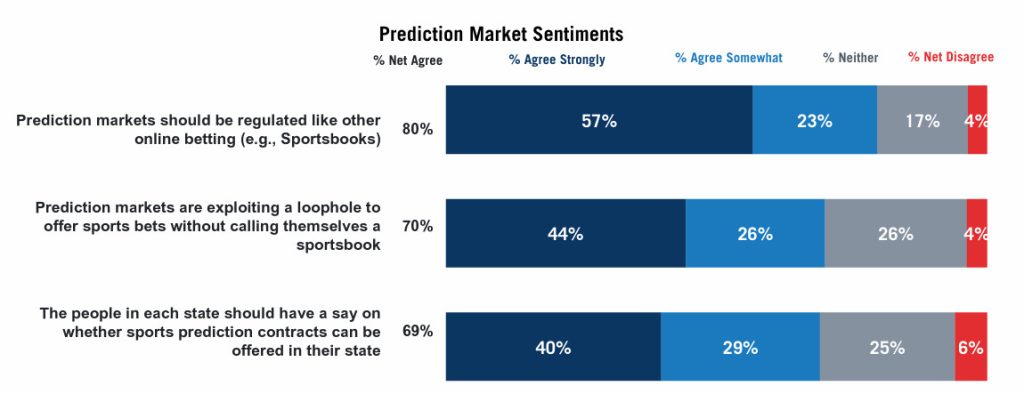
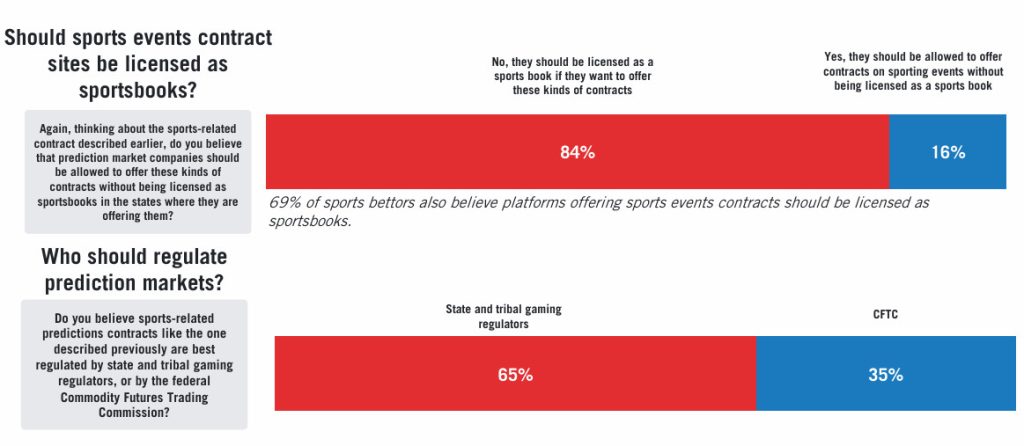
Only 16% of the people surveyed said prediction markets like Kalshi should be allowed to offer contracts on sporting events without being licensed as a sportsbook.
However, the proportion of respondents who said that a license should be necessary fell from 84% to 69% when only sports bettors’ opinions were considered.
When it comes to the question of who should regulate such platforms, 65% said oversight should rest with state and tribal gaming regulators, while 35% said the CFTC should have that authority.
“This research has made it clear: Americans know a sports bet when they see one — and they expect prediction markets offering sports event contracts to be held to the same rules and consumer safeguards as every other state-regulated sportsbook,” read a statement from AGA President and CEO Bill Miller. Miller opined that the results underscore the need for greater enforcement from both the CFTC and Congress.
The survey comes amid ongoing court cases, including one in California in which multiple tribes are suing Kalshi for advertising its product as sports betting that is “legal in all 50 states.”
An AGA spokesperson told SBC Americas directly that such marketing from prediction market operators “confirms what our research demonstrates and underpins our strong belief that if it’s gambling, it must only be permitted under the U.S.’s existing state and tribal regulatory frameworks.”
AGA references Kalshi legal counsel’s quote
The AGA also harkened back to a feisty debate at the National Council of Legislators from Gaming States (NCLGS) summer meeting. On a panel at the conference, lawyer and ex-CFTC employee Josh Sterling, who serves as an independent counsel to Kalshi, emphasized Kalshi’s steadfast belief that the CFTC has overarching authority over sports contracts.
Sterling also made comments on arguments around consumer protections. “People are adults, and they’re allowed to spend their money however they want it, and if they lose their shirt, that’s on them,” he said, a quote that garnered some attention within the industry.
The AGA directly quoted that remark in its report, using it as the basis for a question.
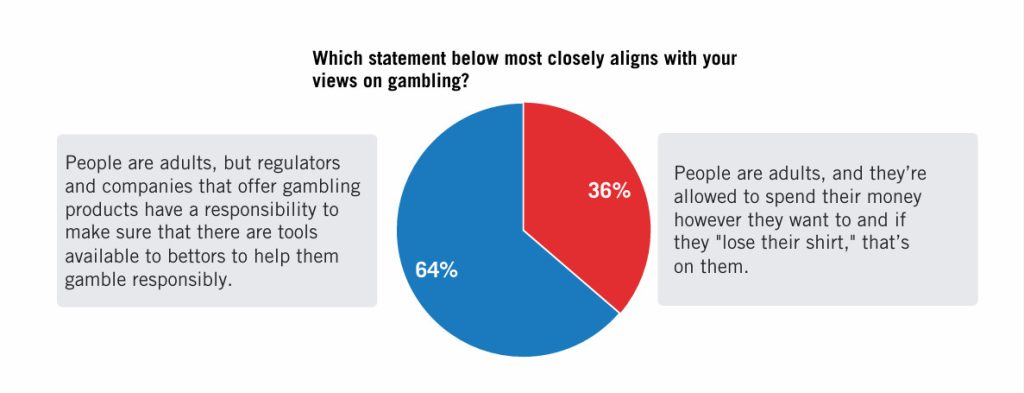
More than one-third of respondents (36%) said that Sterling’s statement aligned more closely with their views on gambling than the alternative statement.
In contrast, the remaining 64% identified more closely with the alternative statement, which was crafted for the purposes of the survey: “People are adults, but regulators and companies that offer gambling products have a responsibility to make sure that there are tools available to bettors to help them gamble responsibly.”
AGA also took pulse on sweeps
In addition to publishing the survey, the AGA has set up a new landing page on its website for all things related to sports event contracts, spotlighting what stakeholders and regulators have said about the products, as well as the AGA’s own research.
The sports event contracts report followed a report from the AGA earlier this summer that surveyed sweepstakes players abotu their opinions on the vertical.
That sweeps-related survey, published on July 31, found that 90% of sweeps players said that sweepstakes gaming is either definitely or probably gambling, and 68% said their reason for using the sites was to win money.