
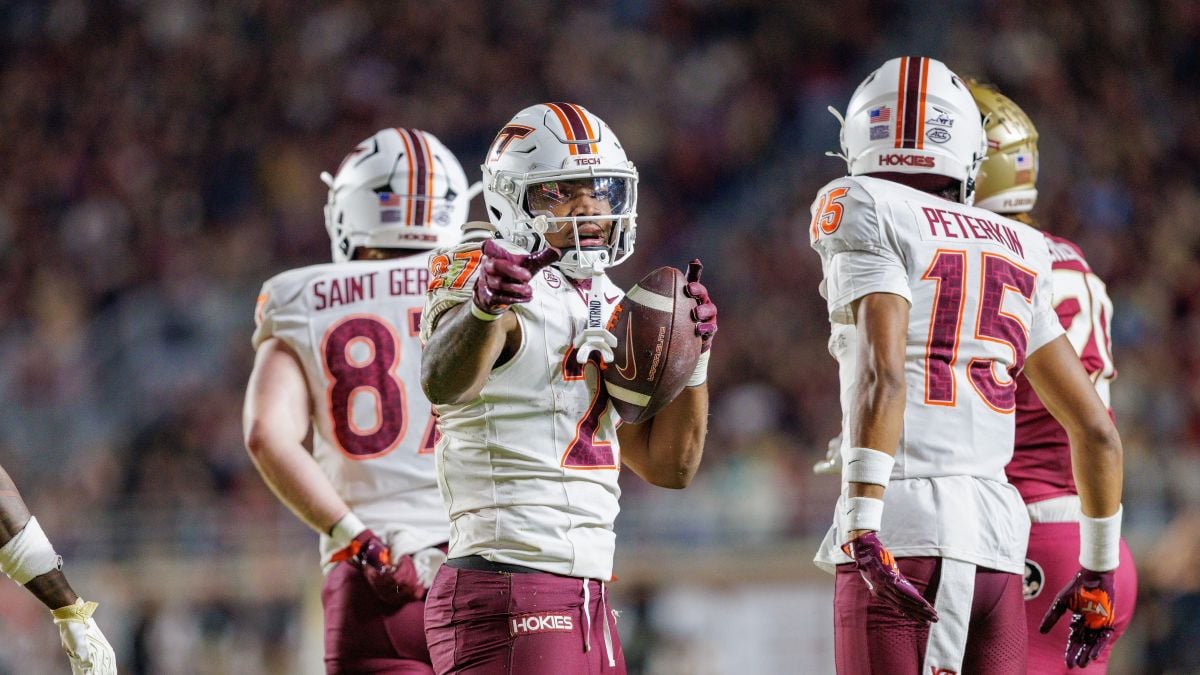
Across the U.S., state legislators have plenty of opinions on what to do when it comes to betting on college sports. Virginia Delegate Garrett McGuire hopes he’s found a way to ensure that it directly benefits the very in-state teams that people are wagering on.
McGuire is the chief patron of a bill that would expand legal betting on college sports in Virginia by ending the prohibition on gambling on in-state NCAA Division I schools such as the University of Virginia, Virginia Tech and James Madison University. Currently, people in Virginia can only bet on out-of-state teams.
The delegate explained to SBC Americas that he believes authorizing more college betting can be a net positive for the state, as long as it’s done in the right way. To that end, his House Bill 1527 would give every dollar of the additional tax revenue generated from legalized betting on in-state teams directly to those schools’ athletics programs.
“Here in Virginia, we have a ton of great universities and colleges, many of which are Division I and compete at the highest level,” Virginia Tech graduate McGuire said in an interview. “And I was looking for opportunities to inject more revenue into our state university athletic funds. The idea really came from, how can I better position the universities in our state to compete at the highest level? I want us to compete, I want Virginia schools to win national championships, and I know they all need more resources to compete at that level. What can I do?”
Home is where the heart is
McGuire’s proposal awaits discussion in the General Laws Committee, which already this year has housed gambling bills that would do everything from legalizing online casino gaming to taxing daily fantasy sports. The college betting expansion was introduced by unanimous consent, an early sign that other legislators may be open to the idea. Part of the appeal may be that betting on Virginia schools already happens, just not in a way that actually benefits Virginia or those schools.
“I looked at our sports gambling law, which currently prohibits gambling on Virginia schools — and that’s for a very legitimate reason,” he continued. “However, in some of our neighboring states, you can bet on our schools. Where I’m from in Fairfax County, Washington, D.C., is not that far away, Maryland is not that far away. And in the southern part of the state, North Carolina is right there.
“I could drive my car 20 minutes across the bridge and place a bet on a Virginia school in D.C. to circumvent our prohibition anyway. That means revenue is going to D.C. or North Carolina and Maryland. So, maybe it’s time to re-examine that.”
Playing the percentages
Speaking of revenue, core to McGuire’s idea is the unique tax twist: HB 1527 would tax all bets on D1 Virginia schools at 50%.
In an industry where tax is always a testy topic, that’s a big number, especially considering it would be implemented on the new category of legal bets instead of the 15% currently levied on online sports wagers across the board.
“Sportsbooks don’t like that number,” McGuire acknowledged. “But what I tell them is that’s 50% of money you’re not getting right now. We have one of the lowest tax rates on sports gambling revenue right now for sportsbooks, in the teens. If we could just carve out this one section of it at 50%, it seems reasonable to allow you to operate [these new bets] within our state.
“I don’t know if that’d be the biggest amount of money, just adding betting on Virginia schools, so the split between the state and the sportsbook has to be dramatic for it to really make a difference money-wise. That’s why I did the 50-50.”
College props would remain big no-go
Much of the conversation around college sports and betting, whether it’s in legislative chambers or public comments from athletes or leagues, hinges on the issue of integrity. The NCAA has seen more than its fair share of betting-related troubles in recent times, from match-fixing scandals to reports of players being abused by angry bettors.
That climate has led to more states either passing or mulling bans on college prop bets. In that way, the relatively old online sports betting market of Virginia is ahead of the game; it already bans college props. McGuire was keen to stress that nothing about his bill would change that.
“I in no way have any intention to open up prop bets on student athletes. That’s a hard no for me. The safety and mental health and integrity of our student athletes and our institutions is extremely important to me. It seems like every week, we hear another story about an athlete, professional or college, betting because it’s so prevalent and so easy to do.
“But the schools themselves, I think there’s a way to do it that makes sense for the state. And if we’re going to open it up to in-state institutions, let’s also give a little bit more money to the people that are helping folks who find themselves having a problem,” he added, noting that his bill would also double the percentage of revenue from the general 15% tax rate on sports betting that is dedicated to a specific problem gambling support fund.
Many gambling bills are filed every year. In Virginia alone, that number is in double figures already in 2026. Whether or not HB 1527 builds a head of steam, its patron hopes it gets his fellow legislators thinking.
“I don’t know that this is going to be something that becomes law this year, but I at least want to get the conversation started,” McGuire concluded. ” I’m also interested to see what else is out there and what other states are doing. Everyone’s kind of throwing things at the wall. Let’s see what sticks.”