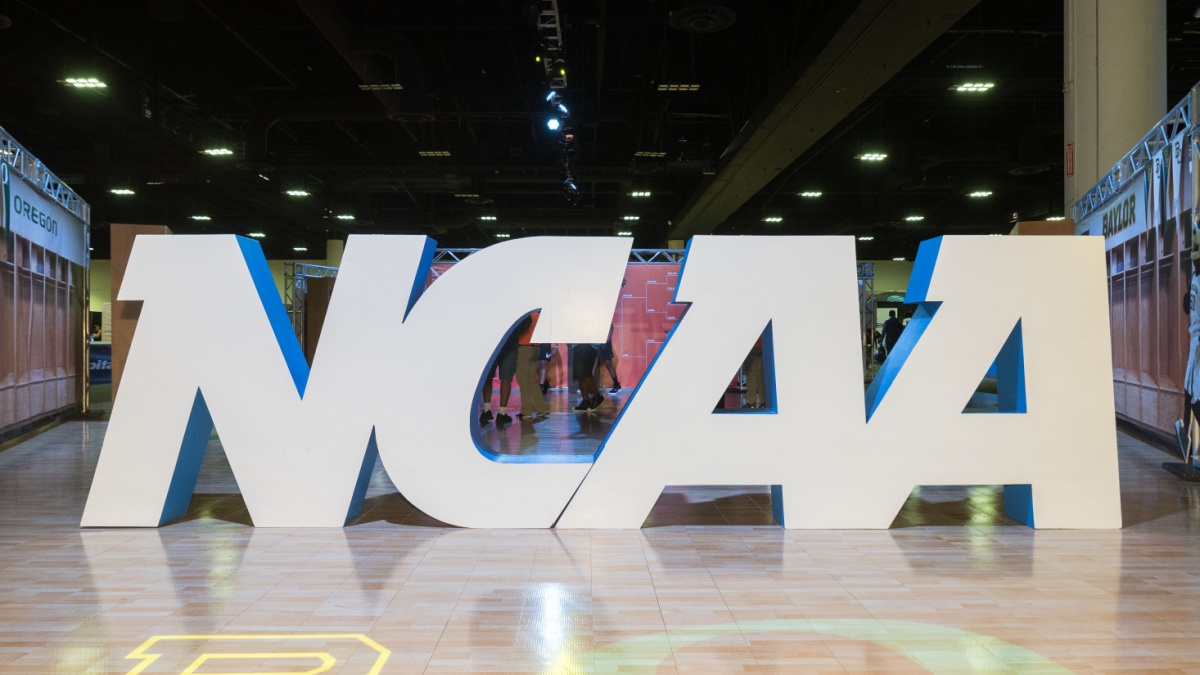
NCAA President Charlie Baker has been outspoken about the impact of legal sports betting on its student-athletes, but the organization is also having to consider another vertical.
Baker sat down with Yahoo! Sports to discuss the legal sports betting industry and how the NCAA is responding to recent gambling infractions across sports and the steps the organization is taking to protect its student-athletes. Baker also discussed the growing popularity of prediction markets and how the NCAA perceives the emerging platforms.
Easy access to online wagering changed the game
Since the overturning of PASPA in 2018, the NCAA has worked to develop and implement a framework that protects student-athletes from gambling-related harm and ensures the integrity of competition. However, the rapid pace of growth and the accessibility of online sports wagering impacts how the NCAA sets a standard related to regulated gambling.
“I don’t think anybody was anticipating that it [legal sports betting] would be as ubiquitous as it became when DraftKings and FanDuel, in particular, created phone-based opportunities for people to bet on pretty much anything,” said Baker “You think about parlays, that’s something that was really hard to do without technology and almost simultaneous betting opportunities. The phone changed everything.”
The accessibility and popularity of online sports wagering in America has led to gambling-related abuse and harassment directed toward NCAA student-athletes both on and off campus. The abuse is putting pressure on the NCAA to ensure the protection of its student-athletes, who are more vulnerable than professional athletes who face similar issues.
The NCAA believes it has an added responsibility to protect its student-athletes.
“There’s a big difference between being a professional athlete with a lot of structure and a lot of advisors around you and being a kid who eats in a dining hall. And studies in a library. And goes to class with their classmates. And is so much more gettable with respect to practically anything around this,” continued Baker. “So yeah, for sure, [we feel an added responsibility].”
Between Sept. 30 and Oct. 5., the NCAA conducted a Student-Athlete Needs, Aspirations and Perspectives (SNAP) study. The study found that over one-third, 36%, of DI men’s basketball players reported experiencing social media abuse related to sports betting within the last year. The results doubled FBS football players at 16%.
Rates were much lower among women student-athletes, with only 1% of all D1 women athletes reporting receiving betting-related harassment through social media channels.
Baker talks prediction markets & sports event contracts
The NCAA is also having to consider the impact of prediction markets on student-athletes. Baker took notice of the resignation of DraftKings, FanDuel and Fanatics from the American Gaming Association (AGA). The three brands left the trade group to enter the prediction market space.
“It [the exits from the AGA] just says this whole thing is going to get worse unless somebody does something about it,” said Baker. “And solving it at the federal level is going to be really challenging because it’s still new and not fully formed. So, I mean, you’re basically talking about no rules, no oversight, no nothing. And that just feels catastrophic to me. Not just for us, but for everybody.”
The NCAA has already taken steps to address prediction markets with the organization sending a letter to Kalshi, asking the sports event contract provider to stop implying it has a relationship with the organization. The NCAA sent the letter over concerns about suffering harm after Kalshi published language that said the NCAA approved data for the company’s use.
The NCAA requested Kalshi to amend its language related to the NCAA and provide a disclaimer that it has no affiliation with the national governing body of college sports.
Earlier this year, the NCAA also said that it was “deeply concerned” about the lack of consumer protection standards for online prediction markets and sports event contracts.
The NCAA has yet to draft explicit rules that pertain to sports event contracts.
Baker discusses recent NCAA gambling infractions
Baker also addressed recent gambling infractions discovered by NCAA enforcement staff.
Earlier this week, the NCAA ruled a former men’s basketball player permanently ineligible after an investigation found he provided gambling-related information to a third party. The third party was a fellow basketball player at Fresno State, who was dismissed from the university earlier this year and also ruled permanently ineligible for wagering on himself.
“I hate the fact that we’ve caught a whole bunch of young people engaging in this stuff, which just sucks for everybody,” added Baker. “But our message has been, ya know, ‘if you do this, we will catch you.’ We run a really big integrity monitoring program, probably the biggest in the world. I’m not sure people appreciate that.”
According to data provided by Baker, the monitoring services used by the NCAA have monitored more than 2.75 million athletes over the last five years. The monitoring has also led to gambling-related penalties for student-athletes and staff at Fresno State, Temple, Eastern Michigan, Arizona State, New Orleans and Mississippi Valley State.