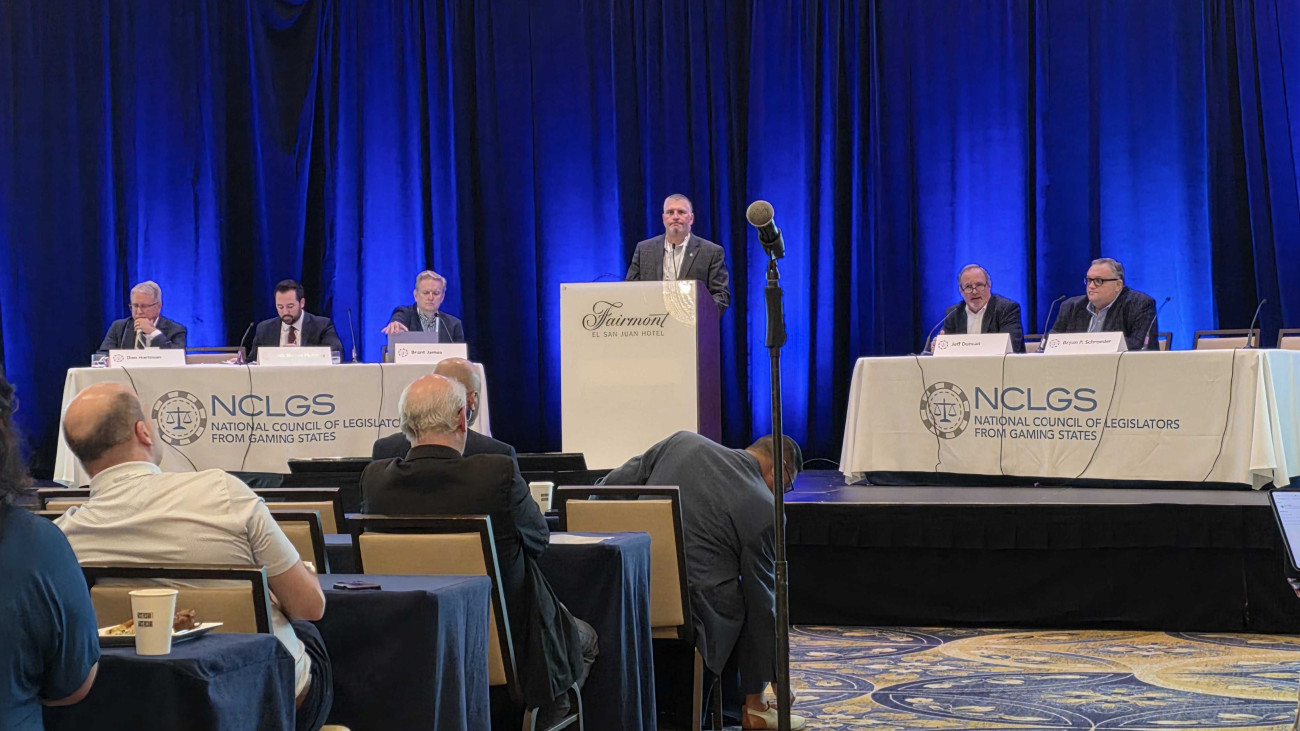
For the second year in a row, the National Council of Legislators from Gaming States (NCLGS) Winter Meeting tackled the topic of sweepstakes gaming. In the 12 months between the respective year-end sessions in 2024 and 2025, a lot has changed.
Six states enacted legislation this year that either explicitly or implicitly prohibits dual-currency gaming, including California and New York, while another dozen or so issued cease-and-desist orders to various sweeps operators.
After a rough year for the vertical, the pro-sweeps argument was well represented on a Thursday panel in San Juan, Puerto Rico.
A missed opportunity for states?
Speaking on a panel with current and former state legislators, the prevailing message from Social Gaming Leadership Alliance (SGLA) Executive Director Jeff Duncan was that the association and its members want to work with states, not against them.
“We want to be regulated, we want to pay taxes,” Duncan told the room. “We’re advocating for a modernized regulatory framework that reflects social games’ role as a safe and growing component of an interactive entertainment industry. We want you to go after the bad actors.”
Representatives from the SGLA, including members VGW and ARB Interactive, were frequent voices in legislative hearings discussing potential sweepstakes bans throughout 2025. Operators of sweeps, or “social plus” games, say their games are beloved by many Americans, do not equate to real-money gambling and, if regulated, offer states another avenue to create revenue and expand consumer choice.
Bryan Schroeder, general counsel at ARB, criticized what he sees as the weaponizing of sweepstakes gaming by state lawmakers and regulators.
“Transparently, in my opinion, social plus operators are being used as pawns in the issue of approved iGaming,” he said. “Most [iGaming] bills were tied to an attack on sweepstakes.”
Duncan and Schroeder were also adamant that part of the reason sweepstakes gaming is not more accepted is that wider gaming laws are outdated.
“The definition of what gambling is, modernizing that for a digital 21st-century era is very, very important,” stressed Duncan. “I think in a lot of situations, they’re dealing with antiquated laws on gaming. As a former legislator, I know it’s tough to get good legislation passed. Regulators are doing the best they can. Maybe new legislation is needed.”
Do sweepstakes quack like a duck?
Opponents ranging from operators of typical gambling products to state regulators and lawmakers like West Virginia Delegate and NCLGS President Shawn Fluharty continue to contend that sweeps are tantamount to illegal online gambling.
“Politicians seldom agree on anything, we could argue the color of this carpet all day long,” said Fluharty from his seat on the other side of the panel. “But on this issue, we agree on what this represents: Illegal gaming operations. You’re calling it social plus, it’s a great pivot. It’s great politicking.”
Fluharty, who is also head of government affairs at sweeps-opposed gaming supplier Play’n GO, compared sweeps trying to co-exist with licensed and regulated online gaming operators to “the moonshiner advertising next to Anheuser-Busch or somebody selling Gucci bags on the corner.”
“I can’t think of another industry where that’s taking place and it’s allowable,” he opined. “That’s why you’re seeing states fight back accordingly through the avenues available. I think lawmakers are smart enough to look at this and say, ‘It walks like a duck and talks like a duck, it’s a duck.’”
Sweeps say they’re playing the long game
Fluharty noted that while prediction market platforms such as Kalshi and Crypto.com have readily challenged state regulatory actions in court, there has been no such reaction from the social plus industry. Typically, state C&Ds have been met by sweeps operators either scaling back or pulling their products out of market.
“I think maybe you’re playing the long game and want to have a license available to you down the road,” Fluharty mused.
Duncan and Schroeder countered that for them, it’s about long-term reconciliation.
“I don’t like the Kalshi approach, which is just absolutely ‘we’re legal, screw you, we’re going to sue,’” Schroeder acknowledged. “I think that’s a short-term play. We could take the approach of proactively suing. The long-term marathon approach is to educate attorneys general, to educate regulators.
“Our experience is, when we are prohibited in a state or we’re asked to leave, the good operators follow these rules, the bad operators stay.”
Controls are here, but too little, too late?
To that end, Duncan and Schroeder emphasized that SGLA’s member operators like ARB and VGW have made efforts to add player safety protocols such as stringent age verification, KYC and geolocation tools. ARB is about to transition to GeoComply’s IDComply, noted Schroeder.
Panel moderator Rep. Chris Kannady of Oklahoma stepped in to ask what took ARB and its comrades so long to do so, a question echoed by Fluharty and fellow panelist Dan Hartman, a GMA Consulting advisor and the former Colorado Division of Gaming director.
“You can’t operate through the back door, you’ve got to come in through the front door,” said Hartman. “Some of the stuff that the SGLA wants to do, it’s nice to see. Maybe a little too late. It’s a step forward. But you need to be in the system, and should have been in the system from the beginning.”
“I commend the gentlemen here for coming and saying, ‘Hey, we’re going to start playing ball now,’ but the record shows that you’re over a year when it comes to that effort,” added Fluharty. “But I guess you’re going to move forward and try anyway with this pivot to social plus.”
New year, same issue?
The conversation is unlikely to end with the end of 2025. Bills targeting sweeps have been filed ahead of 2026 in Florida, Maine and Indiana. “It’ll be interesting to see how the chips fall another year from now,” suggested Fluharty.
In the meantime, sweepstakes companies got their seat at the table.
“The title of this panel was crossroads,” reflected Duncan. “We are at a crossroads. We’ll do whatever is necessary to educate legislators so you make informed decisions going forward and understand the industry that you’re looking to regulate or enhance.”