

As major Illinois sportsbooks, including FanDuel and DraftKings, implemented customer surcharges at the start of September, the total number of sports wagers placed in the state fell by more than five million bets year over year.
September 2025 revenue data released by the Illinois Gaming Board (IGB) late last week showed that sportsbooks took around 30.2 million online bets on sports that month, down around 15% from the 35.7 million placed in September 2024.
However, handle rose 9% year over year to $1.42 billion, suggesting that, while gamblers are placing fewer bets, they’re staking more per wager on average.
“As you’d expect, we’re seeing a reduction in the number of bets there, but increasing handle per bet,” said Flutter CEO Peter Jackson on an earnings call last week.
Illinois takes sportsbooks to the bank
The Illinois government continues to reap the reward of the per-wager tax it implemented on July 1. Illinois charges each of its 10 online sportsbooks 25 cents per bet placed, up to a threshold of 20 million wagers in a fiscal year. Beyond that mark, the fee doubles to 50 cents per bet.
FanDuel and DraftKings, which together account for around two-thirds of the Illinois sports betting market, both exceeded that 20 million mark in September and began incurring the 50-cent tax. That was a major factor in Illinois’ monthly receipts from the per-wager tax eclipsing $10.5 million. That is more than the totals from July and August combined. FanDuel (nearly $4.5 million) and DraftKings (almost $4.1 million) together accounted for more than 80% of that total.
September 2025 Illinois sports betting data
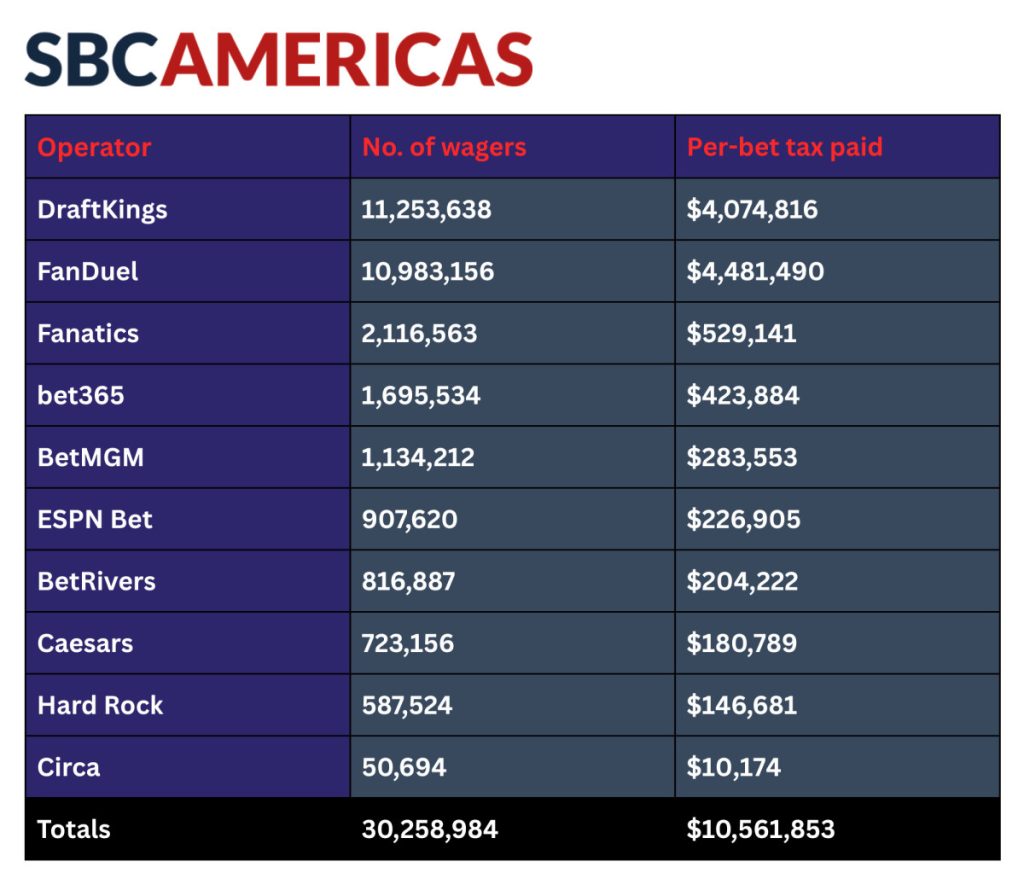
In the first three months since the state implemented the per-wager tax, the measure earned Illinois more than $21 million in extra tax revenue, nearly $16.5 million of which came from the top two sportsbooks.
Lobbying group the Sports Betting Alliance called the September results “astounding” and a warning that too-high taxes on sports betting risk shrinking the market and pushing players to illegal, untaxed operators.
FY 2026 Illinois sports betting data
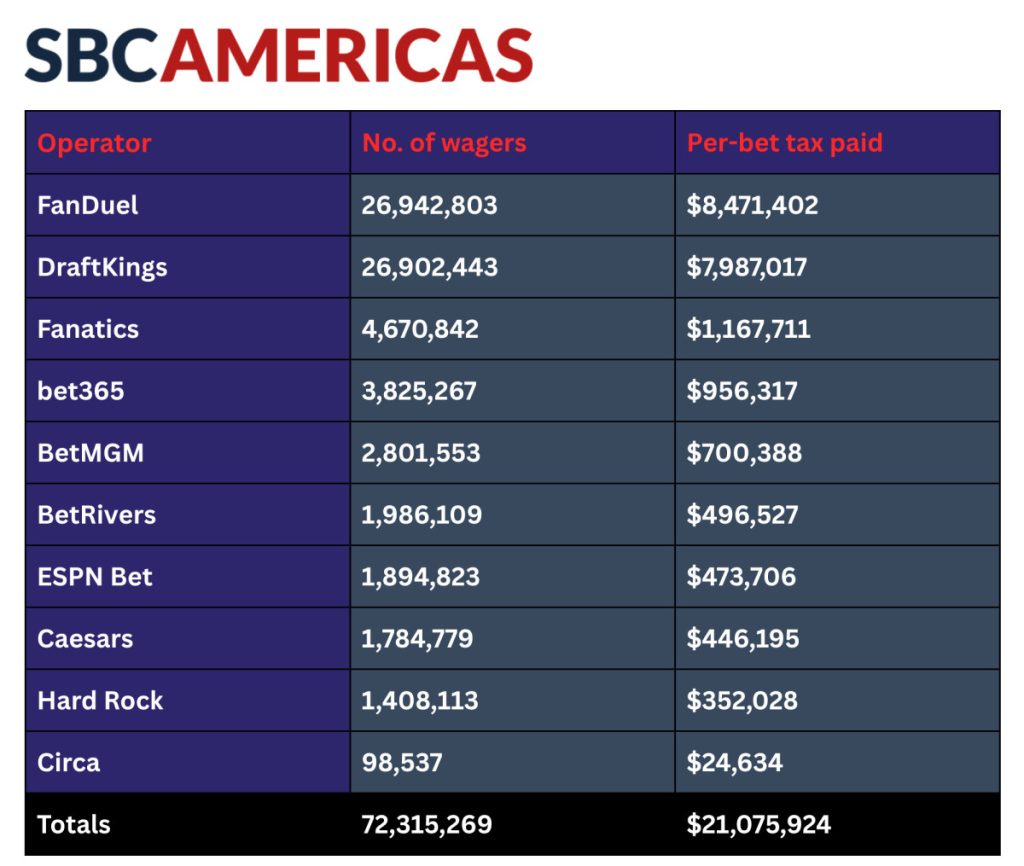
That per-wager tax revenue is in addition to the state’s progressive tax rate on adjusted gaming revenue, which now has a ceiling of 40%, more than triple the previous flat rate.
Between the AGR tax and the per-wager fee, Illinois made $27.8 million in betting tax revenue in September alone and almost $99 million in the first quarter of the fiscal year.
Sportsbook surcharges hit customers
Online sportsbooks’ total AGR in September was $100.7 million, down 26.2% from a year ago. The IGB confirmed to SBC Americas that the AGR totals now includes the money sportsbooks are generating from the customer surcharges they have implemented in response to the per-wager tax.
FanDuel began charging customers 50 cents per bet on Sept. 1, the same day that DraftKings introduced a surcharge of either 25 cents or 50 cents, depending on the user in question and certain conditions. Fanatics, bet365 and Caesars also announced they would respond with surcharges, although as of Sept. 22, Fanatics told SBC Americas it had not implemented it.
The state’s other five sportsbooks opted to install minimum bet stakes rather than a surcharge, another factor which may be playing a part in the increased average stake per bet in Illinois.
If you take a walk, I’ll tax your feet
The surcharge revenue that is now included in some sportsbooks’ AGR totals must also be reported on operators’ tax forms in Illinois, the IGB told SBC Americas. Meanwhile, a 2% regional tax in Cook County, which contains Chicago, netted the county $1.1 million in September.
Between its various layers and forms of sports wagering tax, Illinois is one of the most expensive markets in the country for operators to do business. If Chicago Mayor Brandon Johnson has his way, the burden will be even heavier.
Johnson’s 2026 budget plan includes a measure to add a 10.25% tax on revenue that online sportsbooks make from bets placed within the city, which would be charged in addition to the statewide AGR tax and the statewide per-wager tax.
Within days of that proposal being published, five Illinois Democrats filed a bill opposing the idea. Illinois House Gaming Committee Chair Daniel Didech’s HB4171 now has more than two dozen co-sponsors and bipartisan support.