

Online sports betting market leaders FanDuel and DraftKings together paid Illinois nearly $4 million in additional tax revenue in August due to the state’s per-wager tax fee, even before they began paying the higher 50-cent rate.
The Illinois Gaming Board’s (IGB) August 2025 revenue data shows that FanDuel and DraftKings continue to account for around three-quarters of both the total number of wagers placed and the resulting money the state makes from the per-bet charge that it officially introduced on July 1.
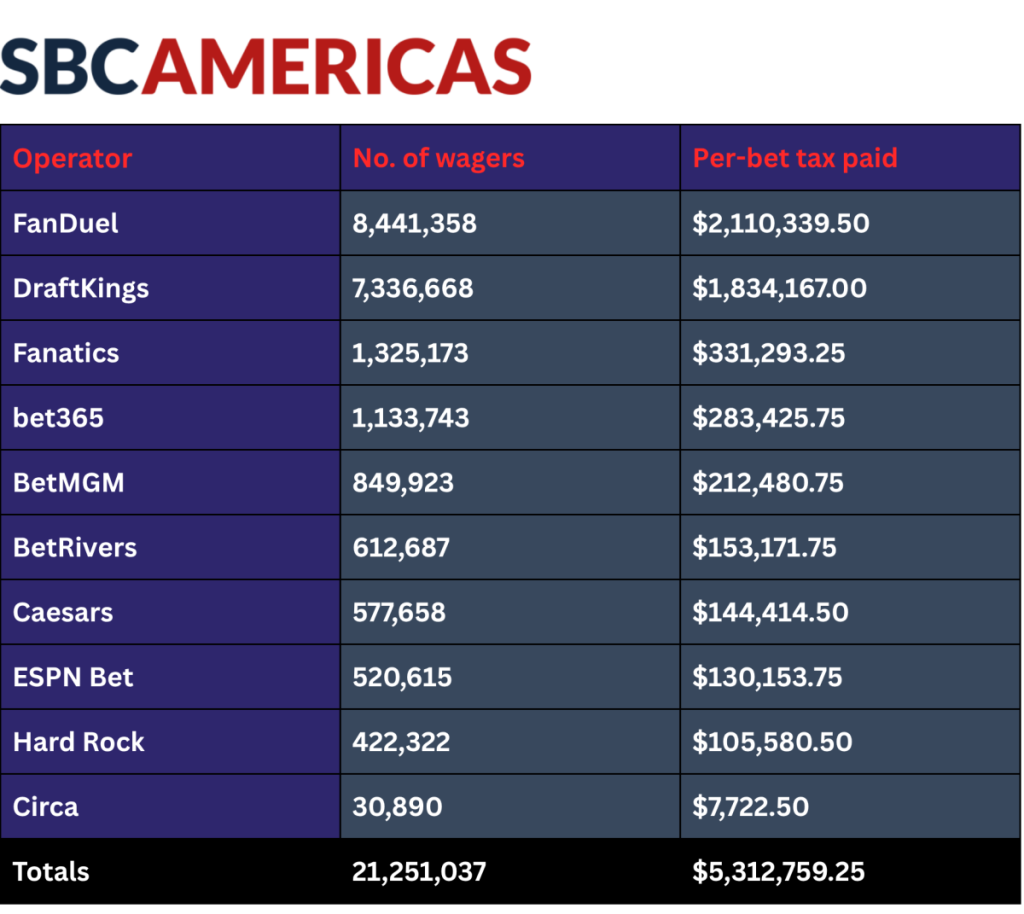
FanDuel took more than 8.4 million bets in the Land of Lincoln in August, while DraftKings handled more than 7.3 million. Illinois’ initial 25-cent fee on each wager meant the two operators paid more than $2.1 million and $1.8 million in per-wager tax, respectively.
In total, the per-wager charge raised more than $5.3 million for the state from the more than 21.2 million in online sports wagers placed in August. As the bronze-medal sportsbook in Illinois, Fanatics paid the third-highest amount of $331,293 on 1.3 million bets.
Here’s the full breakdown for August:
Illinois also taxes online sportsbooks on a sliding scale according to their adjusted gross revenue. In total, between its multiple levies, the state earned almost $33 million in online sports wagering tax revenue in August. FanDuel and DraftKings, which are in the top AGR bracket of 40% tax, handed over almost $11.8 million and more than $12.7 million, respectively.
Overall in August, the IGB reported $1.03 billion in total sports betting handle, up 17.3% on last year. Operators won $107.8 million in adjusted gross sports betting revenue.
DraftKings set the pace with $38.1 million in revenue from $360.6 million in handle, ahead of FanDuel’s $34.3 million from $296.3 million in wagers.
Two titans paying double
Through August, all 10 of Illinois’ mobile sportsbooks paid 25 cents to the state for every wager they handled, in addition to the pre-existing AGR tax.
However, FanDuel and DraftKings both eclipsed 15.6 million wagers between July 1 and Aug. 31. Once an operator exceeds 20 million wagers taken in a fiscal year, its per-wager tax fee doubles to 50 cents. It’s a safe bet that both FanDuel and DraftKings crossed that threshold and began paying that amount in September, particularly given the boost of the return of the NFL in that month.
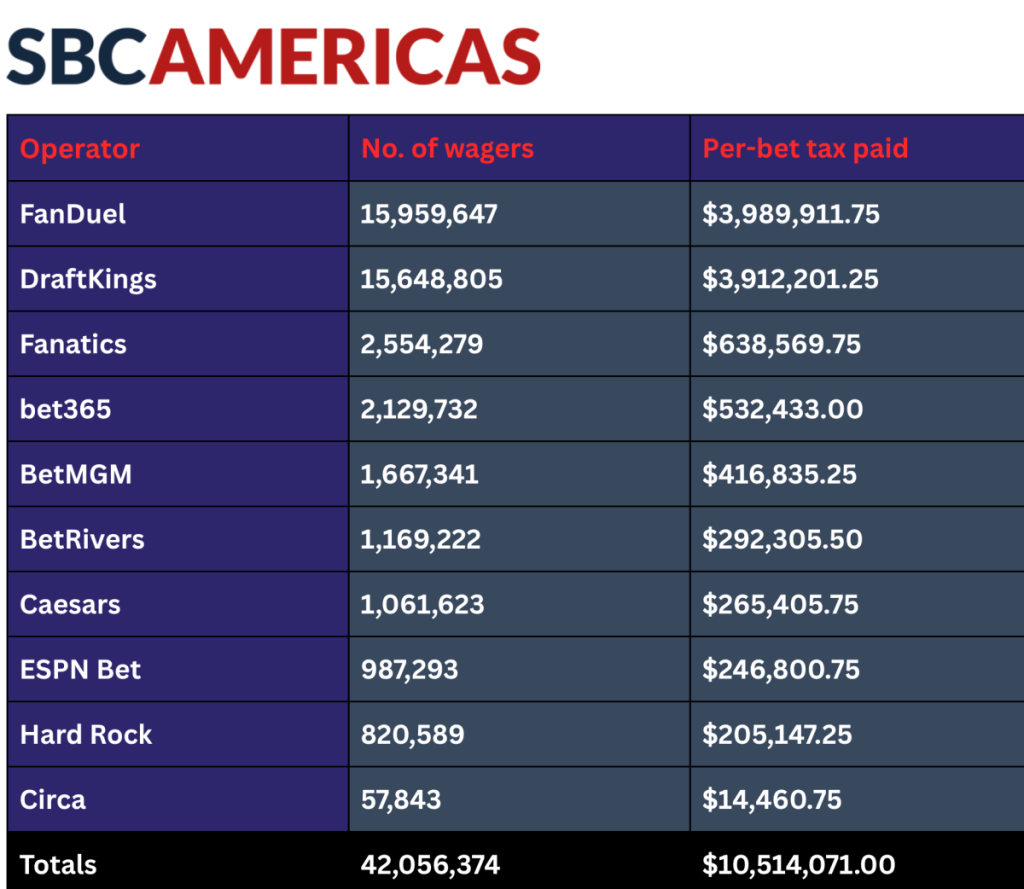
All in all, FanDuel and DraftKings paid more than $7.9 million in the per-wager tax through the first two months of the fee’s existence, at more than $3.9 million each.
Fueled by the price paid by those two giants, Illinois’ per-wager tax raised more than $10.5 million in receipts for the state in its first 62 days, adding to more than $50 million in AGR tax revenue it has reaped in that time.
Here’s what the first two months of the per-wager charge have looked like:
Customer surcharges in effect
While FanDuel and DraftKings began paying 50 cents in tax per wager in September, that month was also when they started passing the extra cost onto their customers by charging users for each bet placed.
Half of Illinois’ 10 online sportsbooks responded to the per-wager tax by implementing a per-bet fee on their platforms for customers in Illinois. Starting Sept. 1, FanDuel began charging customers 50 cents per bet and DraftKings also introduced a surcharge of either 25 cents or 50 cents, depending on the user in question and certain conditions. Fanatics, BetMGM and bet365 also previously announced an upcoming Illinois surcharge, while the five other books opted to set minimum bet values instead.
SBC Americas reached out to the IGB seeking clarity on whether operators’ customer surcharges will be denoted in future revenue reports. IGB’s September reporting will be available in mid-November.
What is certain is that sportsbooks that implemented a retaliatory customer surcharge will have to include the resultant revenue on their tax forms. The IGB sent operators a letter on July 10 in which it explained that when reporting their AGR each month, sportsbooks must include the money they make from these customer fees under “Other Gross Sports Wagering Receipts.”
“Sportsbooks are permitted to charge patrons whatever fees they wish to place wagers, but all such fees are taxed as sports wagering receipts,” an IGB spokesperson told SBC Americas.