

Long before Las Vegas and mobile apps, gambling in America began as a fundraising tool for colonial universities and militias. Today, it’s a $66.5 billion industry, with digital platforms driving over one-third of all revenue.
The story of how gambling transformed from colonial fundraising tools to a sophisticated digital ecosystem reveals fundamental aspects of American entrepreneurship, regulatory evolution, and our enduring fascination with risk and reward.
Colonial foundations and early American gaming
Gambling arrived in America with the earliest settlers, but it quickly took on a distinctly practical character. Throughout the 1700s, colonial lotteries became essential funding mechanisms for public projects, financing everything from roads and militias to the endowments of prestigious universities like Harvard and Yale. This tradition of using gambling proceeds for public benefit would become a recurring theme in American gaming history.
For a deeper look into how gambling evolved from these early lotteries to the regulated casino landscape we know today, CasinoRank offers a comprehensive timeline of gambling history in the U.S., covering pivotal shifts, legal reforms, and major milestones.
By the 19th century, gambling had found its most romanticized American expression along the Mississippi River, where floating casinos operated as entertainment hubs for a rapidly expanding nation. These riverboat casinos brought games of chance to America’s frontier, establishing gambling as part of the country’s cultural fabric long before Las Vegas existed.
The Nevada revolution and casino expansion
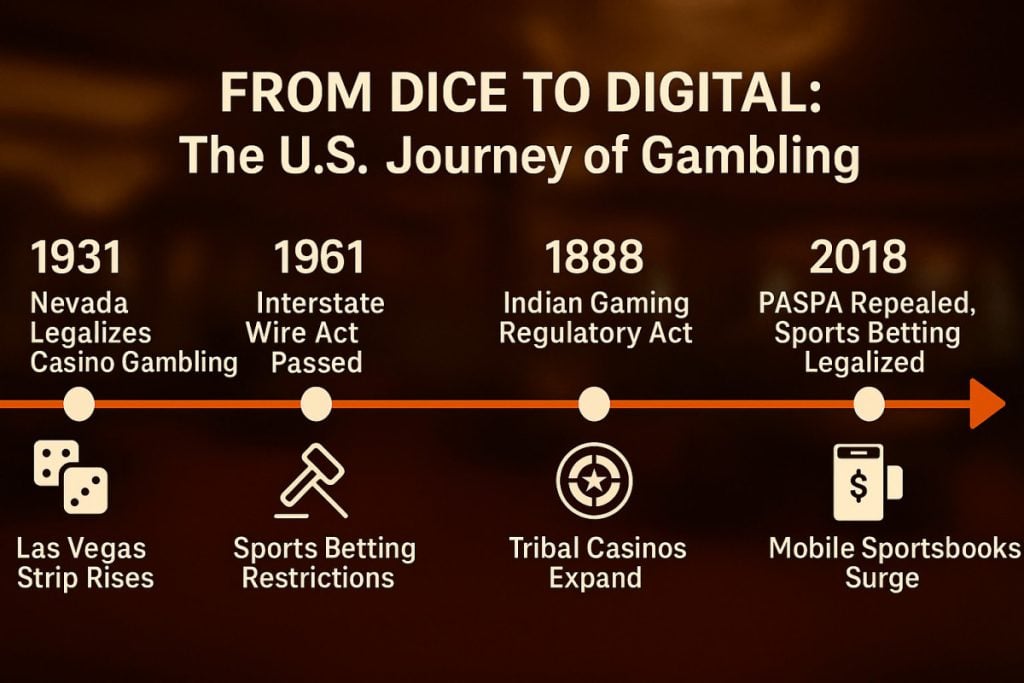
The modern American casino industry began in 1931 when Nevada legalized commercial casinos, transforming a remote desert state into the nation’s gambling capital. This bold regulatory move created the template for legal, regulated gaming that would eventually spread across the country.
Atlantic City followed in 1978, bringing casino gaming to the East Coast and proving that Nevada’s success could be replicated elsewhere. However, the most significant expansion came with the 1988 Indian Gaming Regulatory Act, which established the framework for tribal-run casinos. Today, more than 500 tribal gaming facilities operate nationwide, generating tens of billions in annual revenue and fundamentally reshaping the American gaming landscape.
Federal regulation meets the digital age
As the internet emerged in the 1990s, American gambling faced a complex regulatory challenge. The 1961 Interstate Wire Act, originally designed to combat organized crime’s involvement in sports betting, suddenly became relevant to digital wagering. This decades-old law would shape how online gambling developed in America.
Throughout the mid-1990s and 2000s, offshore poker and sports betting sites began targeting U.S. bettors, operating in a legal gray area that frustrated regulators. Congress responded in 2006 with the Unlawful Internet Gambling Enforcement Act (UIGEA), which blocked payment processors from handling transactions for illegal online bets, effectively pushing most online gambling offshore.
The regulatory landscape shifted dramatically in April 2011 when the Department of Justice issued a crucial Wire Act opinion, clarifying that the law applied only to sports betting, not other forms of gambling. This interpretation opened the door for states to offer intrastate online poker, casino games, and lotteries, setting the stage for America’s digital gambling revolution.
The sports betting transformation
The most dramatic change in American gambling history occurred on May 14, 2018, when the Supreme Court overturned the Professional and Amateur Sports Protection Act (PASPA) in Murphy v. NCAA. Within weeks, New Jersey launched the first legal post-PASPA sports wager at Monmouth Park, igniting a nationwide expansion that continues today.
The growth has been extraordinary. By mid-2025, 38 states plus Washington D.C. had legalized sports betting in some form, with approximately 30 of those permitting statewide mobile wagering. The total handle since 2018 has exceeded $500 billion, with smartphone bets accounting for more than 90% of all wagers in mature markets.
This mobile-first approach represents a fundamental shift from traditional casino-based gambling. The median online bettor is nine years younger than the typical brick-and-mortar casino patron, reflecting how digital platforms have attracted a new generation of players who prefer the convenience of wagering from anywhere.
The rise of iGaming
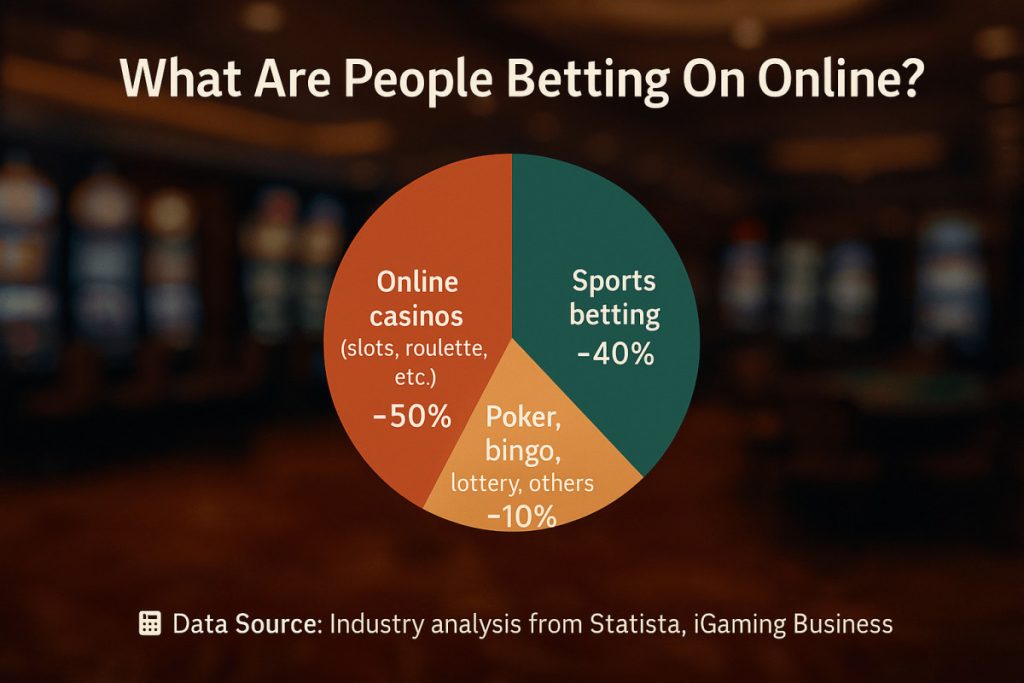
While sports betting captured headlines, online casino gaming (iGaming) has quietly become one of the most lucrative segments of digital gambling. New Jersey led the way in 2013 by launching full online casino offerings, including digital slots and table games.
To date, seven states – New Jersey, Michigan, Pennsylvania, Connecticut, West Virginia, Delaware, and Rhode Island – have authorized comprehensive iGaming, while Nevada permits online poker only. The financial results have been impressive: iGaming generated approximately $7 billion in revenue in 2024, with tax rates of 20-30% far exceeding the single-digit rates typically applied to sportsbooks.
This higher tax yield has made iGaming particularly attractive to state governments seeking new revenue sources, suggesting continued expansion as more states recognize the financial benefits of regulated online casino gaming.
Technology and payment evolution
The American online gambling experience has been shaped by continuous technological innovation. In the early 2000s, players relied on prepaid cards and electronic checks to fund their accounts. The 2010s and 2020s brought instant bank transfers and digital wallets, making deposits and withdrawals seamless.
Today’s platforms are experimenting with cutting-edge technologies including blockchain payment rails, augmented reality overlays for live sports betting, virtual reality casino rooms, and AI-driven in-play odds calculations. These innovations promise to make online gambling even more immersive and accessible.
Device preferences reveal interesting patterns in American gambling behavior. Approximately 66% of online bets are placed on iPhones, with 25% on Android devices, reflecting the premium nature of much mobile gambling and the disposable income of typical players.
Market dynamics and future outlook
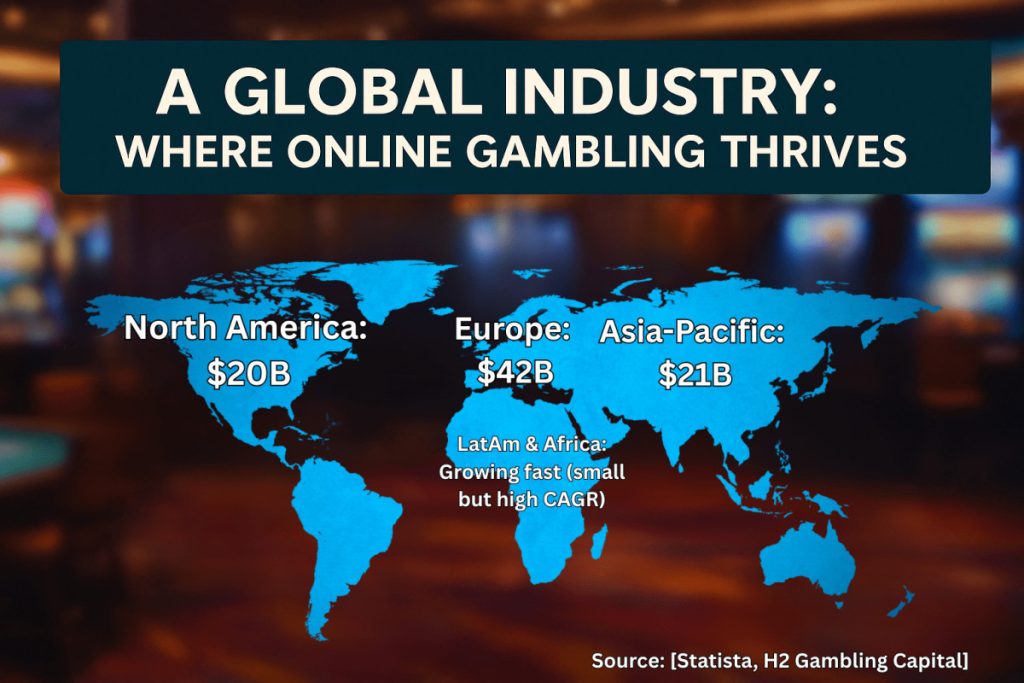
The American online gambling market has developed distinct characteristics that set it apart from international markets. The state-by-state regulatory approach has created a complex patchwork of laws, with each jurisdiction developing its own rules for taxation, licensing, and consumer protection.
This fragmented approach has both advantages and challenges. While it allows states to tailor regulations to local preferences and maximize tax revenue, it also prevents the creation of a truly national market. Players can only access licensed operators in their home states, limiting liquidity and competition compared to unified national markets in other countries.
Despite these constraints, the growth trajectory remains strong. Commercial gaming revenue reached an estimated $66.5 billion in 2024, with digital platforms representing the fastest-growing segment. As more states legalize online gambling and existing markets mature, industry analysts expect continued expansion.
The path forward
American online gambling stands at an inflection point. Having evolved from colonial lotteries that funded universities to sophisticated mobile platforms processing billions of dollars in annual wagers, the industry continues to innovate and expand. The next phase is likely to bring further state legalization, technological advancements, and regulatory refinement.
What remains constant throughout this evolution is the fundamental appeal of gambling; the timeless thrill of risk and reward that has captivated Americans since colonial times. From casting lots to fund the Continental Army to spinning digital slots on smartphones, gambling has continually adapted to each era’s dominant technology while preserving its essential excitement.
The transformation from local gambling halls to national digital platforms represents more than technological progress; it reflects America’s capacity for innovation and regulatory adaptation. As virtual reality, blockchain technology, and artificial intelligence promise even more dramatic changes, the American gambling industry continues betting on the future.
Industry observers, including platforms like CasinoRank, are closely tracking these shifts as the market matures and new technologies reshape how Americans engage with games of chance.
With mobile apps, billion-dollar markets, and state-by-state rollout, today’s $66.5 billion gambling industry would leave colonial lottery operators speechless. But the impulse remains the same: the thrill of chance, the hope of reward, and the dream of hitting it big.