

The sports betting industry universally balked at Ohio Sen. Louis Blessing’s proposal to tax both handle and revenue in his state. Even a small number like the two percent proposed by Blessing would have a huge financial impact if the figure being taxed is bets placed as opposed to revenue earned.
State sportsbooks currently pay 20% on gross revenue with no promotional credit deductions. Blessing’s framework would tax 2 percent on handle minus the federal excise tax. The total handle amount would include promotional credit but not voids.
This new tax from a state that already doubled the sports betting tax rate since launch would be bad news for every Ohio operator, but would some operators feel the pain more than others?
SBC Americas looked at the most recent month of revenue from Ohio sportsbooks and calculated how the proposed handle tax would impact each operator. The results not only reflected a substantial uptick in total taxes paid, but a framework that put a greater financial burden on sportsbooks with lower hold. In fact, were the proposed tax implemented on April returns, two operators would have been required to pay substantial sums of taxes despite posting no revenue in the month.
At the top line, Ohio reaped $14.8 million in tax revenue in April, while the proposed changes would bump that number to nearly $30.7 million. State sportsbooks accepted $8.9 billion in wagers in 2024, which would produce around $178 million in additional tax revenue for the state to go with the approximately $180 million sportsbooks paid on revenues.
FanDuel and DraftKings would pay lowest effective rates
Here is a breakdown of every operator’s potential tax obligation under Blessing’s bill:
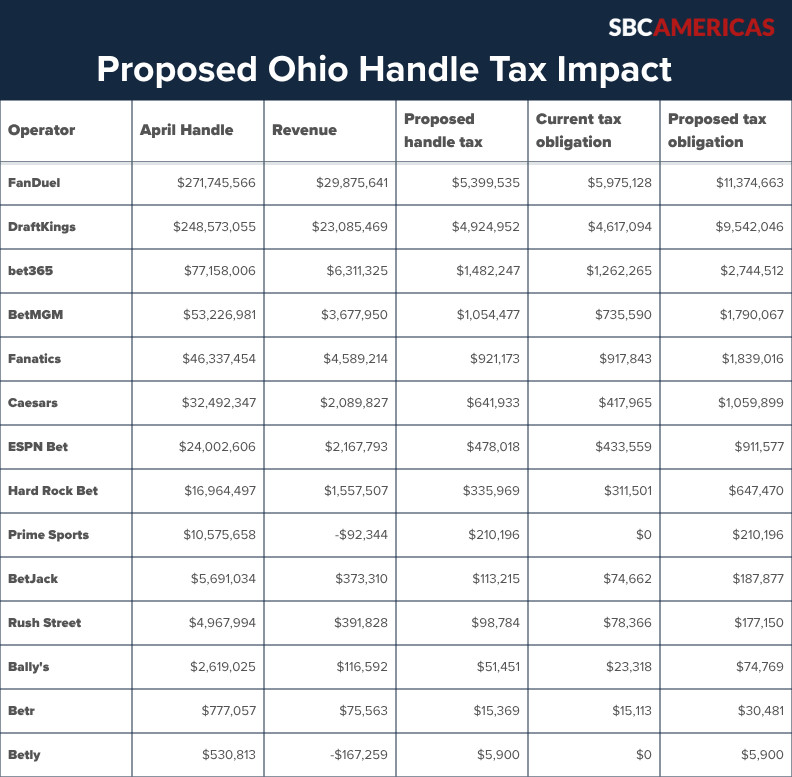
Like statewide totals, the two biggest operators in the state would roughly double how much they paid to Ohio in the form of sports betting taxes under the proposed framework. However, the effective revenue tax rate for these operators were far from the highest. In fact, FanDuel’s effective revenue tax rate would come in at 38 percent, the lowest of any operator in the state.
Low margin sportsbooks would pay taxes despite no revenue
The operators paying the highest effective tax rates would be the ones with the lowest hold. Prime Sportsbook, an operator that prides itself on small margins, regularly trades at a loss in Ohio. Under the current system, if Prime does not post revenue, it does not pay taxes.
Under the proposed system, Prime would be paying heavily because, though it posted revenue losses of $92,000 for the month of April, it generated the ninth-most handle of the 14 operators in the state, with $10.5 million in wagers. With the handle-based tax, Prime Sportsbook would be expected to pay the state $210,196, an amount greater than four competitors that posted revenue for the month would pay.
Betly, the other operator to post a loss on the month, would also be expected to pay taxes on its handle, but with only $295,000 in taxable handle, the tax obligation would be just $5,900.
Some operators would be givin 50%+ of revenues to Ohio
Looking at operators that didn’t post a loss, the steepest effective tax rate on revenue belongs to Bally’s, which posted $116,592 in revenue on $2.6 million in wagers, a hold rate of just over four percent. With the handle tax factored in, the effective tax on revenue would be 64 percent.
The other two operators with an outsized effective tax rate are Caesars and BetJack, both of which would be paying more than half of their revenue to the state in taxes for the month.
The remaining operators would be paying between 40-45 percent of their revenue in taxes, putting Ohio in the same range as Illinois and just shy of New York as the most expensive open market in the country in terms of taxes.
Promo credit would produce $486K in tax obligations
The amount of money paid to the state would also include nearly $486,000 paid on handle that is technically not even money. The bill is written to include the tax on promotional credit offered by the sportsbooks. April is generally a slower month for promotional offers, so state sportsbooks doled out a total of $24.3 million in credit, which would result in $485,780 tax dollars on the activity.
Were Ohio sportsbooks to experience some of the “customer-friendly” results they experienced during March Madness and the late NFL season, the effective tax rates would be even higher, as it would be a period of increased promotional spending, higher handle and lower than average revenues.
Proposal would quadruple tax payments from original rate
These numbers all reflect the difference between the current tax rate and the proposed changes. However, when you consider that these operators have already had the tax rate on the original framework doubled since the market launched.
The original tax rate for the state was a relatively low 10%. If the handle tax were adopted, each operator would be paying at least 380% what they would have under the framework they agreed to when they initially entered the state. For mid-tier operators, the increase is staggering:
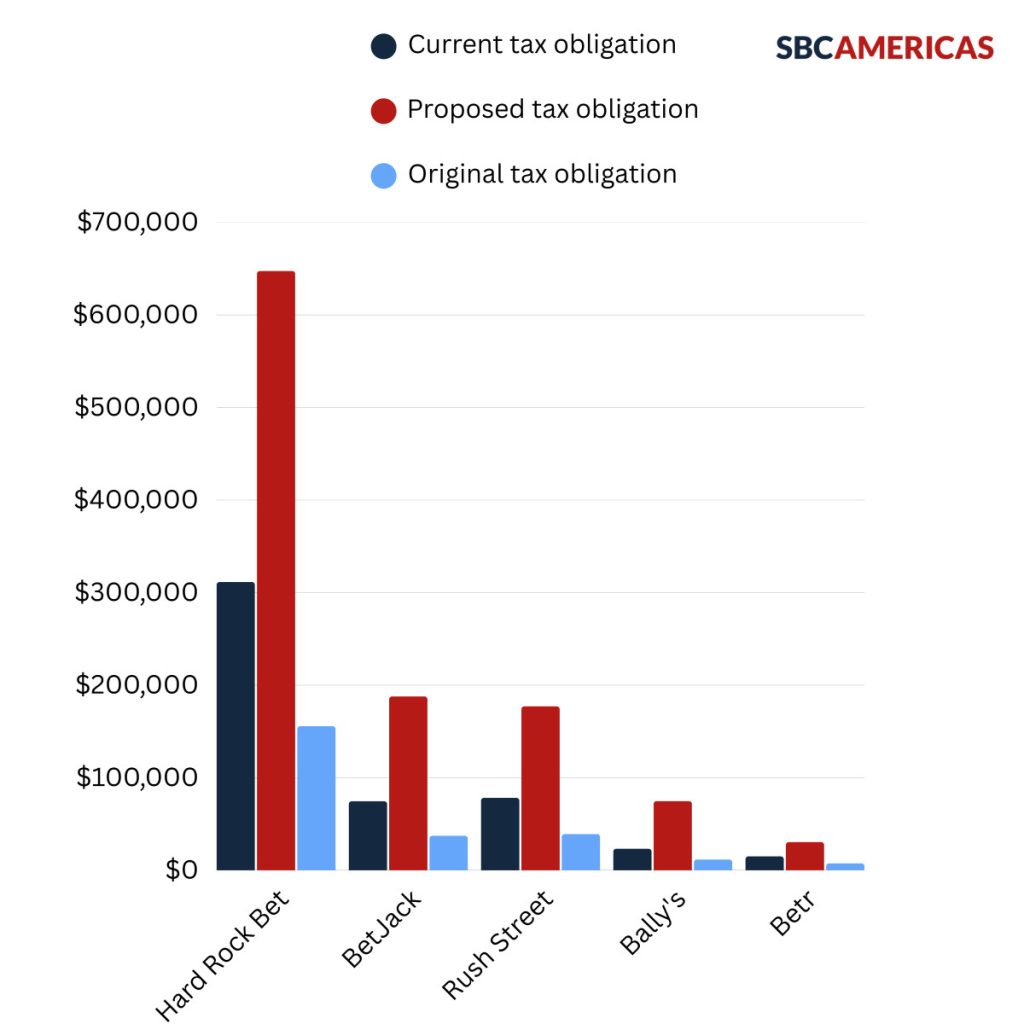
It also raises the question if decisions like these and the tax hike in Illinois, which are seemingly aimed at big operators, will force the smaller players out of the market.