

There can be little doubt about this week’s biggest prediction markets newsmaker: the litigation war unfolding in Utah that has Kalshi’s co-founders facing felony charges and gaming operators making hasty retreats.
Other notable headlines this week in the world of event contracts included:
- The NBA announcing its first prediction markets partnerships
- New York’s gambling regulator turning up the court heat on Kalshi
- Polymarket beginning to take sports offline in Michigan
As always, every Friday, we also highlight some of the stories you might have missed in our Prediction Markets Weekly roundup.
Is Kalshi really worth $40bn?
While it continues to fight states across the country for its right to offer sports, the category that various analyses suggest makes up more than 90% of its volume, Kalshi’s valuation keeps soaring to new eye-watering numbers.
The company completed a $1bn funding round this week, co-led by venture capital and asset management firms Wellington Management and Sequoia Capital. The latest round values the prediction market exchange at $40bn, almost double the $22m theoretical valuation established upon the completion of a previous funding round in May. That number is a whopping eight times the $5bn valuation from just one year ago, in October 2025.
The skyrocketing valuation comes despite multiple U.S. circuit appeals courts ruling against the company and amid reports of artificially inflated volumes. It also emerged in the same week that Kalshi deepened its connections to traditional financial services by partnering with the S&P Dow Jones.
In a blog post announcing the funding round, Kalshi said prediction markets were just the start. The firm said the $1bn will go towards “building the next-generation financial exchange” with a wider variety of products. There is continued talk, fueled by comments from CEO Tarek Mansour, that Kalshi might hold an initial public offering (IPO) in 2027.
Congress quizzes Kalshi, Polymarket on election insider trading
Another thing happening while Kalshi’s value soars and soars is continued mainstream media and federal legislative scrutiny on its non-sports markets.
Sens. Elizabeth Warren (D-MA) and John Curtis (R-UT) wrote to Mansour and Polymarket CEO Shayne Coplan on Oct. 28 to interrogate the executives about their company’s political contracts. Warren is the ranking member of the Senate Banking Committee and Curtis (notably, given this week’s events) is a Republican out of Utah.
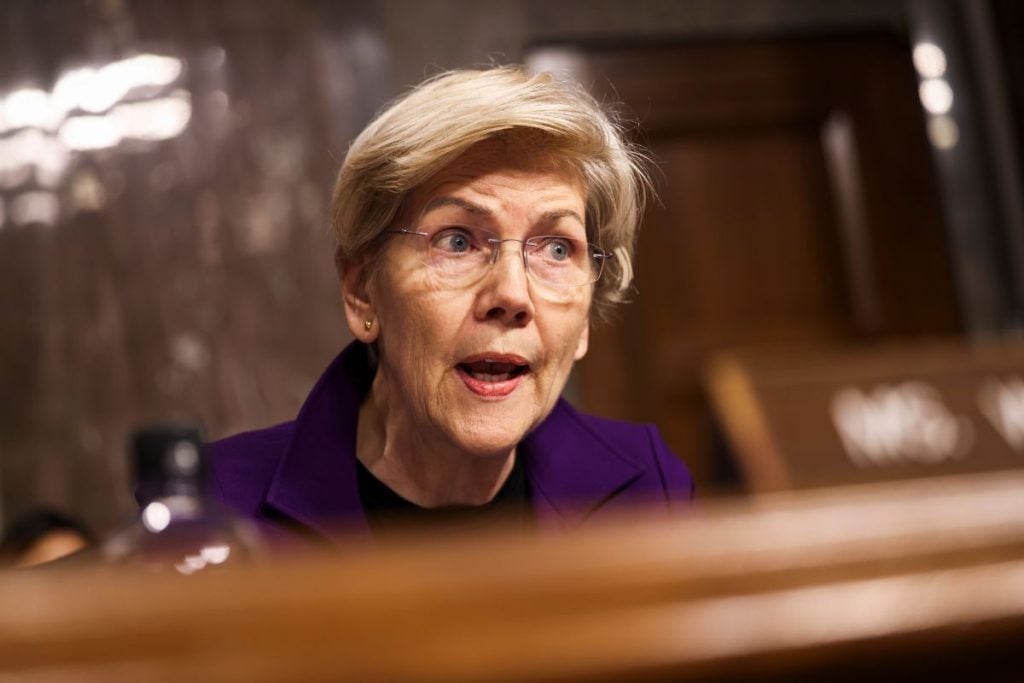
In the bipartisan letter to the prediction market leaders, the members of Congress asked each company seven questions focused on how they work to prevent insider trading and manipulation on election markets, including how many suspected cases each company has found and how many it referred to the CFTC or law enforcement.
“We are particularly troubled by election-related event contracts. Event contracts tied to elections receive prominent coverage and are treated by some observers as indicators of political momentum,” wrote the Senators. “There are also documented cases of candidates betting on their own races, which undermines the overall integrity of the American electoral process.”
The lawmakers referenced several incidents in which political candidates were found to have traded on their own races, and expressed concern with the midterm elections around the corner.
“We remain skeptical that your companies can sufficiently police these even contracts with effective scrutiny and meaningful accountability,” the Senators added. “The identification of isolated instances of improper trading does not demonstrate that these markets are adequately protected. Instead, it raises serious questions about how much similar activity may be going undetected.”
The Senators asked for responses by Election Day, Tuesday, Nov. 3.
NFL told Saquon Barkley to sell Polymarket equity stake
Front Office Sports reported that the NFL told Philadelphia Eagles running back Saquon Barkley to sell his equity stake in Polymarket because the league now does not allow players to invest in or endorse gambling or prediction market companies.
“I am not in that right now,” Barkley told FOS. “I am not allowed to be in that. I was in it before, but no bueno.”
The NFL confirmed to FOS that it now bans its players from striking endorsement deals or investments with prediction markets, as an extension of its prohibition on promoting and investing in sportsbooks.
It continues the NFL’s markedly different stance from other major leagues. NBA stars like LeBron James (Polymarket) and Giannis Antetokounmpo (Kalshi) have deals with prediction market companies, and Atlanta Braves star Ronald Acuña Jr. became the first MLB player to sign with Kalshi.
The NFL has repeatedly stated cautious views on sports event contracts and has not partnered with prediction markets firms, although it does have deals with three sportsbooks (DraftKings, FanDuel, and Fanatics) that also offer prediction markets.
The NBA this week unveiled official deals with Kalshi and Polymarket, joining MLB and the NHL in signing commercial agreements with leading prediction market operators.
Seventh Circuit agrees to hear Kalshi’s Ho-Chunk appeal
The Seventh Circuit Court of Appeals will allow Kalshi to appeal a Wisconsin court ruling that denied its motion to dismiss the Ho-Chunk Nation’s lawsuit.
The federally recognized tribe sued Kalshi in August 2025, alleging that its sports event contracts violate the Indian Gaming Regulatory Act and its exclusive Class III gaming rights.
In May, a federal judge ruled that the tribe’s lawsuit can proceed despite Kalshi’s protestations, finding that it demonstrated a likelihood of success on the merits of the case and that IGRA likely applies to Kalshi’s sports markets. Kalshi filed a petition to appeal, and the circuit court granted that request this week.

Other tribal lawsuits have had mixed results. Several California tribes were denied a preliminary injunction against Kalshi earlier in 2026, while in September, the Ninth Circuit partially overturned a lower court ruling that denied preliminary injunctions to two California tribes.
Meanwhile, the CFTC sued Wisconsin and state officials in April after the state pursued legal action against operators including Kalshi, Polymarket, and Crypto.com.
Kalshi touts new limits for 18- to 20-year-old traders
Kalshi said on Tuesday that it expanded protections for its 18- to 20-year-old traders, a demographic generally catered to by prediction market platforms but commonly shut out by state-regulated sportsbooks.
Kalshi said that every account for a verified user aged between 18 and 20 will now be automatically subject to extra protections with responsible trading education built in. Specifically, those accounts now have a $2,500 monthly deposit limit and Kalshi will alert new under-21 users with an account balance of $1,000+ if they trade more than 25% of that balance on a single trade.
The company also said it partnered with parent and youth safety organizations in a bid to “give parents everything they need to know to ensure responsible trading habits and keep minors off of Kalshi.”
“We know that young adults are often new to markets and may need more education and safeguards, so we are expanding our protections for this group of users,” said Kalshi co-founder and COO Luana Lopes Lara.
That $2,500 monthly deposit limit still allows users aged 18 to 21 to deposit $30,000 with Kalshi over 12 months.
Robinhood’s PM revenue up 6x, but neither sports nor Kalshi the focus
Robinhood’s prediction market revenue increased sixfold year over year in Q3 to reach $173m, and event contract trading volume reached a record 16.4 billion contracts, up from 2.3 billion a year earlier. According to Robinhood’s Q3 earnings report, event contracts accounted for nearly 20% of the company’s $867m in transaction-based revenue, exceeding its $120m in cryptocurrency revenue.
CFO Shiv Verma said that non-sports contracts accounted for approximately 30% of trading in Q3, up from 15% in Q2. CEO Vlad Tenev said the company is increasingly focused on financial event contracts, and not so much on sports.
“I think we can own the financial category because that’s a unique advantage we have,” said Tenev on an earnings call. “We’re less excited about doing what everyone else is doing, which is just all sports all the time, because I think that’s rapidly going to get commoditized and is just, frankly, a little bit less differentiated.”
The total of $173m in event contract revenue included $28m from its Rothera exchange joint venture with Susquehanna, which generated more than $100m in annualized revenue and processed more than 6.4bn contracts since launching in June.
Verma added that although Robinhood recently unveiled partnerships and equity interests with Crypto.com and OG, Rothera will be Robinhood’s primary exchange. The firm expects to move away from most other exchange partners, including Kalshi, by early 2027 to concentrate trading on Rothera and Crypto.com/OG.