
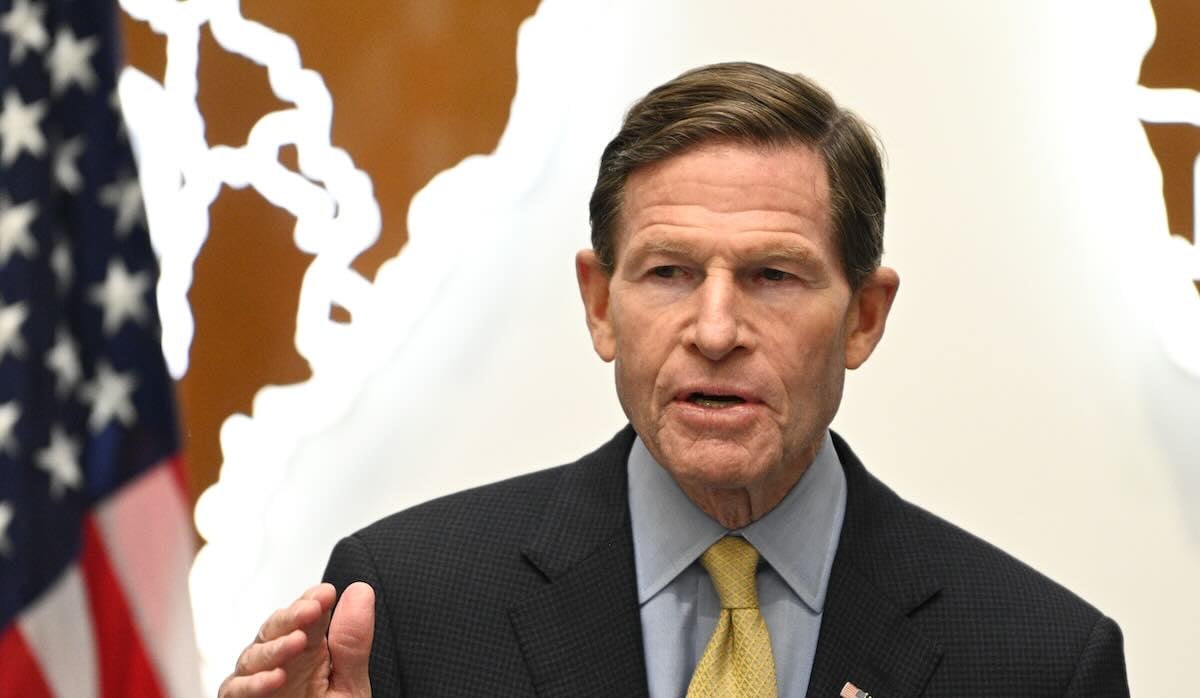
Sen. Richard Blumenthal and Rep. Paul Tonko are again calling for federal gambling reform, this time explicitly including prediction markets in a broader campaign focused on consumer protections and industry oversight, as well as ties among wagering companies, sports organizations and technology platforms.
The lawmakers joined the Public Health Advocacy Institute (PHAI) and Families and Friends of Gamblers (FFG) on Wednesday to launch the “Truth and Integrity: The Movement for Gambling Reform” initiative. The initiative calls for congressional hearings, minimum federal safety standards, stronger state enforcement and public pressure on the gambling industry and its business partners.
“Prediction markets are exploiting problem gambling, they are relentlessly and tirelessly taking advantage of vulnerability to simply make more money,” Blumenthal said. “We need to raise people’s awareness. It’s almost like the gambling industry is exploiting people invisibly but in plain sight.”
Blumenthal and Tonko are two of Congress’s most persistent critics of the sports betting market and are now treating prediction markets as another part of an expanding online gambling ecosystem. Tonko said prediction markets are indistinguishable form traditional sportsbooks and have exploded in recent months.
“In this new landscape, sports betting is everywhere, woven into the fabric of sports and entertainment.” Tonko said. “Parents should be able to take children to a game without seeing ads.
“It is impossible to ignore the similarities of sportsbooks today and big tobacco decades earlier.”
Broader gambling reform coalition
The initiative’s Congressional agenda includes investigative hearings, minimum federal safety standards and legislation. Its state agenda calls for stronger regulation and enforcement and the organizations said lawmakers in multiple states have expressed early support.
The launch formalizes a political coalition that sees sports wagering, prediction markets, technology platforms and sports organizations as parts of the same consumer protection debate. As operators contend their event contracts are federally regulated financial products, Blumenthal and Tonko are increasingly arguing that the products belong within a stronger state gambling regulation framework.
PHAI has also become a more visible legal adversary of major gambling companies. In March, the organization filed a product liability lawsuit against DraftKings, FanDuel, Genius Sports and the NFL, alleging the companies developed and promoted online sports betting products built around addictive live in-game microbetting.
Prediction markets move into focus
Earlier this year, Blumenthal introduced legislation aimed directly at prediction markets.
His Prediction Markets Security and Integrity Act would establish federal protections around insider trading, market manipulation, fraud and underage access. It would also prohibit markets involving war, death and military action, require age verification, and restrict advertising to minors and self-excluded consumers.
It also would aim to reverse the Commodity Futures Trading Commission’s position that federal commodities law preempts state gambling regulation. Blumenthal’s bill would explicitly restore state authority over gambling regulation, a result state attorneys general and gaming regulators are seeking through litigation nationwide.
The legislation also reaches beyond event contract exchanges. It would require states that offer sports betting to meet federal minimum standards related to advertising, affordability and artificial intelligence, tying the prediction market issue directly to the consumer protection agenda Blumenthal and Tonko have pursued in recent years.
Summer campaign against CFTC preemption
Blumenthal has also made state authority central to his prediction markets campaign.
In July, he joined Sen. Jeff Merkley and other Democratic senators in criticizing what they characterized as the CFTC’s effort to override state gambling laws. The lawmakers argued that sports event contracts may look and function like sportsbook wagers while avoiding the licensing, tax, consumer-protection and responsible gambling requirements that apply to regulated operators.
Blumenthal’s proposed legislation would attempt to resolve that federal-state conflict politically rather than wait for the courts. The Third and Ninth circuits have already taken divergent positions on the reach of the Commodity Exchange Act, and New Jersey, along with operators, have asked the US Supreme Court to review the split.
Longstanding sports betting reform advocates
The new initiative also extends a legislative agenda that Blumenthal and Tonko have pursued for years.
The pair have repeatedly introduced the Supporting Affordability and Fairness with Every Bet Act, or SAFE Bet Act, which would require states with legal sports betting to meet federal standards concerning advertising, affordability checks and the use of artificial intelligence.
Blumenthal reintroduced the measure with Tonko last year, while continuing to press separate legislation focused on funding gambling addiction prevention and treatment.
Their recent activity has also focused on VIP programs and athlete marketing.
Blumenthal, Tonko and Rep. Valerie Foushee recently urged FanDuel to end its VIP program, arguing that the product structure can push customers, particularly people with gambling problems, to continue betting despite mounting losses.