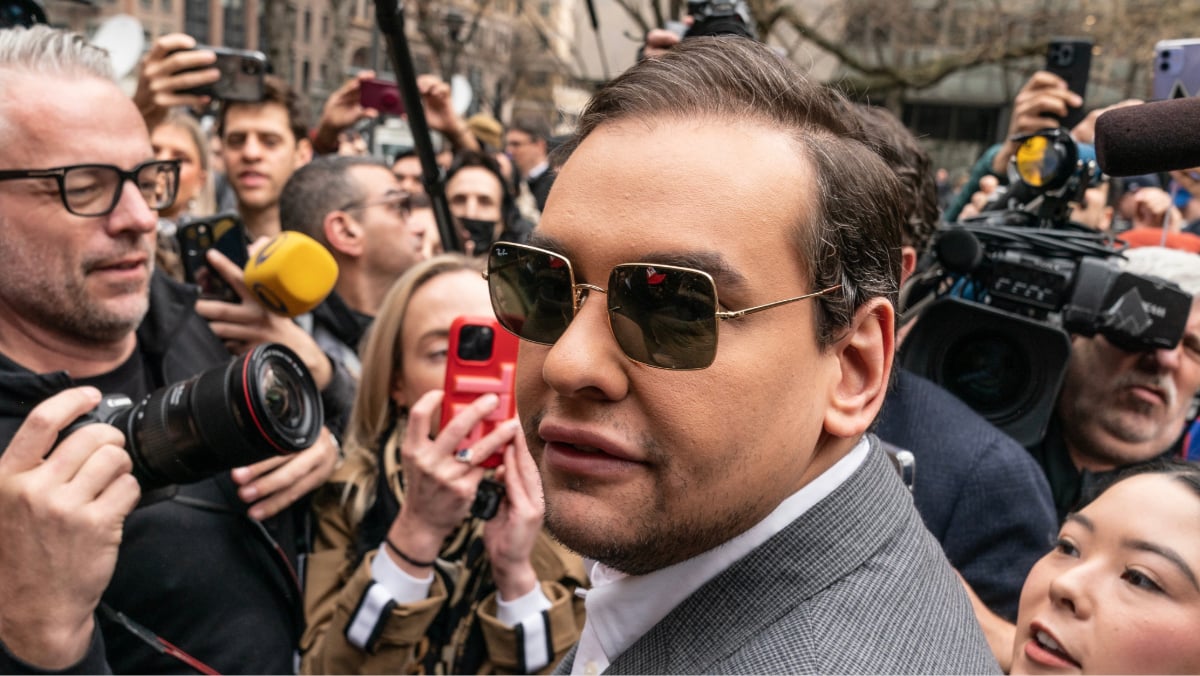
Insider trading concerns involving prediction markets continue to stir as former Congressman George Santos is reportedly under investigation for suspicious trades.
According to an NPR report later confirmed by multiple outlets, the U.S. Department of Justice (DOJ) has been notified of suspicious trading activity by a Kalshi account tied to Santos, leading to an additional inquiry by the Commodity Futures Trading Commission (CFTC).
Santos is under investigation after Kalshi flagged suspicious trades for political markets related to appearances at the State of the Union address that took place in February. Before the trades were made, Santos said on social media he planned to attend the event “in the gallery.” He is barred from sessions after pleading guilty to federal wire fraud and identity theft, although he served just 84 days of his seven-year sentence after President Donald Trump commuted it.
Santos did not attend the State of the Union despite his social media claim. He allegedly pocketed “tens of thousands of dollars” for trades that he would not attend. He simultaneously was receiving money from Polymarket as an ambassador, a relationship the company ended this week in light of this news.
According to data provided by the Associated Press, one day before the State of the Union address, odds for Santos to attend the event were trading at approximately 75%. Santos allegedly missed the State of the Union address because of travel disruptions.
Santos denies wrongdoing on social media
Kalshi reacted to the alleged suspicious trades by Santos by freezing his account and alerting the CFTC of the potential issues. Santos also reacted to Kalshi’s actions and the CFTC and DOJ’s probes by denying any wrongdoing tied to trading with prediction markets.
“The bases of the accusation is preposterous and I look forward to supplying any information asked of me to any agency that inquires, till then media please do not inquire,” said Santos in an X post.
SBC Americas reached out to Kalshi for comment on the probes into Santos.
Alleged illicit trades made before new policy for Kalshi
Santos’s alleged prediction market scandal kickstarted in February, just one month before Kalshi implemented a new policy to combat insider trading across its prediction market.
Kalshi implemented “new technological guardrails” to prevent athletes and politicians from trading on sports and political markets. The company is leveraging the products and services of Integrity Compliance 360 to thwart insider trading activity on its platform.
Kalshi’s new policy is geared toward blocking active politicians. It is unclear whether the policy would have impacted Santos’s trading as someone who is no longer holding office.
Insider trading remains at the forefront of prediction markets following the arrest of U.S. Army soldier Gannon Ken Van Dyke in late April. The servicemember allegedly pocketed more than $400,000 while trading with Polymarket for event contracts tied to the political status of Venezuelan President Nicolás Maduro.
State, federal leaders attempt action
Key stakeholders in state government are taking steps to curtail insider trading activity:
- Illinois Gov. JB Pritzker and California Gov. Gavin Newsom reacted to insider trading concerns involving prediction markets by issuing executive orders. The orders restrict state employees in their respective markets from trading event contracts on prediction markets.
- State legislators are also taking the issue into their own hands by introducing measures that tackle insider trading on prediction markets. New York Rep. Ritchie Torres introduced a bill in January to ban trading for federal elected officials and employees.
At the federal level:
- Sens. Amy Klobuchar and Jeff Merkley introduced the End Prediction Market Corruption Act in March, proposing a prediction market ban for government officials.
- Meanwhile, Sen. Chris Murphy and Rep. Greg Casar filed the Banning Event Trading on Sensitive Operations and Federal Functions (BETS OFF) Act. It outlaws prediction markets from offering event contracts on government actions, wars, and terrorism.
- A legislative attempt to ban event contracts involving elections and government activities has also been made by Reps. Blake Moore and Salud Carbajal, through their introduction of the Event Contract Enforcement Act.
- Lawmakers also voiced insider trading concerns to CFTC Chairman Michael Selig in April during a hearing hosted by the House Committee on Agriculture. During the hearing, Selig stressed that the CFTC takes “a zero-tolerance policy” on insider trading activity.