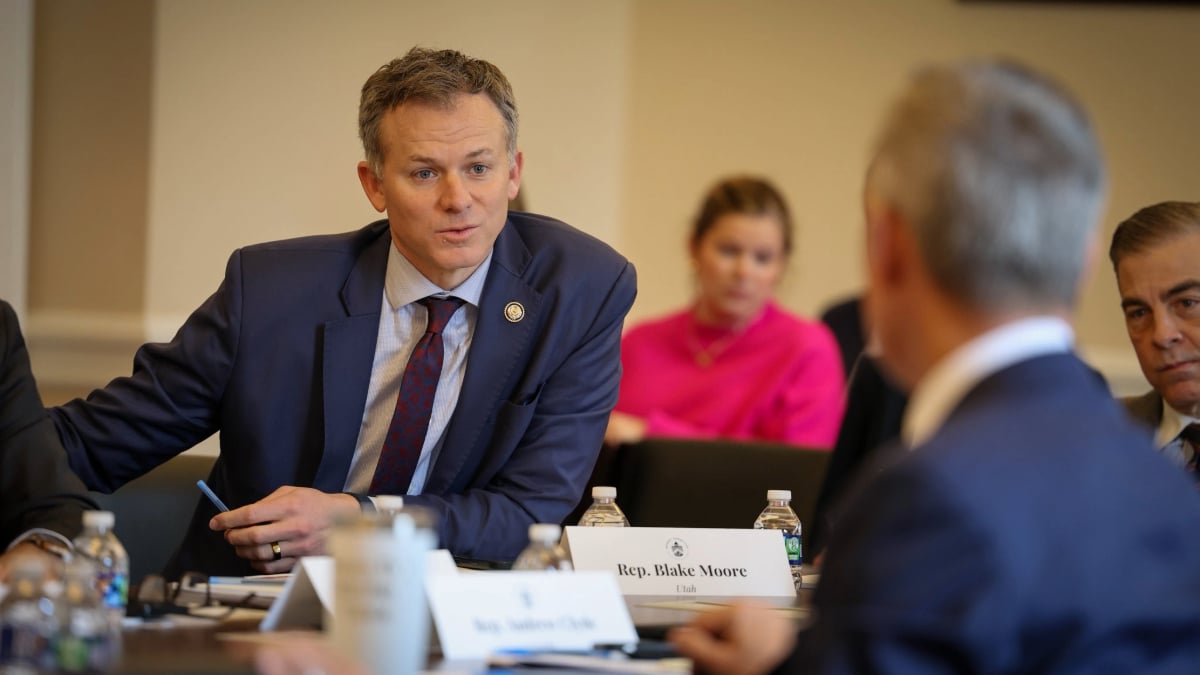
A pair of House members from Utah and California are the latest lawmakers to make a legislative attempt to change how prediction market platforms can offer event contracts.
Reps. Blake Moore and Salud Carbajal introduced the Event Contract Enforcement Act, legislation that would require the Commodity Futures Trading Commission (CFTC) to prohibit the delivery of certain event contracts to the public. The measure proposes amending the Commodity Exchange Act to ban event contracts tied to terrorism, assassinations, war, gaming, elections and government activities.
Carbajal and Moore said they introduced the act to protect Americans from safety and national security risks associated with “problematic” event contracts and to prevent sensitive information from being used for insider trading.
“Under-regulated prediction markets are creating an environment ripe for insider trading. The monetization of military activities or election processes threatens our national security and further erodes public trust in government,” said Carbajal in a press release. “The Event Contract Enforcement Act is a strong first step toward protecting consumers and upholding ethical standards across all levels of government.”
Moore and Carbajal acknowledge the CFTC’s authority over derivatives markets and event contracts, but note the agency does not enforce bans on political or sports contracts. They consider that a risk to public safety, prompting their bipartisan effort.
US states given gaming ‘opt-out’ option
The Event Contract Enforcement Act differs from other prediction market-related measures that aim to protect U.S. consumers and combat insider trading in some ways, including a provision that allows states to “exempt themselves from the prohibition on gaming contracts.”
The Event Contract Enforcement Act provides a definition for gaming, which is “any aspect of a live, simulated, or virtual physical or mental challenge or game of chance.”
The provision that centers around controversial sports contracts would allow states to explicitly allow or deny access to event contract trading on sports, which are considered to resemble sports betting, in their respective jurisdictions. The act takes a different approach to combating the proliferation of sports contracts that resemble gambling by leaving the decision in the hands of states.
“Prediction markets also sponsor sports-related contracts against the wishes of many states, including Utah, that would otherwise prohibit these contracts if offered as traditional sports betting,” said Moore.
Tribes, new coalition praise bill
The bill received support from the leadership of a new coalition that advocates for the enforcement of state and tribal laws for sports contracts, as well as from Indian leaders.
“These so-called prediction markets are nothing more than a backdoor for unregulated gambling,” said ex-Republican Congressman Mick Mulvaney, Executive Director of Gambling Is Not Investing. “They are unilaterally making online sports gambling widely available to anyone in the country without the consumer protections, age restrictions, and state and local tax benefits that govern legalized sports betting.”
Gambling Is Not Investing wants prediction markets that offer sports contracts to abide by the same consumer protection and regulatory rules that licensed sportsbooks follow. The coalition argues that the CFTC’s regulation of prediction markets and sports event contract trading creates friction between the agency and regulated sports betting markets.
“These unsafe and unregulated sports gambling markets are bad for Americans,” added Mulvaney.
Speculation of insider trading raises concerns
Moore and Carbajal want to ban the offering of government-related event contracts after two geopolitical trading incidents tied to Polymarket’s global platform.
Earlier this year, a trader on the platform pocketed more than $400,000 on the political status of Venezuelan President Nicolás Maduro before his arrest by U.S. federal authorities. The trades raised insider trading concerns amid the confidential operation.
Last week, another Polymarket user drew insider trading concerns after they made over $553,000 through trading on markets related to Iran and its leadership regime. Meanwhile, six traders reportedly made $1.2m from trading on America’s involvement in Iran.
Other bills address insider trading concerns
Carbajal and Moore are far from the only lawmakers drafting bills related to prediction markets.
Last week, Sens. Amy Klobuchar and Jeff Merkley filed the End Prediction Market Corruption Act, a piece of legislation that aims to prevent government officials from leveraging their access to insider information to trade on prediction markets.
Under the act, a ban on event contract trading by government officials would extend to the U.S. President, Vice Presidents, members of Congress and other public officials. Penalties for violating the bill’s standards include a civil penalty of at least $10,000 for each violation, levied by the U.S. Attorney General. The legislation also acknowledges the CFTC’s authority over prediction markets, providing the agency with the right to investigate potential insider trading violations.
Elsewhere, New York Rep. Ritchie Torres introduced the Public Integrity in Financial Prediction Markets Act, proposing to ban federal elected officials, political appointees, and executive branch employees from trading event contracts related to government policy or action.
Meanwhile, in one of several other examples, Tennessee Sen. Ferrell Haile filed Senate Bill 1992, a bill that makes influencing the “outcome of an event” that has ties to a prediction market a Class E felony.