

Emily Thompson, content writer & researcher at CasinoRank, takes a look at consumer trends in the U.S online gambling sector in 2025.
The way people in the U.S. engage with online gambling is changing. With mobile access improving and laws evolving, more players are choosing short, frequent gaming sessions over longer ones. This pattern matches broader shifts in how people use digital services—favoring quick and convenient access. CasinoRank’s research highlights how mobile use is influencing gambling behavior, which games are most popular, and how these trends differ by region.
The U.S. gambling landscape: CasinoRank insights
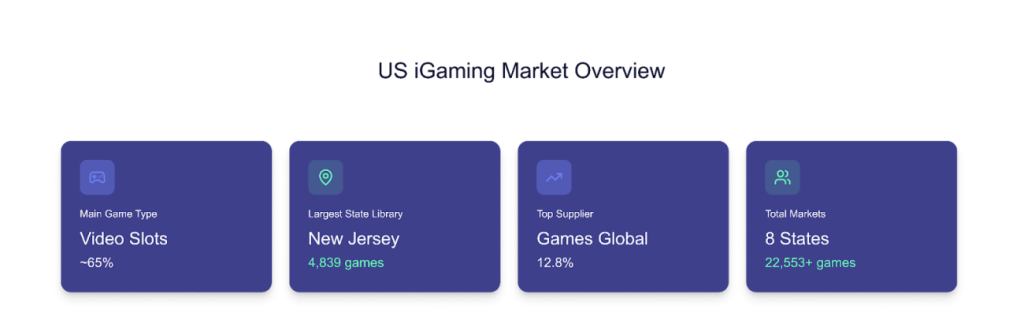
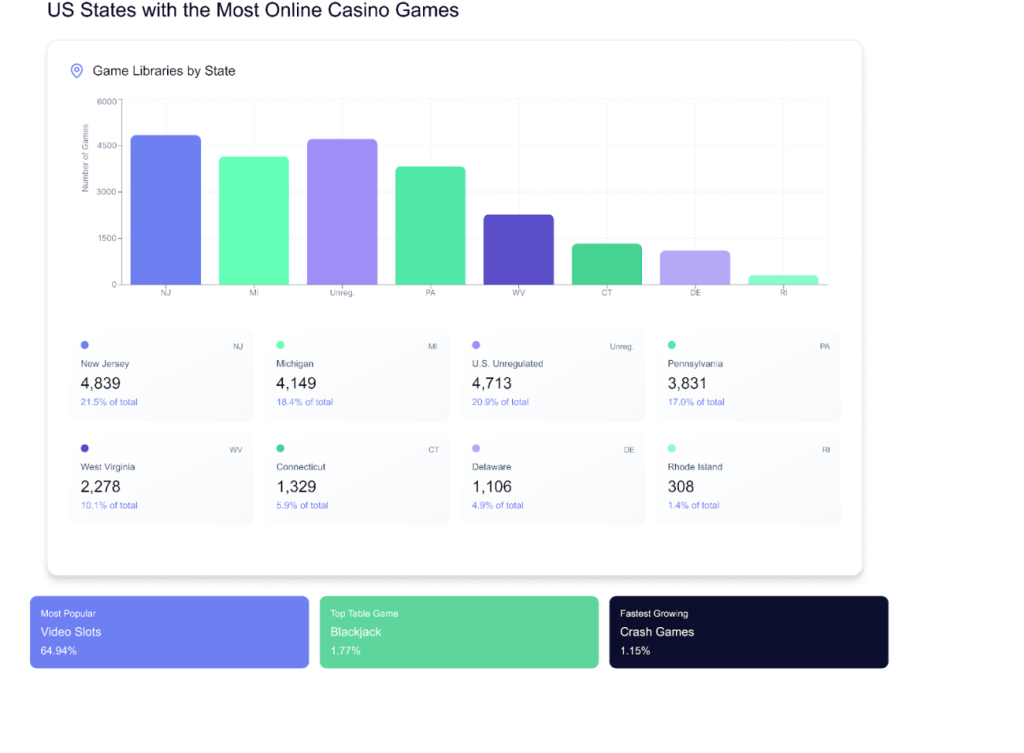
The U.S. online casino market continues its rapid expansion, with several states now offering regulated iGaming options. New Jersey leads with the largest game library with 4,839 titles, followed by Michigan with 4,149 and Pennsylvania with 3,831, forming what industry insiders call the “revenue triad” – each generating over $3 billion annually in gross gaming revenue. Smaller but growing markets include West Virginia with 2,278 games, Connecticut with 1,329, Delaware with 1,106 and Rhode Island with 308 game titles.
This patchwork of regulation has created distinct regional gambling ecosystems, yet player preferences remain remarkably consistent nationwide. Video slots dominate the market with nearly 65% content share, followed by progressive jackpots of 8.83% and standard jackpots of 6.64%. Traditional table games like blackjack of 1.77% and roulette of 1.48% maintain steady popularity, while newer formats like crash games of 1.15% and game shows of 0.88% are gaining traction among players seeking novel experiences.
U.S. player preferences through the years at online casinos
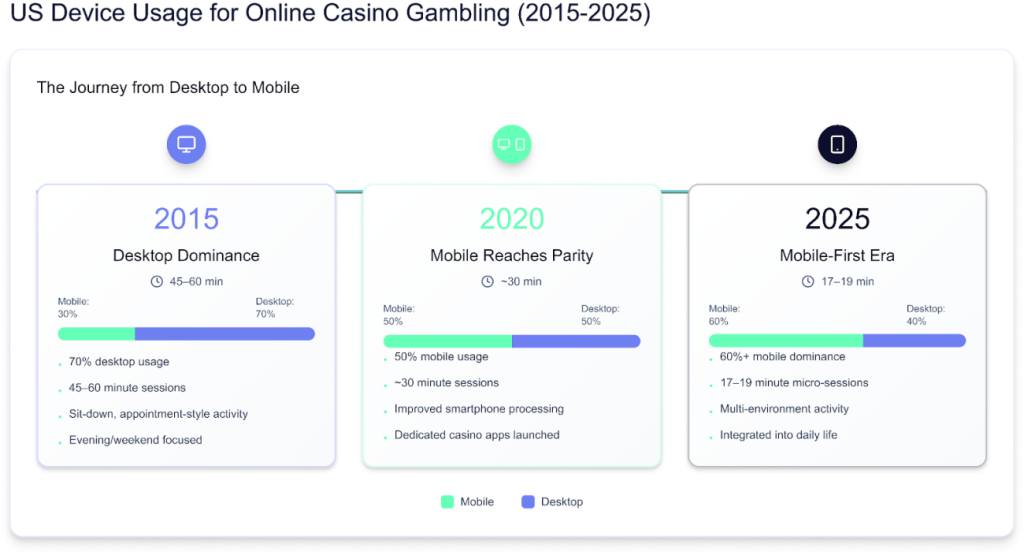
According to Mordor Intelligence’s Insights, the user preferences for device types during the year are as follows:
2015: Desktop dominance
- Approximately 70% of U.S. online casino players accessed platforms via desktop computers.
- Gameplay sessions averaged 45–60 minutes, closely resembling the long, immersive sessions typical of physical casinos.
- Online gambling was positioned as a sit-down, appointment-style activity, usually done during evening hours or weekends.
2020: Mobile reaches parity
- Mobile usage surged to around 50% of all online gambling activity.
- Major drivers of growth included:
- Rapid improvements in smartphone processing power
- Wider availability of dedicated casino apps
- Enhanced mobile web performance and responsive site design
- Rapid improvements in smartphone processing power
- For many users, mobile gambling became a convenience-based option, complementing—not yet replacing—desktop play.
2025: Mobile becomes the primary channel
- Mobile now represents over 60% of all online gambling sessions across the U.S.
- This shift signifies a definitive change in player habits, with gambling becoming:
- A multi-environment activity—during commutes, lunch breaks, or short downtimes
- A casual, integrated part of daily life rather than a dedicated leisure event
- A multi-environment activity—during commutes, lunch breaks, or short downtimes
- Operators have adapted by prioritising mobile-first game design, vertical screen optimisation and fast-loading interfaces.
Session duration evolution: 2015–2025
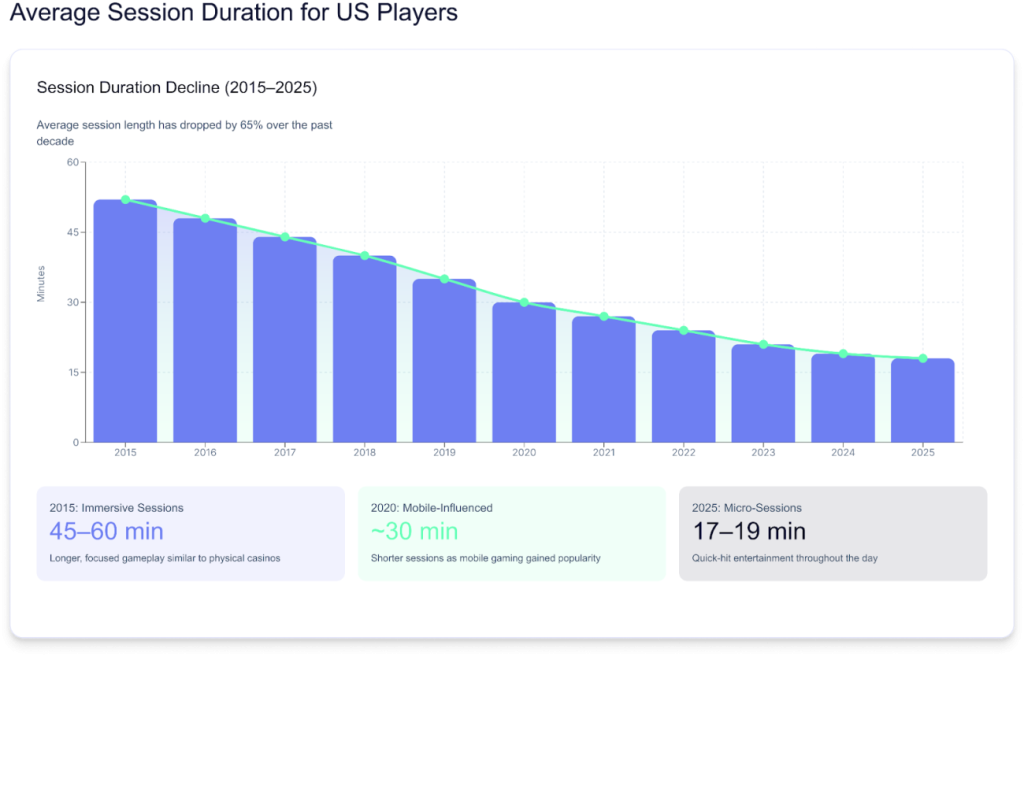
2015: Longer, Immersive Sessions
- Average online casino session: ~45 minutes
- Most players participated in fewer, longer sessions, often concentrated in the evenings
- Desktop environments encouraged focused gameplay, with minimal interruption and higher immersion
2020: Mid-length mobile-influenced sessions
- Average session length dropped to ~30 minutes
- As mobile gaming gained popularity, players increasingly engaged in shorter, more spontaneous sessions
- Multitasking became common, reducing the uninterrupted time formerly associated with desktop play
2025: Rapid, frequent micro-sessions
- Today’s average session lasts 17–19 minutes, marking the steepest decline to date
- Players are now spreading their activity across multiple short sessions throughout the day
Key behavioral insights include:
2025 recap: U.S. players’ session time
Slots: Quick spins dominate in the U.S.
Video slots remain the undisputed kings of short-session play, perfectly suited for mobile gambling with simple mechanics and instant gratification. Popular titles like “Starburst,” “Buffalo Gold,” “Divine Fortune” and “88 Fortunes” offer players the ability to enjoy complete gameplay experiences in just minutes. The average slot session in 2025 lasts approximately 15 minutes, with players typically spinning 80-100 times before concluding their session. Progressive jackpot slots see slightly longer engagement (18-20 minutes) as players chase life-changing payouts.
Live dealer: The social experience
Live dealer games represent the middle ground between short and long sessions. The average live dealer session lasts 22 minutes, longer than slots but still accessible for on-the-go players. Games like “Lightning Roulette,” “Infinite Blackjack,” “Baccarat Squeeze” and “Ultimate Texas Hold’em” provide social interaction and an authentic casino atmosphere that keeps players engaged. The human element and chat functionality create a more immersive experience that encourages longer play, particularly during evening hours when players have more free time.
What affects player sessions in the U.S.?
Geographic patterns
Where you live in the U.S. makes a noticeable difference. In mature iGaming markets (like the Northeast), players tend toward multiple short sessions daily — often 3–4 sessions of 12–15 minutes each. In states where online gambling is newer or more restricted, the pattern shifts toward fewer but longer sessions, especially where offshore platforms are used.
Demographics & lifestyle
Age and lifestyle often shape gambling habits more than geography. Younger players (21–35) favour quick mobile sessions — maybe 10–15 minutes while commuting or during breaks. Middle-aged players (36–50) spread their gambling between short mobile bursts and the occasional longer desktop session at night. Those over 50 tend to favour calmer, longer sessions (30+ minutes), usually at a desk, often playing strategic games like poker or video poker. Urban dwellers — regardless of age — often lean more toward short, frequent sessions, reflecting busy daily schedules and constant connectivity.
Tech makes it easy
Modern tech plays a huge role: biometric logins (fingerprint, Face ID), near-instant deposits via services like Apple Pay or Google Pay, and dramatically faster game load times make it trivial to log in and play for just a few minutes. In short — even a five‑minute slot spin becomes a perfectly valid gambling experience.
Trends & future outlook on online casinos in the U.S.
Looking ahead, several emerging trends are likely to shape the next chapter of online gambling in America:
- Hyper‑casual games: ultralight games designed for 1–3 minute play sessions, ideal for people with only a few spare minutes
- Cross‑device play: seamless transitions between mobile and desktop, letting players pick up a session where they left off
- AI‑powered personalisation: game and bonus suggestions tailored to how often you play and how long you tend to stay logged in
- Micro‑rewards: frequent small bonuses designed to match short‑session habits
- More social features: multiplayer modes, leaderboards, and community functionality to make short sessions still feel social
- Voice‑activated gambling: hands‑free gameplay while commuting, doing chores, or multitasking — reducing friction even more
- Regulatory expansion: as more states legalise online casinos, expect greater regional variation in habits — and plenty of innovation
Conclusion: Are short sessions the ultimate choice in the U.S.?
For operators, success now depends on optimising for the new reality: creating games that deliver satisfying experiences in minutes rather than hours, while ensuring seamless technical performance across devices. As U.S markets continue to change, understanding regional and demographic differences in session patterns will become increasingly crucial for targeting and retention strategies.
For a better understanding of U.S. trends in short-session gaming, check out CasinoRank’s full article.