

The payments revolution in U.S. online casinos is happening faster than most realize. According to the 2025 American Customer Satisfaction Index debut of online gambling, “payment integrations/helpfulness” scored 77 out of 100 in importance among players—making it a core satisfaction driver that can make or break player retention.
With only seven states currently authorizing regulated iGaming and 33% of users identifying as exclusively online casino players, understanding what drives payment preferences in this concentrated market has never been more critical for operators looking to maximize revenue and minimize player churn. The broader iGaming landscape from CasinoRank highlights emerging trends and market dynamics.
The data reveals three game-changing payment trends
Speed Trumps Everything in Withdrawal Preferences
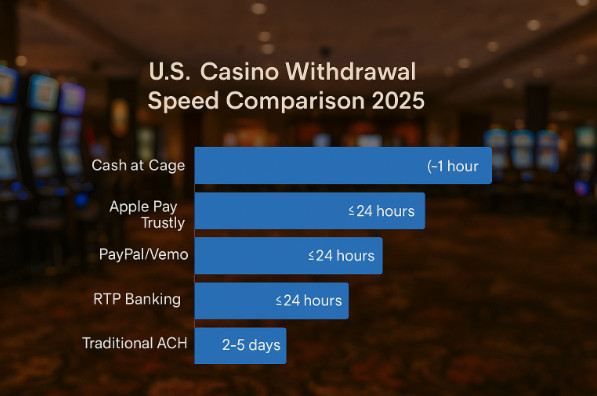
The most striking finding from 2025 payment data is how aggressively U.S. casino players prioritize withdrawal speed. According to support.draftkings, typical withdrawal timelines show a clear hierarchy: Apple Pay processes in approximately one day, Trustly Verified delivers funds within one day, debit cards complete transfers within 24 hours, while traditional ACH banking still requires 2-5 days.
This speed obsession is reshaping player behavior in measurable ways. Players are increasingly storing multiple payout methods to avoid the dreaded ACH wait times. The pattern is clear: any payment rail that consistently delivers funds within 24 hours gains adoption, while slower methods get abandoned except when higher limits are required.
FanDuel’s integration of Real-Time Payments (RTP) technology exemplifies this trend, pushing many bank withdrawals to under 24 hours for supported institutions. The message from players is unambiguous. Time is money and waiting 3-5 business days for ACH transfers feels antiquated in 2025.
The Apple Pay paradox: Deposit yes, withdraw maybe
Mobile-first payment preferences reveal a fascinating inconsistency in operator support. While Apple Pay deposits are widely accepted across major platforms, withdrawal support varies dramatically by operator. DraftKings supports both Apple Pay deposits and withdrawals (where jurisdictionally permitted), while FanDuel accepts Apple Pay deposits but forces users to designate alternative withdrawal methods.
This fragmentation creates a telling behavioral pattern: Apple-first casino players routinely deposit with Apple Pay but withdraw via PayPal, Trustly, or debit cards. Rather than frustrating users, this multi-method approach has become normalized, with players maintaining payment method portfolios to optimize their casino experience.
The data suggests that mobile-first players value deposit convenience above withdrawal consistency, accepting the need to manage multiple payment rails as long as their preferred funding method remains available.
High-value players migrate to bank-direct solutions
The most sophisticated insight emerges when examining high-limit player behavior. With average U.S. bettor deposits reaching $604 in May 2025 according to Optimove data, serious casino players quickly outgrow traditional card and wallet limits.
VIP Preferred, the industry’s ACH network operated by Pavilion Payments, offers seven day revolving limits up to $50,000 across 100+ online gaming sites. This infrastructure attracts VIP and frequent casino players who need reliable access to substantial bankrolls without the friction of multiple smaller transactions.
The March 2025 integration of Trustly’s Pay-by-Bank solution with Hard Rock Bet across key U.S. markets signals mainstream adoption of open banking technology. These direct bank connections offer both higher limits and increasingly instant payouts, combining the best of traditional banking reliability with modern speed expectations.
Operators must also balance speed with safety. U.S. regulators are closely watching real-time payments and open banking tools to ensure AML and responsible gambling safeguards keep pace. Any operator investing in payments should integrate compliance from day one, not as an afterthought.
Expert analysis: Why payment friction equals lost revenue
“The payment preferences we’re seeing in 2025 reflect a maturation of the U.S. online casino market,” explains Jacob Mitchell. “Players have moved beyond simply wanting their preferred payment method available—they now expect seamless, predictable experiences across multiple rails.”
A recent article outlined that payment-flow breakdowns continue to represent a significant margin drag in U.S. iGaming. PayNearMe’s CMO captured the stakes perfectly, noting: “Every failed deposit is a lost bet, a frustrated player, and revenue left on the table.”
It has also been remarked that the concentration of legal iGaming in just seven states creates unique dynamics.
Unlike sports betting, which operates in 30+ states, online casino players represent a more concentrated, higher-intent audience. These, users develop sophisticated payment strategies because they’re not casual bettors—they’re engaged players who understand that payment efficiency directly impacts their gaming experience.
The behavioral data supports this analysis. Casino players maintain multiple payment methods not out of confusion, but out of optimization. They’ve learned that card declines happen, ACH transfers take time, and having backup rails preserves what the industry calls “bet momentum”—the crucial window when a player wants to fund their account and start playing.
Practical takeaways for online casino operators
The payment preference data reveals several actionable insights for operators looking to improve player satisfaction and reduce churn:
• Prioritize sub-24-hour withdrawal rails: Players clearly value speed over small fee differences. Operators should prominently feature payment methods that consistently deliver funds within 24 hours, including debit push, PayPal/Venmo, Trustly Verified, and RTP-enabled banking options.
• Embrace multi-method player strategies: Rather than pushing players toward single payment solutions, operators should optimize cashier flows that assume players will use different methods for deposits and withdrawals. This includes clear messaging about withdrawal method requirements for Apple Pay depositors.
• Invest in VIP payment infrastructure: High-value players drive disproportionate revenue but require specialized payment solutions. Partnerships with VIP Preferred-style ACH networks and Pay-by-Bank providers become essential for player retention in the high-limit segment.
• Maintain omnichannel cash options: Cash at Cage remains valuable for players near partner properties, offering fee-free, immediate access that digital rails can’t match. This is particularly relevant in concentrated legal markets where physical proximity is feasible.
• Treat payment UX as product differentiation: With payment integrations scoring 77/100 in importance according to ACSI data, cashier flow optimization represents a high-impact retention lever. Streamlined payment experiences directly correlate with player satisfaction in the concentrated U.S. casino market.
The bottom line on casino payments
Understanding payment preferences is now central to online casino success. In a market limited to just seven states, every smooth transaction strengthens loyalty, while every failed payment risks losing a player for good. The rapid evolution of payment rails and shifting regulatory requirements demand constant attention and adaptation. Operators that monitor behavior closely, test new rails quickly, and build flexibility into the cashier experience will stay ahead. In 2025, payments aren’t just transactions—they’re the difference between growth and churn. A detailed breakdown of payment methods and their impact on U.S. casino players is available in the online casino payments guide.